5 November: bigger edibles in South Dakota, no organic CBD in the EU, and the rescheduling briefs close
Five dates fell due on 5 November. Two changed rules businesses must follow, one shut a door on CBD in Europe, and two moved paperwork along.
By Neil Cartwright · · 5 min read
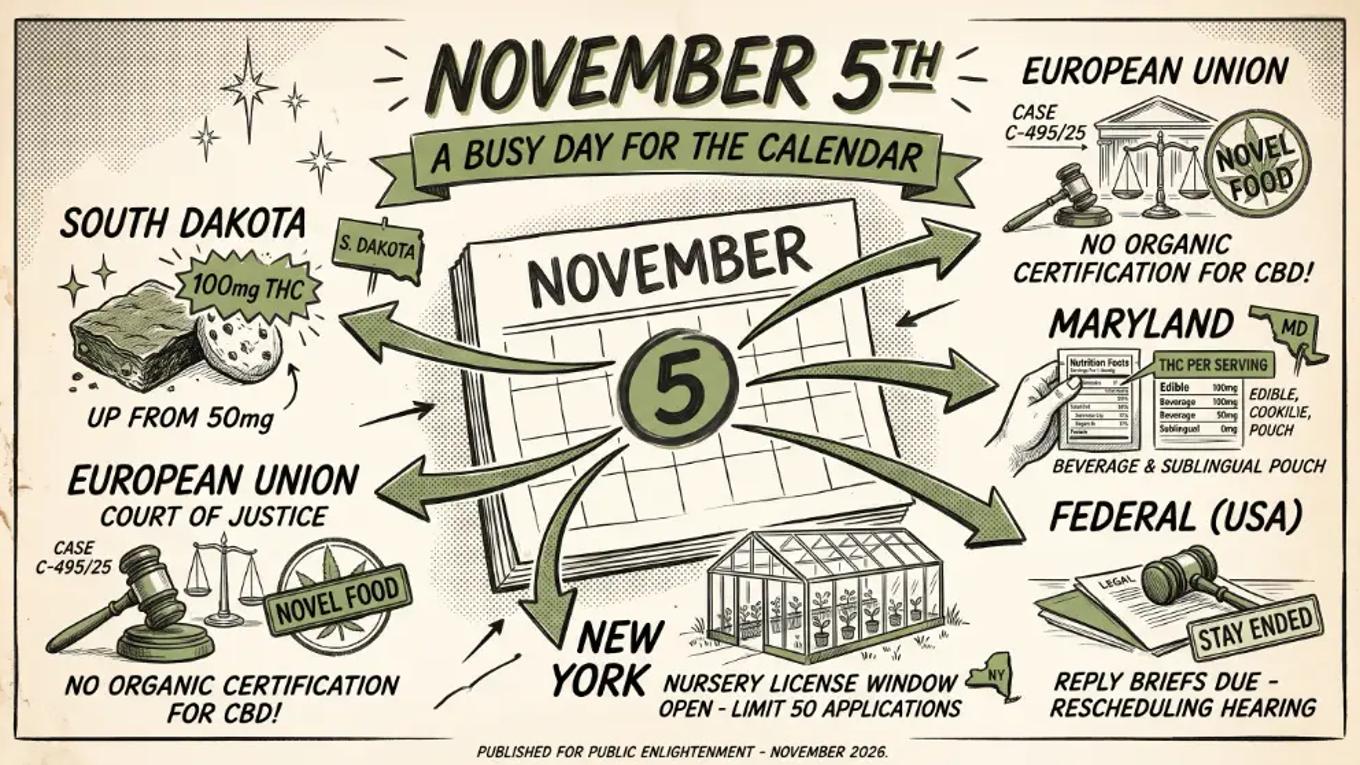
Five dates on the calendar fell due on 5 November. South Dakota's revised medical cannabis rules took effect, doubling the THC allowed in an edible serving. The Court of Justice of the European Union ruled that CBD cannot be certified organic while it has no novel food authorisation. Maryland began requiring THC per serving to be reported for edibles, drinks and pouches. New York opened its nursery licence window, and the briefing period in the federal rescheduling hearing closed.
The results in one place
- South Dakota: amendments to 35 sections of the medical cannabis rules took effect. Edibles may now hold 100 mg THC per serving, up from 50 mg.
- European Union: CBD cannot be certified organic as long as it is not authorised as a food, including products made only for export (Case C-495/25).
- Maryland: delta-9 THC and total THC must now be reported in milligrams per serving in Metrc for edibles, beverages, exempt liquid edibles and sublingual pouches.
- New York: the nursery licence window opened. It closed again at 10:08AM after the Office of Cannabis Management had 50 applications.
- United States (federal): reply briefs on the GAO report were due, which closes briefing in the rescheduling hearing and, under the judge's order, ends its stay.
South Dakota: a bigger edible, and cards that go in the shredder
The rules took effect on 5 November. The text that took effect had not been posted on the state's rules site by 6 November.
The South Dakota Register of 26 October lists 35 sections of article 44:90 as filed on 16 October and effective on 5 November. The Department of Health's latest posted version, dated 7 October, shows what they do:
- Edibles: up to 100 mg THC per serving, up from 50 mg. The 500 mg cap per package is unchanged (44:90:07:04).
- Caregivers: when a patient removes a caregiver or a home-grow designation, when a caregiver stops, or when the patient dies, the caregiver must destroy the registry card immediately. The old rule allowed 15 days to return it (44:90:02:10 to :13).
- Lab certificates: a certificate of analysis must say whether the cannabis was decontaminated or pretreated before testing, or remediated after it (44:90:09:11).
- Fines: for Category 4 and 5 violations, a first offence now needs an approved corrective action plan. Fines of $1,000 and $500 apply from the second offence (44:90:12:11).
- The rest: changes to security cameras, visitors, waste, transport and laboratory rules.
The adopted text may differ from the 7 October version, and Green Ark will check it once the Department posts it. Sources: the South Dakota Register, 26 October 2026, the Department's rule page and its 7 October version of the rules.
European Union: no organic label for a food that may not be sold
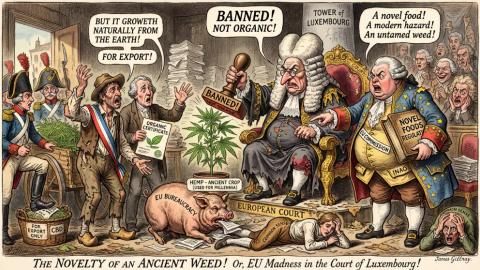
The case began in France. The Institut national de l'origine et de la qualité (INAO) told organic certifiers that natural CBD products, other than hemp oil not enriched with CBD, and foods enriched with CBD could not be certified organic. The hemp trade body Syndicat professionnel du chanvre challenged that before the Conseil d'État, which asked the Court of Justice.
The Court sided with INAO:
- Scope: CBD falls within the EU organic regulation's category of processed agricultural products for food. So do novel foods without authorisation, and even products whose sale is banned.
- Certification: being in scope gives no right to the label. Certification promotes a product and gives consumers, in the Court's words, "a positive image of quality and approval". Certifying an unauthorised novel food could compromise health and consumer protection.
- Exports: the same applies to products made only for sale outside the EU, because certifying them could damage the label's reputation.
The Commission treats CBD as a novel food and has not authorised it as a food, the Court's release notes. The Court did not find CBD harmful: the problem is the missing authorisation, so the bar falls if CBD is ever authorised. The Conseil d'État now decides the French case. Source: the Court's press release No 159/26 (in Spanish); the full judgment is on CURIA.
Maryland: milligrams, not percentages
The change came in a bulletin from Metrc, the state's tracking vendor, issued with the Maryland Cannabis Administration on 22 October.
- What: delta-9 THC and total THC reported in milligrams per serving.
- Which products: infused edibles, infused liquid edible beverages, exempt liquid edibles and sublingual pouches.
- Also: six more terpenes may be reported. Terpene testing stays optional.
- What it is not: the bulletin sets no new potency limits and cites no change to Maryland's regulations.
Source: Metrc bulletin MD_IB_0131.
New York: fifty, then closed
The Cannabis Control Board advanced a nursery licence window to open on 5 November. It closes when the Office of Cannabis Management has received 50 applications, so the deadline is set by other applicants, not the calendar. Source: Cannabis Control Board, 1 October 2026.
Rescheduling: the briefs are in, the judge is next
On 22 October the administrative law judge admitted the GAO report on drug scheduling, refused to reopen the hearing and allowed short briefs: opening briefs by 29 October, replies by 5 November. His order says the stay ends when that briefing closes.
- Status: the reply deadline has passed. DEA's hearing page had posted no further order by 6 November.
- Next: the judge's recommended decision, then the DEA's final order. Neither has a date.
- Unchanged: cannabis outside FDA-approved products and state medical licences stays in Schedule I. The April order on medical cannabis is not affected.
Source: the 22 October order and DEA's hearing documents page.
What to do if you advise or run a cannabis business
- South Dakota manufacturers: a 100 mg serving is now allowed, but check the filed text before changing a product.
- South Dakota caregivers: destroy a card when a designation ends; don't post it back.
- South Dakota labs: state decontamination, pretreatment or remediation on certificates from 5 November.
- EU sellers of CBD food: organic certification is not available while CBD is unauthorised, including for export.
- Maryland labs and licensees: report THC in mg per serving in Metrc for the four product categories.
- New York nursery applicants: the window closes at the 50th application. You had to be quick. It closed by 10:08AM
- Anyone tracking rescheduling: the judge's recommendation is the next event; DEA's 29 November supply-chain date for timely applicants is separate.
This is information, not legal advice.
Information, not legal advice. Check the primary source before relying on it.