A drug developer that followed the DEA's rules for eight years is suing to undo the shortcut it never got
MMJ International Holdings, which is developing cannabis-based medicines for Huntington's disease and multiple sclerosis, is fighting the federal rescheduling order alongside prohibition campaigners and the drug-testing industry. Its target is not a state but the Attorney General's reliance on state oversight; harm reduction has little to do with it.
By Neil Cartwright · · 8 min read
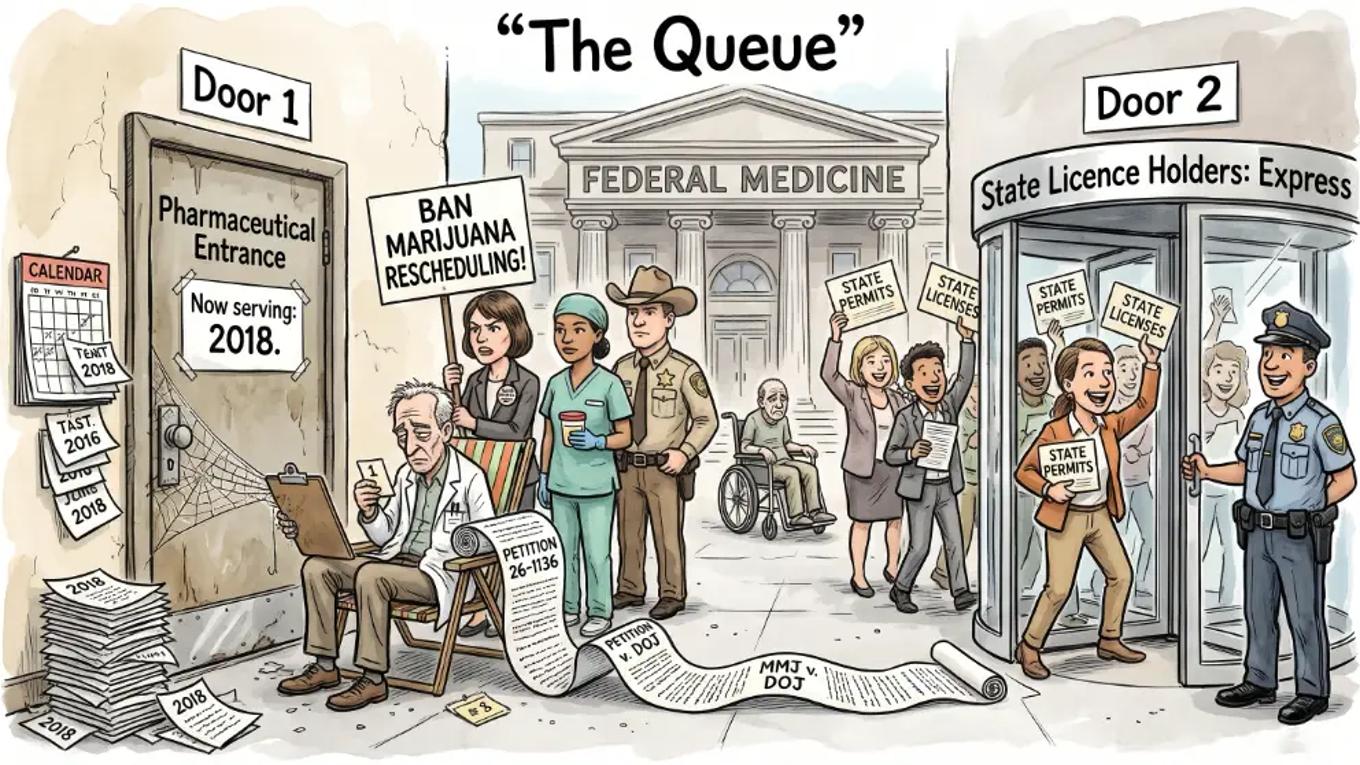
MMJ International Holdings is a small, private drug developer working on cannabis-based treatments for Huntington's disease and multiple sclerosis, none of them yet approved. On 15 November it issued a press release attacking the federal government's medical marijuana rescheduling order, using Oklahoma's narcotics police as its witnesses. Despite the headline, its quarrel is not with a state. It is with the US Attorney General, whose April order lets state-licensed medical marijuana businesses into the federal system on the strength of state oversight. MMJ has spent eight years trying to get into that system through the pharmaceutical front door, and is still waiting.
The case in one place
- The order: AG Order No. 6754-2026, published on 28 April 2026 (91 Fed. Reg. 22,714). It moved marijuana in FDA-approved drugs and state-licensed medical marijuana into Schedule III, and created a federal registration route for qualifying state-licensed operators under 21 CFR § 1301.13(k).
- The challenge: three petitions in the US Court of Appeals for the D.C. Circuit, consolidated on 29 May as SAM, Inc. v. Department of Justice, Nos. 26-1106, 26-1130 and 26-1136. MMJ and its two subsidiaries are petitioners in No. 26-1136, filed on 28 May. The press release cites No. 26-1130, which is the petition brought by Nebraska and Indiana; the cases are heard together.
- So far: the court refused to suspend the order on 9 September, so it stays in force while the challenge is heard. The court has not ruled on the merits or on whether MMJ has standing to sue.
- What the release asks for: it does not name a remedy. It asks for the evidence behind the order's view of state programmes: inspection findings, enforcement records, diversion assessments, product testing and the method used to judge state systems.
- MMJ's own application: its subsidiary's request to grow cannabis as a federally registered bulk manufacturer has been pending with the DEA since December 2018.
What the order did, and why it matters to MMJ
The April order keeps two kinds of marijuana apart. Marijuana in an FDA-approved medicine, and marijuana "subject to a state medical marijuana license", are Schedule III. Everything else remains Schedule I while a separate DEA hearing on wider rescheduling runs its course. The order also gives state-licensed medical operators a quicker way to register with the DEA. Its reasoning rests in part on the states: according to MMJ's release, the order says state regimes have developed "robust infrastructure for preventing diversion".
That is the sentence MMJ wants tested. Its argument, in its own words, is that state licensing is not federal compliance, that a DEA registration is not scientific validation of a product, and that the record should show what evidence the government had. "MMJ is not opposed to marijuana derived medicine," its chief executive said; it opposes replacing scientific evidence with "regulatory assumptions".
Who MMJ is
- What it develops: a standardised THC and CBD soft-gel capsule, under two FDA investigational new drug applications (IND 137754 for Huntington's disease and IND 140712 for multiple sclerosis), with orphan drug designation for Huntington's. The company says about 50,000 capsules have been made under good manufacturing practice for investigational use. None has FDA marketing approval.
- Its federal footing: MMJ BioPharma Labs holds a DEA Schedule I analytical laboratory registration. MMJ BioPharma Cultivation applied in December 2018 to become a DEA-registered bulk manufacturer, so it could grow its own pharmaceutical-grade cannabis for clinical trials.
- The wait: that application has been through a DEA administrative law judge, a hearing that ended without the evidence MMJ wanted heard, a lawsuit by MMJ arguing that DEA judges are unconstitutionally appointed, and a dispute over whether it had the "bona fide supply agreement" the rules require. MMJ says it did. In February 2026 its chief executive wrote that the application "has not been denied" and remains with the DEA Administrator.
- Its spending: the company says it has spent more than $10 million over nearly a decade on the federal route.
Read together, MMJ's releases over two years tell one story: a company that did everything the DEA and FDA asked, waited, and then watched the government open a shorter route for businesses that, in its view, grew cannabis outside federal law for years. In a release in May it pointed to the DEA's 2020 rule on marijuana growing, which said "particular emphasis" would be placed on an applicant's "prior compliance with the Act".
The company it keeps
MMJ is not litigating alone, and its allies explain why the cannabis trade press calls the coalition "anti-marijuana", a label MMJ rejects.
- No. 26-1106: Smart Approaches to Marijuana (SAM), the best-known US group opposing legalisation, and the National Drug and Alcohol Screening Association (NDASA), a drug-testing trade body.
- No. 26-1130: the states of Nebraska and Indiana. Louisiana joined and later withdrew.
- No. 26-1136, MMJ's petition: an addiction recovery clinic, physicians and a cannabis-victims advocacy group, alongside MMJ.
- The stay motion: brought jointly by NDASA and MMJ. It argued that a stay would "avoid the devastating effects that will flow from ballooning access to marijuana while this case is pending". The court was not persuaded.
- A second front: MMJ and SAM are appellants together in SAM v. Kennedy, No. 26-5205, challenging a Medicare programme (the Substance Access Beneficiary Engagement Incentive) that lets participating providers furnish hemp-derived cannabinoid products. A district judge dismissed the case in May for lack of standing, finding that MMJ had "no product" on the Medicare market. The government says Medicare does not pay for the hemp products. Briefing ends on 16 December 2026.
So the alliance is a drug developer, a prohibition campaign, the drug-testing industry, an addiction clinic and two conservative states. Each wants the April order gone for a different reason. MMJ's reason is the one it states: if state-licensed operators can register on the strength of state oversight, the pharmaceutical route it chose looks like a long way round to the same place.
The Oklahoma evidence
The new release leans on testimony that an officer of the Oklahoma Bureau of Narcotics and Dangerous Drugs gave to North Carolina policymakers, as reported by NC Newsline on 13 November and quoted by MMJ. By MMJ's account he described:
- about 8,400 commercial growers by 2021, after grow licences were at first uncapped;
- diversion of overproduction, and 27 illegal groups from at least 16 countries;
- more than 50,000 illegal plants seized;
- an enforcement budget of about $10 million a year for 48 agents and analysts;
- straw ownership, abandoned sites and pesticide concerns.
Two points keep this in proportion. First, MMJ's release itself says the testimony describes reported enforcement experience and alleged illegal activity, and does not show that all Oklahoma licensees are non-compliant. Second, Oklahoma is the state that has moved fastest to use the federal route the order created: it told licensed manufacturers and distributors in May that they must register with the DEA or risk their state licence, with enforcement running to January 2027. Oklahoma's problems are real and well documented. Whether they say anything about the evidence behind a national order is the question the court, not a press release, will answer.
Is this about harm reduction?
No, not as the term is normally used. Harm reduction means accepting that people use drugs and making that use safer: tested supply, accurate labels, lawful access in place of an illegal market. If anything, that is closer to the logic of the April order, which pulls state-licensed medical supply into a federal system of registration and records.
MMJ's argument is a different one. It is about standards of proof: one scientific standard for medicine, FDA review before federal endorsement, and evidence before assumptions. Its co-petitioners add a public-health case against wider access. MMJ's petition says the government failed to consider risks such as psychosis and harm to adolescent brain development. That is harm prevention, the argument for keeping a substance harder to get, not harm reduction. Patients who already use state-licensed medical cannabis, and who would gain from federal oversight of their supply, do not appear in either version.
The money question
MMJ's interest is commercial as well as principled, and it says so: describing its stay motion, it claimed "competitive injury, financial injury, and procedural injury". According to MMJ, the Justice Department has called its interest merely a "pocketbook interest". Courts have so far been sceptical of whether it is enough to sue. One cannabis law firm noted that MMJ's real grievance, the DEA's delay on its own application, would not be cured by suspending or even overturning the rescheduling order.
None of that makes the company's questions wrong. Whether a national order can rest on the states' own account of their diversion controls is a fair legal question. A court reviewing the order will look at its record. The release is MMJ's way of asking the question in public before the court asks it in private.
What happens next
- The D.C. Circuit: the consolidated case continues on the merits. The order stays in force unless the court sets it aside.
- 29 November 2026: the date by which state applicants the DEA treats as timely were expected to have compliant supply chains under the order.
- 16 December 2026: briefing closes in the Medicare hemp appeal, SAM v. Kennedy.
- Undated: the DEA Administrator's decision on MMJ's bulk manufacturer application, and the administrative law judge's recommendation in the separate hearing on wider rescheduling.
How to read it if you advise a cannabis business
- State-licensed medical operators: the order is in force and the court refused to pause it. Keep DEA registration work on schedule; the litigation is a risk to plan for, not a reason to stop.
- Applicants relying on the state-oversight route: expect the government's evidence on diversion controls to be argued over in the litigation. Records of inspections, testing and seed-to-sale tracking are what the challengers say is missing; have yours in order.
- Pharmaceutical developers: MMJ's experience is a measure of how slow the bulk manufacturer route has been. Its argument that compliance has become a disadvantage will be tested on standing before it is tested on substance.
- Anyone citing the release: check the case number against the court docket and attribute the Oklahoma figures to the testimony as reported, not to MMJ or to a finding.
Sources
- MMJ International Holdings, press release on the rescheduling order and Oklahoma testimony (15 November 2026)
- Department of Justice, AG Order No. 6754-2026, 91 Fed. Reg. 22,714 (28 April 2026)
- US Court of Appeals for the D.C. Circuit, petition for review, No. 26-1136 (28 May 2026) and petition for review, No. 26-1130 (22 May 2026)
- Carter Ledyard & Milburn, D.C. Circuit challenge and DEA hearing put federal cannabis rescheduling to the test (8 July 2026)
- Cannabis Business Times, Federal court denies anti-rescheduling parties' motion to stay (September 2026)
- Harris Sliwoski, The motion to stay DEA's Schedule III rule: strong enough to stick?
- NC Newsline, Oklahoma law enforcement offers hard lessons as NC weighs cannabis legalization recommendations (13 November 2026)
- Marijuana Moment, Oklahoma officials say medical marijuana businesses must register with DEA (May 2026)
- Marijuana Moment, Federal appeals court sets schedule for lawsuit challenging Medicare hemp coverage program
- MMJ International Holdings, releases of 16 May 2026, 15 July 2026 and August 2026; Cannabis Law Report, MMJ BioPharma, the DEA's ALJ reassessment (18 February 2026)
This article is information, not legal advice.
Information, not legal advice. Check the primary source before relying on it.