Brazil for cannabis companies: 870,000 patients, new rules, and how to get in
Brazil is a prescription-only market that rebuilt its rules in 2026 and that its own big pharmaceutical groups are now entering. Here is who sells what, what the election changes, the import rules, the partners a foreign company needs and where the gaps are.
By Neil Cartwright · · 12 min read
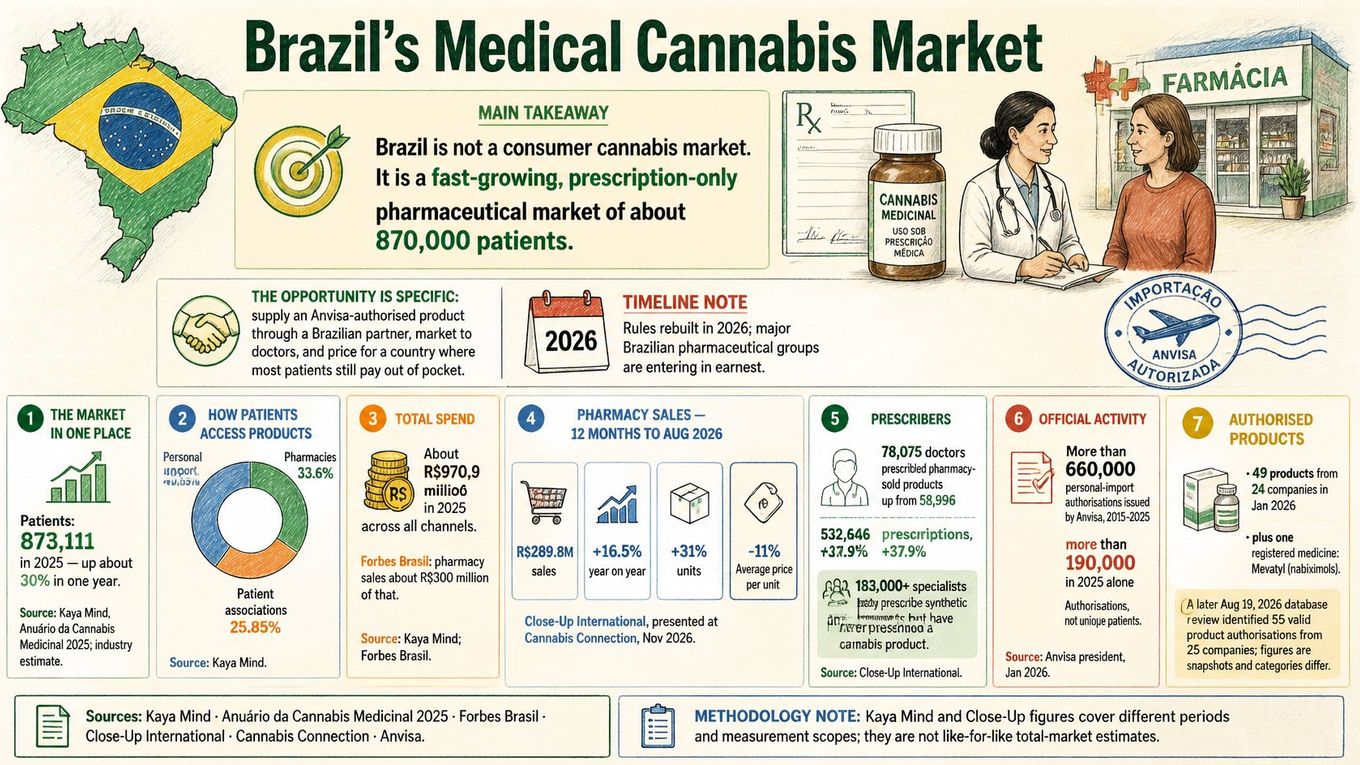
If your company is weighing Brazil as its next medical cannabis market, here is the short version of the advice you would get across the table. Brazil is not a consumer cannabis market and will not become one in the next four years. It is a fast-growing, prescription-only pharmaceutical market of about 870,000 patients, which rebuilt its rules this year, and which Brazil's own big pharmaceutical groups are now entering in earnest. The opportunity is real and specific. It goes to companies that can supply an Anvisa-authorised product through a Brazilian partner, market it to doctors, and price it for a country where most patients still pay out of their own pocket.
The market in one place
- Patients: 873,111 in 2025, up about 30% in a year (Kaya Mind, Anuário da Cannabis Medicinal 2025; industry estimate).
- How they get it: personal import 40.55%, pharmacies 33.6%, patient associations 25.85% (Kaya Mind).
- Total spend: about R$970.9 million in 2025 across all channels (Kaya Mind). Forbes Brasil put pharmacy sales at about R$300 million of that.
- Pharmacy sales, latest: R$289.8 million in pharmacies and drugstores in the twelve months to August 2026, up 16.5%; units up 31%; average price per unit down about 11% (Close-Up International, presented at Cannabis Connection, November 2026).
- Prescribers: 78,075 doctors prescribed products sold in pharmacies in that period, up from 58,996; prescriptions up 37.9% to 532,646. Close-Up counts more than 183,000 specialists who already prescribe synthetic anticonvulsants and have never prescribed a cannabis product.
- Official activity: more than 660,000 personal import authorisations issued by Anvisa from 2015 to 2025, more than 190,000 in 2025 alone (Anvisa's president, January 2026). These count authorisations, not patients.
- Authorised products: 49 products from 24 companies in January 2026, plus one registered medicine, Mevatyl (nabiximols).
Two numbers tell you where the market is going. Units are growing twice as fast as revenue, so prices are falling and volume is the game. And four out of five relevant specialists have not yet written a cannabis prescription.
Who is already there, and what they are worth
The pharmacy channel has stopped being a niche run by cannabis start-ups. Close-Up's ranking for the twelve months to August 2026:
| Company | Pharmacy sales (R$m) | Share | Annual change | What it is |
|---|---|---|---|---|
| Prati-Donaduzzi | 77.1 | 26.6% | −22.3% | Brazilian generics maker (group revenue about R$2.5bn in 2025, reported); first CBD product in pharmacies; launched a CBD tablet in 2025 |
| GreenCare | 51.2 | 17.7% | +22.7% | Specialist cannabis pharmaceutical company |
| Mantecorp Farmasa | 43.1 | 14.9% | +22.5% | Part of Hypera, Brazil's largest listed pharma group |
| Aché | 27.2 | 9.4% | +132.3% | Top-tier Brazilian pharma; licenses products from Ease Labs |
| Eurofarma | 17.9 | 6.2% | +412.3% | Top-tier Brazilian pharma; partnered with VerdeMed since 2022 |
The leader is shrinking while the big groups grow at triple digits. Forbes Brasil reported in June that at least five of the seven largest Brazilian pharmaceutical groups now have cannabis products: Eurofarma, Aché, Hypera, Biolab and Teuto, with União Química the latest. The deals give a fair picture of how entry works:
- VerdeMed and Eurofarma: VerdeMed, incorporated in Canada, supplies; Eurofarma sells. VerdeMed's chief executive, José Bacellar, said it would have taken five years to reach the volume Eurofarma reached in one, and that VerdeMed was negotiating a partnership or acquisition with a large international group.
- Ease Labs and Aché: two products on five-year contracts worth about R$4 million each; Ease Labs also supplies FURP, São Paulo state's public pharmaceutical laboratory, and is targeting R$100 million in revenue in 2027.
- União Química (Genom) and Nunature: finished products imported from Colorado and tested in Brazil before distribution; about 200 people on the project; three more products planned.
- Biolab and Promediol; Cellera Farma and Endogen: licensing and co-promotion, using big-pharma sales forces of up to 1,200 representatives.
- Farma USA: the only company producing CBD-isolate active ingredient with Anvisa's own GMP certificate, according to Forbes; four products; an Anvisa quota of one tonne of active ingredient to supply compounding pharmacies; planning exports.
The lesson for a foreign entrant: the winning model so far is a foreign or specialist manufacturer paired with a Brazilian group that has the regulatory licences and the sales force. Abiquifi, the pharmaceutical ingredients association, told Forbes that only cannabis companies with such alliances "will remain competitive".
The rules that changed in 2026
Brazil rebuilt its framework this year, under orders from the Superior Court of Justice (STJ). The five February resolutions are the most important regulatory change since 2019.
- RDC 1.015/2026 (products), in force since 4 May: replaced RDC 327/2019. Products hold a five-year sanitary authorisation (Autorização Sanitária), expressly not a medicine registration. Products must be CBD-dominant (CBD at least five times THC). At 0.2% THC or below they move from the black-stripe narcotic prescription to the red-stripe retained prescription, which Forbes reports covers about 98% of formulations in pharmacies. Above 0.2% THC, products are limited to serious debilitating or life-threatening conditions. Permitted routes now include inhalation, dermatological, sublingual and buccal as well as oral. Advertising is allowed to prescribers and dispensing pharmacists. Digital prescriptions can be sent by WhatsApp or email.
- RDC 1.013/2026 (cultivation), applications open since 4 August: legal entities can apply for a special authorisation to grow cannabis at or below 0.3% THC for medical and pharmaceutical use, and, after RDC 1.023/2026, for export.
- RDC 1.011/2026 (lists): plants at or below 0.3% THC moved from the proscribed list to special control. Synthetic CBD and synthetic dronabinol are carved out of the proscribed-list controls.
- RDC 1.012/2026 (research) and RDC 1.014/2026 (a regulatory sandbox): the sandbox gives patient associations a supervised route, but it excludes advertising and commercial sale.
- Compounding (RDC 1.015, Article 72): pharmacies may compound CBD-isolate preparations once Anvisa issues a good-compounding-practice rule. It has not yet done so.
- The courts: the Supreme Court decriminalised possession for personal use in 2024 (RE 635.659); the STJ grants individual patients habeas corpus to grow at home; and on 14 October 2026 the STJ held that private health plans need not pay for CBD products for home use unless a law or the contract says so (REsp 2.260.165).
What the election means
President Luiz Inácio Lula da Silva won a fourth term on 25 October 2026 with just over 51% of the vote against Senator Flávio Bolsonaro, after trailing in the first round, and takes office on 5 January 2027. Mr Bolsonaro has said he will seek to annul the result over a two-hour extension of voting. Lula acknowledged in his victory speech that he faces "the most right-wing Congress in recent memory", in Al Jazeera's words: "I do not choose the Congress."
For cannabis, read it this way.
- The regulator is the lever, not Congress. Everything that has opened the market since 2015 came from Anvisa resolutions and court orders, not statutes. Anvisa's directors are nominated by the president and confirmed by the Senate. A re-elected government means continuity at the agency that wrote the 2026 rules, and its Secretary-General, Guilherme Boulos, met the sector in January to discuss an interministerial agenda.
- Big legislative liberalisation is unlikely. PL 399/2015, the bill that would regulate cultivation and sale, has been stuck in the Chamber on a procedural appeal for years, and much of what it proposed has now been done by Anvisa. PL 5511/2023 sits in a Senate committee. Neither is likely to pass a more conservative Congress, and both should be rechecked when the new legislature sits in February 2027.
- The risk to watch is in the other direction. PEC 45/2023, a constitutional amendment to criminalise possession of any quantity, is pending in the Chamber. It is aimed at the Supreme Court's 2024 decriminalisation, not at medical products, but a Congress that passes it would set the tone for everything else.
- Health-system access moves locally. São Paulo state's Lei 17.618/2023 created free supply of cannabidiol products through the public health system (SUS), regulated by Decree 68.233/2023, and city councils from São Paulo to small towns are passing their own. Paraná's "Lei Pétala" exists, but local press reports families still waiting months. These programmes buy by public tender.
How patients get their products today
- Personal import (about 41% of patients): under RDC 660/2022 a patient with a prescription registers on the gov.br portal, receives a two-year personal authorisation, and imports from any properly regularised foreign maker, in any THC or CBD concentration the prescriber chooses, by courier or in baggage. No flower since July 2023. Anvisa has said this route causes "distortions" and needs review; an early draft of the 2026 reform would have barred imports where an equivalent Brazilian product exists. That did not make the final text we have read, but it is the clearest regulatory risk to a foreign brand that sells only by this route.
- Pharmacies (about 34%): Anvisa-authorised products dispensed only by a pharmacist, recorded in Anvisa's controlled-products system (SNGPC). Large chains hold 66.2% of pharmacy cannabis sales; independents (14.1%) and pharmacy buying groups (9.3%) are growing fastest (Close-Up). São Paulo, Rio de Janeiro and Minas Gerais account for 47% of sales; Bahia grew 39.5%.
- Patient associations (about 26%): non-profits such as Abrace, mostly operating under court orders, supplying members at lower cost. The new sandbox offers a formal route but no commercial one.
- Home cultivation: by individual habeas corpus only.
Prescribing is open to any doctor or dentist following the patient, where there is no satisfactory alternative. Telemedicine prescribing is allowed. There is no public subsidy outside the local SUS programmes, and private plans are not obliged to pay.
What sells, and where the gaps are
CBD isolate is 60.6% of pharmacy sales and full or broad extracts 39.4%, but extracts grew 25.3% against 11.5% for isolate (Close-Up). Oils dominate; tablets arrived in 2025. The commercial conditions treated most often, according to the companies' own portfolios, are autism, epilepsy, anxiety, chronic pain, sleep and Alzheimer's.
Set Brazil beside Germany, Australia, the UK or Canada and the gaps are clear.
- Extracts and formulations beyond oil. The new rule allows sublingual, buccal, dermatological and inhalation routes. Brazil's shelves are still mostly bottles of oil. Capsules, tablets, oral films, topical creams for authorised indications and flavoured paediatric formulations (MedKaya, a Rio compounder, says its US operation existed partly to make flavours children will take) are underserved.
- THC products for the conditions the rule now allows. Above 0.2% THC is permitted for serious debilitating conditions, which Anvisa says now include fibromyalgia and lupus. Balanced and THC-forward products, the backbone of German and Australian markets, are thin in Brazilian pharmacies.
- Price. With most patients paying privately, falling prices and an STJ ruling against plan cover, a product that can sell at a lower price per milligram of CBD wins. That favours domestic finishing, local active ingredient (Farma USA) and eventually local cultivation.
- Doctor education and dosing support. 28,885 doctors stopped prescribing in the period Close-Up measured, typically after about two prescriptions. Those who kept going wrote 29% more. Retention is the industry's weak point, and the remedy is clinical support, which is now lawful to provide.
- Inhalation, carefully. Inhalation is now an authorised route, but vaporisers are banned outright under RDC 855/2024 and flower is excluded. A metered inhaler sold as part of an authorised product is legally untested. It is a gap only for a company with the regulatory patience to test it.
- Minor cannabinoids and export. LeafHub's chief executive told Forbes that Brazil's tropical climate is an advantage for CBG and other minor cannabinoids. With cultivation open and exports allowed, Brazil may become a supplier as well as a buyer.
- Not gaps, and not coming soon: flower, vapes, edibles sold as food, CBD cosmetics and consumer wellness CBD. RDC 1.015 excludes foods, cosmetics and smoking products from its scope, and there is no other legal route for them.
How to import: the partners you need
A foreign company cannot sell into Brazilian pharmacies on its own. You need a Brazilian legal entity, your own or a partner's, holding the licences, and your factory needs Anvisa's own certificate.
- A Brazilian authorisation holder. The company that applies for the five-year sanitary authorisation must hold an operating authorisation (AFE) and a special authorisation for controlled substances (AE).
- An importer with a distribution certificate. Importers need an AFE, an AE and a good distribution and storage certificate (CBPDA). They import under an Anvisa quota based on expected sales over the first three years (Articles 41 to 45 of RDC 1.015).
- Anvisa GMP certification for your plant. A foreign manufacturer needs an Anvisa-issued Certificado de Boas Práticas de Fabricação for the specific production line and pharmaceutical form (Article 12). Foreign GMP certificates are not accepted automatically, and Anvisa inspections take time; build that into the plan.
- A Brazilian testing laboratory. Every imported batch of active ingredient and finished product must be tested in Brazil (Article 16), at a REBLAS-accredited laboratory or a CBPF-certified manufacturer.
- A commercial partner. The Eurofarma, Aché, União Química, Biolab and Cellera deals show the pattern: the Brazilian group's sales force reaches doctors and pharmacy chains the foreign brand cannot.
- Labels and leaflets in Portuguese to Anvisa's prescriptive format (Articles 17 to 29), including "Este produto não é um medicamento" in bold, the red or black prescription stripe and a GTIN barcode.
The faster but narrower route is to supply patients who import under RDC 660/2022, usually through Brazilian service companies that handle prescriptions and paperwork. It needs no Brazilian authorisation, but the products cannot be advertised as Anvisa-authorised, the route may be restricted, and Anvisa has just shown it reads websites: on 13 November it banned the advertising of a Rio compounding pharmacy's cannabis products.
Where the opportunities are
- Be the supplier a Brazilian pharma group needs. Five of the seven big groups are in, and more want pipelines. A foreign manufacturer with Anvisa-certifiable GMP, stability data and a differentiated formulation is the partner they are looking for. VerdeMed's experience suggests the exit may follow.
- Win the 183,000 doctors who have not prescribed. Promotion to prescribers is newly legal. Medical education, dosing tools and representatives are the lawful growth channel, and retention is where competitors are losing.
- Bring formats Brazil does not yet have. Tablets, capsules, films, paediatric flavours, topicals, and THC-containing products for the serious conditions now covered.
- Compete on price per milligram. Local finishing (Alko do Brasil's model of bottling and formulating in Brazil, R$10 million invested and R$30 million more planned), local active ingredient and, later, local cultivation are how prices fall without margins disappearing.
- Supply the compounders and the state. When Article 72's rule arrives, compounding pharmacies will need pharmaceutical-grade CBD isolate; and SUS programmes in São Paulo and elsewhere buy by tender.
- Grow in Brazil for the world. Cultivation applications opened in August; export is permitted; the climate suits minor cannabinoids. This is a five-year play, not a launch plan.
The honest limits: Anvisa GMP certification and authorisation take months to years; the import route most foreign brands use today is the one Anvisa wants to review; prices are falling; and a conservative Congress makes the regulator, not the legislature, the only route to further change.
What to do
- Before committing (this quarter): map your portfolio against RDC 1.015's limits (CBD-dominance, the 0.2% THC line, permitted routes, prohibited forms and claims); price it against Close-Up's falling average; decide between a partner's authorisation and your own Brazilian entity.
- Find the partner (first half of 2027): approach Brazilian groups with sales forces and the AFE and AE licences; ask what pipeline gaps they have; budget for Anvisa's GMP inspection of your plant and for Brazilian batch testing.
- If you sell by personal import today (now): plan an authorised-product route in case RDC 660 is narrowed; keep every website and social channel free of anything Anvisa would call advertising.
- Watch (2027): the new Congress from February (PEC 45/2023, PL 399/2015, PL 5511/2023); Anvisa's review of RDC 660; the Article 72 compounding rule; the first cultivation authorisations under RDC 1.013; SUS tenders.
Sources
- Close-Up International via Abradilan / Panorama Farmacêutico, Cannabis nas farmácias já movimenta R$ 485,4 milhões (6 November 2026): pharmacy sales, company ranking, prescribers
- Forbes Brasil, A hora dos grandes na cannabis (20 June 2026): pharma partnerships, Farma USA, Alko, LeafHub, Abiquifi
- Kaya Mind, Número de pacientes de cannabis no Brasil em 2025 and Anuário da Cannabis Medicinal 2025 (industry estimates)
- Diário do Comércio, Ease Labs mira R$ 100 milhões em 2027
- Al Jazeera, Lula holds off far right with victory in Brazil presidential election (26 October 2026)
- Sechat, 2026 reserves crucial legislative advances for medicinal cannabis in Brazil (11 February 2026): draft RDC 660 restriction, Boulos meeting
- Anvisa, RDC 1.015/2026; gov.br: authorisation to import cannabis products (RDC 660/2022); Resolução-RE 4.427/2026
- São Paulo, Lei nº 17.618, de 31 de janeiro de 2023
- Gazeta do Paraná, Canabidiol ainda é privilégio? Lei Pétala avança no Paraná (November 2026)
- Green Ark Cannabis Knowledge Base, Brazil entry (RDC 1.011 to 1.015/2026, RDC 1.023/2026, RDC 660/2022, RDC 855/2024, STF and STJ decisions)
This article is information, not legal advice.
Information, not legal advice. Check the primary source before relying on it.


