Australians and Europeans now see cannabis much the same way.
Two government surveys, published a fortnight apart, find about half of those with a view in Australia and the EU want cannabis legal or regulated, and few want users treated as criminals. Australia’s 20-year series adds what Europe’s single snapshot cannot: in 2025, support fell for the first time since 2007.
By Neil Cartwright · · 9 min read
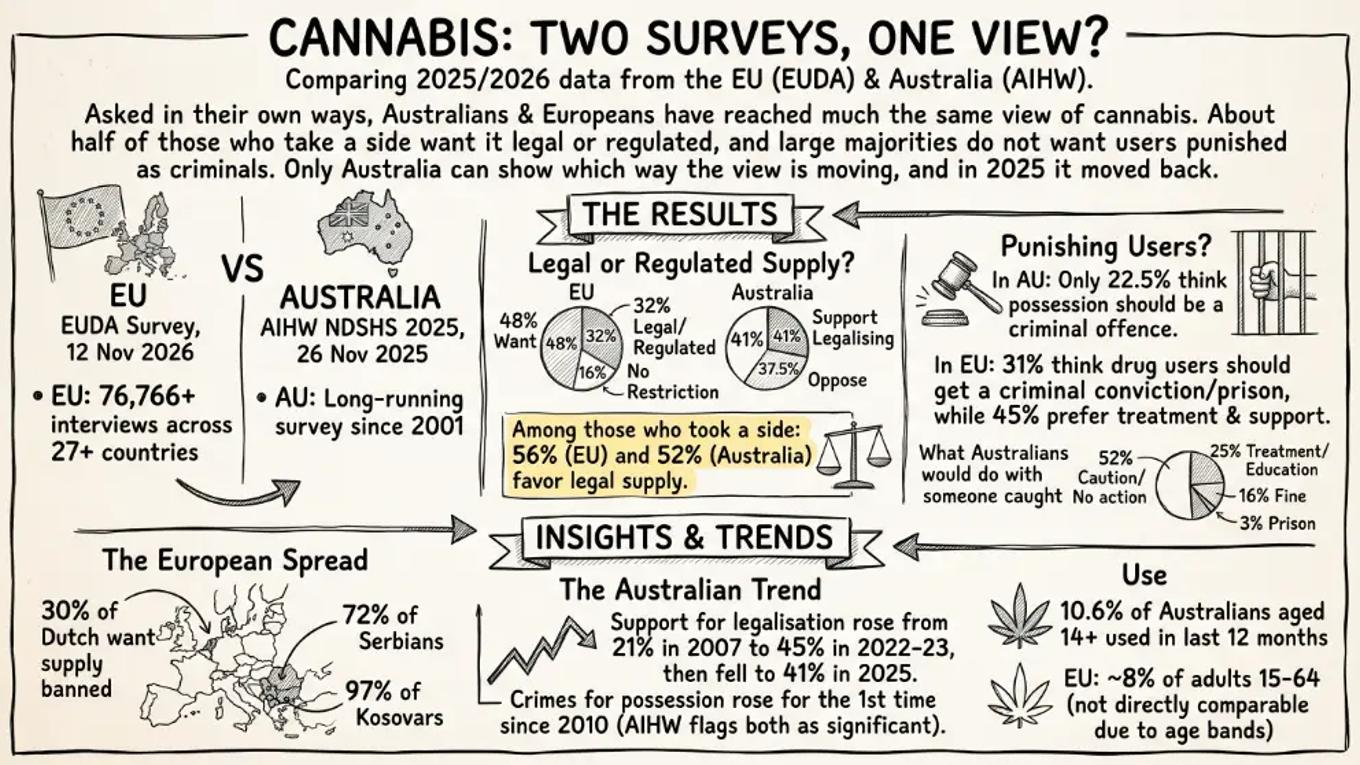
In one line: asked in their own ways, Australians and Europeans have reached much the same view of cannabis. About half of those who take a side want it legal or regulated, and large majorities do not want users punished as criminals. Only Australia can show which way the view is moving, and in 2025 it moved back.
Two government surveys landed a fortnight apart. The European Union Drugs Agency (EUDA) published its first Drug Survey on 12 November 2026: 76,766 interviews across the 27 member states, plus 19,117 in nine neighbouring countries. Australia's Institute of Health and Welfare (AIHW) published the cannabis and attitude tables of its National Drug Strategy Household Survey (NDSHS) 2025 on 26 November. The Australian survey has asked broadly the same questions since 2001. The European one has asked them once.
The results in one place
- Legal or regulated supply: 48% of EU respondents say cannabis supply should be regulated (32%) or available without restriction (16%); 38% say it should stay banned. In Australia, 41% support legalising cannabis and 37.5% oppose it.
- Among those who took a side: 56% in the EU and 52% in Australia come down for legal supply. The gap is smaller than the headline figures suggest.
- Punishing users: 22.5% of Australians think possessing cannabis for personal use should be a criminal offence. In the EU, 31% think people who use drugs (any drug, not just cannabis) should get a criminal conviction or prison; 45% prefer treatment and support.
- What Australians would actually do with someone caught with cannabis: 52% would give a caution or take no action, 25% would refer them to treatment or education, 16% would fine them, and 3% would send them to prison.
- The spread inside Europe is wider than the gap with Australia: 30% of Dutch respondents want cannabis supply banned; 72% of Serbians and 97% of Kosovars do.
- The trend: Australian support for legalisation rose from 21% in 2007 to 45% in 2022–2023, then fell to 41% in 2025. The share who want possession treated as a crime rose for the first time since the question was first asked in 2010. AIHW flags both changes as statistically significant.
- Use: 10.6% of Australians aged 14 and over used cannabis in the previous 12 months. The EUDA's European Drug Report 2023 put last-year use at around 8% of adults aged 15 to 64. The age bands differ, so the two figures are close but not directly comparable.
Are the two surveys comparable?
Partly. Both are government surveys of the adult and older-teen population, weighted to be representative, and both ask about cannabis supply and about how to treat people who use it. They differ in method and in wording, and the wording matters.
| EUDA Drug Survey 2026 | AIHW NDSHS 2025 | |
|---|---|---|
| Who | People aged 15 and over | People aged 14 and over |
| Where | EU-27 plus Norway, Turkey and seven Western Balkan and Eastern European countries | Australia (national; state tables also published) |
| How | Flash Eurobarometer, online and telephone, 24 June to 16 July 2026 | Household survey, run roughly every three years |
| Supply question | Should supply for recreational use be banned, regulated, or available without restrictions? | Do you support or oppose the legalisation of cannabis? |
| Users question | Most appropriate way to deal with people who use drugs (all drugs) | Should possession of cannabis for personal use be a criminal offence? What action should be taken? |
| Trend | None: first edition | Legalisation question asked since 2004 |
Two cautions follow. "Regulated" is a softer word than "legalised", and some Europeans who chose it may have meant medical supply only, which would flatter the European figure. And the European question on users covers every drug, including heroin and cocaine, which pushes its punitive share up. Read with those two corrections, the two populations look closer still.
Is there a difference between Australia and the EU?
Not much on the averages. A great deal inside Europe. The EU average sits where Australia sits. The member states do not.
| Place | Supply should be regulated or unrestricted | Supply should be banned | Users should get treatment | Users should get a conviction or prison |
|---|---|---|---|---|
| Netherlands | 58% | 30% | 50% | 23% |
| Czech Republic | 57% | 31% | 32% | 45% |
| Ireland | 57% | 34% | 53% | 27% |
| Luxembourg | 56% | 39% | 44% | 30% |
| Spain | 54% | 32% | 54% | 22% |
| Germany | 50% | 38% | 39% | 36% |
| Portugal | 49% | 35% | 59% | 21% |
| Malta | 49% | 49% | 51% | 28% |
| Italy | 49% | 35% | 46% | 30% |
| EU-27 | 48% | 38% | 45% | 31% |
| Sweden | 40% | 45% | 45% | 36% |
| France | 39% | 43% | 40% | 33% |
| Serbia | 25% | 72% | n/a | n/a |
| Kosovo | 2% | 97% | n/a | n/a |
| Australia (different questions) | 41% support legalisation | 37.5% oppose | 22.5% say possession should be a criminal offence; 3% would choose prison |
EUDA figures are shares of all respondents, including those who did not answer; the treatment and conviction columns refer to people who use any drug. Australian figures exclude people who said they were not informed enough to answer or were unsure.
Australia, on these numbers, would sit between France and Germany. That is a less exotic place than either side of the debate tends to assume.
Is there a trend?
In Australia, yes: a long rise, then a step back. In Europe, nobody can yet say. The EUDA describes its survey as a first edition and has not announced a repeat, so any claim about European opinion moving "towards" or "away from" anything rests on other surveys with other questions.
| Australia | 2007 | 2010 | 2013 | 2016 | 2019 | 2022–23 | 2025 |
|---|---|---|---|---|---|---|---|
| Support legalisation | 21% | 25% | 26% | 35% | 41% | 45% | 41% |
| Possession should be a criminal offence | n/a | 34% | 33% | 26% | 22% | 20% | 22.5% |
| Caution or no action for possession | n/a | 38% | 42% | 47% | 54% | 59% | 52% |
| Support tougher penalties for supply | n/a | 61% | 58% | 50% | 44% | 39% | 40% |
| Approve of regular adult use | 7% | 8% | 10% | 15% | 20% | 23% | 23% |
- The shift in 2025 came mostly from non-users. Among Australians who have never used cannabis, the share who would caution or take no action fell from 43% to 34%. Among recent users it stayed at 92%.
- Men moved more than women. Men who want possession to be a crime rose from 19% to 23%; the change among women was not significant.
- Age still divides most. Support for legalisation is 54% among 25 to 29 year olds and 24% among those aged 70 and over. Among 14 to 17 year olds it is 29%.
- Use is flat, familiarity is not. Past-year use has stayed between 9% and 13% since 2001, but the share of Australians who have ever used cannabis has risen from 33% to 41%, and from 3% to 31% among people aged 60 and over.
Is there any evidence for why the differences exist?
Neither agency explains its figures, so what follows is a reading of the evidence, not a finding. Three patterns stand out.
1. Opinion tends to follow the law people already live with. The European countries most open to regulated supply include those that already have some form of it: the Netherlands, with its tolerated coffeeshops; Luxembourg, which allowed home growing in 2023; Germany, which legalised home growing in April 2024 and non-profit growing clubs from that July. Portugal, which decriminalised the possession of all drugs in 2001, has the highest preference for treatment (59%) and the lowest for conviction (21%) in the table. The Western Balkans and Moldova, where the law is strict and the debate barely started, are overwhelmingly for a ban. Which comes first, the law or the opinion, the surveys cannot say.
2. People separate the user from the market. In Australia, 77.5% say possession should not be a crime, but only 41% support legalisation. The Czech Republic shows the same split from the other side: 57% favour regulated supply, yet 45% want drug users convicted, the highest share in the table. "Don't prosecute the user" and "license the seller" are different questions, and voters answer them differently.
3. Australia's legal channel is now a prescription, and that channel is under scrutiny. The 2025 tables show how far medical access has spread:
- Prescribed supply: of Australians who used cannabis for a medical purpose, 55% say it was always prescribed by a doctor, up from 2% in 2019.
- Online consultations: 51% of people who used cannabis only for medical purposes got it on a prescription from an online or telephone consultation.
- Share of all users: one in five Australians who used cannabis in the past year (20%) say all of it was prescribed.
- Medical users back legalisation: 93% of people who use cannabis medically support it.
In July 2025 Australia's health practitioner regulator, Ahpra, and the medical and nursing boards issued guidance on medicinal cannabis prescribing. The chair of the Medical Board put it plainly: "Patient demand is no indicator of clinical need." The same survey year recorded the first fall in support for legalisation since 2007. That is a coincidence of timing, not proof of cause. One reading is that a working medical route takes the urgency out of legalisation for some people. Another is that a year of stories about prescribing practices made others less sympathetic. Both may be true at once.
Lessons for companies working in these markets
- Sell into the consensus, not the headline. In both surveys, not prosecuting users has far wider support than commercial sale. Expect governments to move on decriminalisation, diversion and medical access long before licensed retail.
- Price country risk country by country. The EU average of 48% hides a range from 58% (Netherlands) to 39% (France) inside the Union, and a ban preference of 72% to 97% in candidate countries. Malta, which legalised in 2021, is split exactly in two.
- Do not assume opinion only moves one way. Australia's 2025 figures show a significant step back across several measures in a single wave. A business plan that depends on a law changing should be stress-tested against a stall.
- In Australia, the medical channel carries regulatory risk. A model that depends on high-volume telehealth prescribing is exposed to the professional regulators as well as the medicines regulator. The 2025 guidance is the warning.
- Use the data in your own submissions. Both datasets are public and current. A consultation response that cites them carries more weight than one that cites industry polling.
Lessons for governments
- Criminal penalties for possession are out of step with voters. Three per cent of Australians would choose prison for someone found with cannabis. In the EU, 45% prefer treatment to punishment for drug use generally, against 31% who favour conviction.
- Ask the same question twice. Australia's survey is useful because it has asked broadly the same questions for two decades. A single European snapshot cannot show whether Germany's 2024 law has moved opinion. A repeat with unchanged wording would.
- Ask the questions separately. Attitudes to users and attitudes to supply diverge. Policy that bundles them, in either direction, will misread its own electorate.
- Watch medical schemes as supply systems. In Australia, 21% of past-year users say they use cannabis sometimes for medical reasons and sometimes for others. A prescription system that supplies a fifth of all users is, in practice, part of the market, whatever its legal label.
What happens next
- Australia: AIHW's state and territory tables for 2025 are published and will show whether the fall was national or concentrated. The next NDSHS is expected in about three years.
- Europe: the EUDA has not announced a second edition of its Drug Survey. Its European Drug Report, published each year, carries the use figures.
- Green Ark: both surveys are now held in Green Ark's data layer, so the comparison can be rerun when either is updated.
This article is information, not legal advice.
Sources
- AIHW, National Drug Strategy Household Survey 2025: Cannabis in the NDSHS (26 November 2026)
- AIHW, NDSHS 2025 data tables: 4 Illicit drugs (Tables 4.48, 4.50), 6 Medical cannabis (Tables 6.1, 6.3, 6.11, 6.12), 10 Perceptions and attitudes (Tables 10.10, 10.15, 10.24, 10.26, 10.30, 10.32)
- AIHW, Support for alcohol and other drug related policies (26 November 2026)
- EUDA, EUDA Drug Survey 2026: European attitudes towards drugs and drug policy (12 November 2026), questions 6.1 and 13
- Forebygging.no, summary of the European Drug Report 2023: cannabis, the current situation in Europe
- Nursing and Midwifery Board of Australia, Guidance on medicinal cannabis prescribing targets unsafe practice (9 July 2025)
Information, not legal advice. Check the primary source before relying on it.


