Company round-up: a stayed deadline, an unenforceable contract and fourteen days left for hemp
Our Companies desk read 100 company items from 19 to 27 November. The theme: a licence does not settle a company’s position. Courts paused the DEA and voided a $31.8m supply deal, Australia’s regulator agreed A$7.95m in advertising penalties, and hemp sellers count down to 11 December.
By Neil Cartwright · · 12 min read
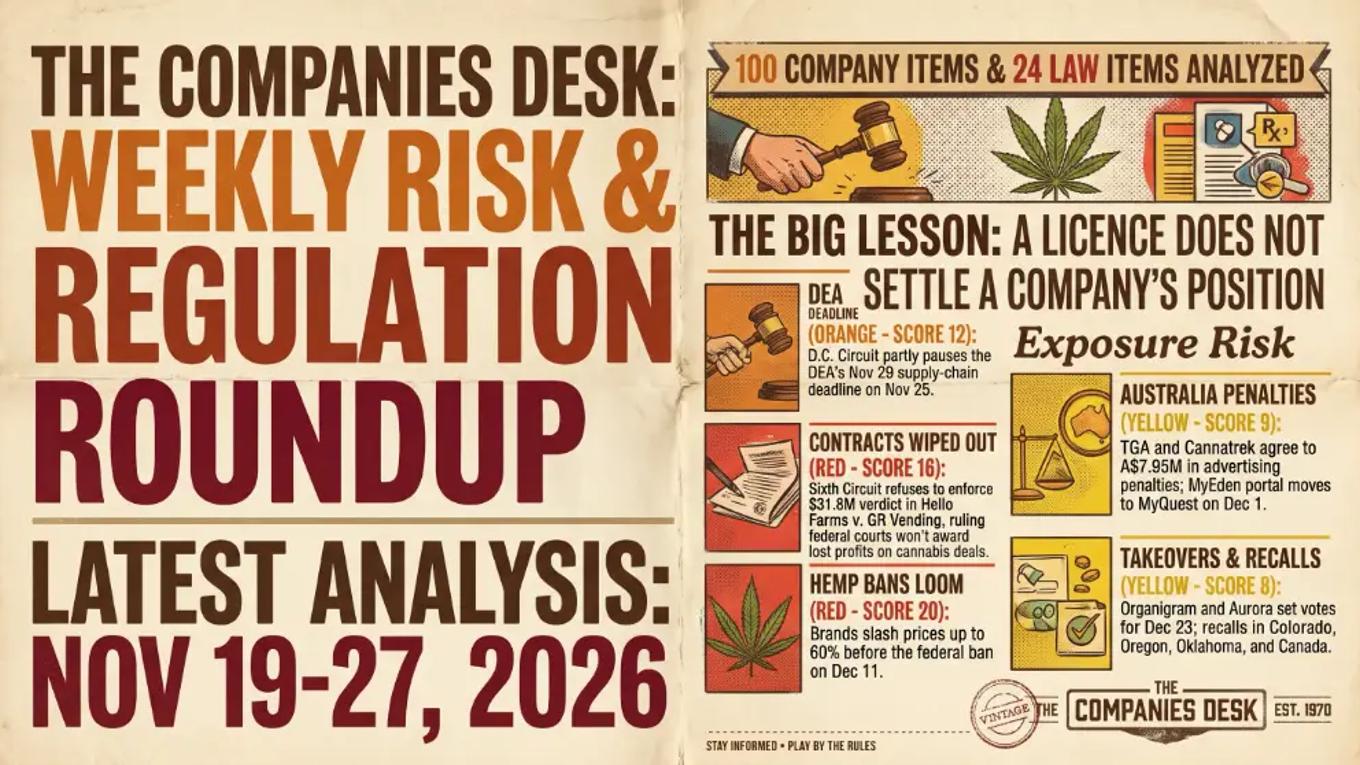
Our Companies desk read 100 company items and 24 law items published between 19 and 27 November. Most of the news was companies doing ordinary things: opening shops, buying back shares, launching products. The stories that matter for anyone advising them share one theme: a licence does not settle a company's position. A federal appeals court has paused the DEA's supply-chain deadline. Another federal appeals court has refused to enforce a $31.8 million cannabis supply contract. Australia's medicines regulator has agreed penalties with a group whose patient portal closes this weekend. Hemp sellers have 14 days left before their products become illegal.
Each exposure below is scored for a named kind of company: severity times likelihood, each from 1 to 5. A score of 16 or more is red, 10 to 15 orange, 5 to 9 yellow, and below 5 green.
The results in one place
- DEA deadline: the D.C. Circuit partly paused the DEA's 29 November supply-chain guidance on 25 November, while it hears eight operators' motions. The pause is not a ruling on the merits.
- Contracts: the Sixth Circuit's decision in Hello Farms v. GR Vending wiped out a $31.8 million jury verdict against a Curaleaf subsidiary. The court held that a federal court will not award lost profits on a cannabis supply deal. A petition for rehearing is pending.
- Hemp: brands are cutting prices by up to 60% or going dormant before the federal ban on 11 December. The Senate rescue bill has not had a hearing.
- Australia: the Cannatrek group and its former chief executive have agreed with the TGA to ask the Federal Court for A$7.95 million in penalties for advertising. Its MyEden patient portal moves into Little Green Pharma's MyQuest on 1 December.
- Takeovers: Organigram and Aurora set shareholder votes for 23 December, with completion targeted for January 2027. Curaleaf's competing bid is still open.
- Recalls: Wana in Colorado (child-resistant packaging, 270 stores), Oregon's regulator (a pesticide, bifenthrin), Oklahoma's regulator (yeast and mould) and Health Canada (a mislabelled "solventless" shatter).
1. Federal law still decides what a state licence is worth
What companies announced. Eight medical cannabis companies asked the D.C. Circuit to block the DEA's guidance requiring timely applicants and registrants to trade only with each other from 29 November. They warned of layoffs and closures. North Dakota, Utah and West Virginia filed a brief on their side on 24 November. On 25 November the court granted a partial administrative stay while it considers the motions. In the same week, a Westlaw commentary published by Reuters set out what Curaleaf's Michigan subsidiaries had won in September. GR Vending MI agreed in November 2020 to buy Hello Farms' 2020 and 2021 harvests. It paid a $2.2 million deposit, took about 2,000 pounds and refused the rest when prices fell. A jury awarded Hello Farms $31.8 million in lost profits.
The law behind it. The DEA's 30 October guidance rests on 21 CFR 1301.13(k)(7). The Justice Department told the D.C. Circuit that state operators have no reliance interest in "violating federal law". In Hello Farms Licensing MI, LLC v. GR Vending MI, LLC, No. 25-1759 (10 September 2026), the Sixth Circuit reversed the verdict. It held that federal law governs the effect of illegality under the Controlled Substances Act. It said damages for the promised cannabis sales would enforce the illegal bargain itself. The appropriations rider protecting state medical programmes did not change that. Nor did April's move of state-licensed medical cannabis to Schedule III, which the court said is not retroactive and is not met by a state licence alone. The commentary notes that the court must refuse enforcement even if no party raises the defence. Hello Farms has petitioned for rehearing, supported by NORML.
The exposure.
- A registrant or timely applicant still buying from, or selling to, an unregistered partner after 29 November: severity 4, likelihood 3 while the stay holds, score 12, orange. Keep the paperwork for both paths ready and do not treat the stay as a ruling.
- A grower or brand whose business depends on enforcing an offtake or supply agreement in Michigan, Ohio, Kentucky or Tennessee: severity 4, likelihood 4, score 16, red. Ask for deposits and prepayment, shorten credit terms, add a state-court forum clause with a waiver of removal, and price the contract as if a federal court will not enforce it.
- A buyer relying on the same defence to walk away: severity 3 (reputation, state regulator, and the rehearing petition), likelihood 2, score 6, yellow.
2. Hemp's last fortnight
What companies announced. Slumber cut prices by up to 60% to clear stock before 11 December. Climbing Kites in Iowa said it will "hibernate" rather than close. A coalition backed by DoorDash brought hemp businesses to Capitol Hill to lobby against the ban, so that delivery platforms can keep selling the products. Missouri officials accused a Jefferson City business of using a hemp loophole. Whitney Economics published figures showing that petrol stations hold 15% of hemp retail licences but take 2.6% of hemp revenue. In Illinois, hemp businesses lost their bid to pause the state's ban while their lawsuit continues.
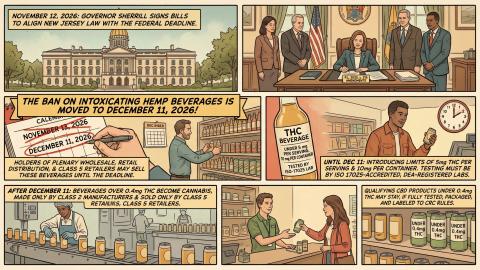
The law behind it. From 11 December the federal hemp definition passed last year measures total THC. It caps finished products at 0.4 mg of total THC per container and excludes synthesised cannabinoids. The Hemp Guardrails Act (Sens. Klobuchar and Sheehy, introduced 17 November) would raise the limit to 1% total THC, set a federal minimum age of 21 and give the FDA authority over these products. It has had no hearing. State dates sit on top of the federal one: in Rhode Island, over-limit stock must be quarantined and listed by 4 December, and the 0.4 mg limit applies from 11 December. New Jersey's ban on intoxicating hemp drinks starts on 11 December, as do Missouri's HB 2641 rules on hemp beverages.
The exposure. A hemp brand, distributor or retailer whose range depends on intoxicating products: severity 5, likelihood 4 unless Congress acts in a spending bill, score 20, red. Count stock by product and state, plan the write-down, and check delivery and marketplace contracts for who carries unsold stock. A state-licensed cannabis company buying hemp-derived inputs scores lower: severity 3, likelihood 3, score 9, yellow. It needs a supplier certificate on the new total-THC basis.
3. Australia: advertising penalties and a telehealth shake-out
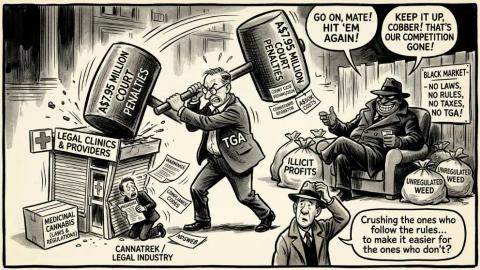
What companies announced. On 27 November the TGA said that Cannatrek Limited, Balnce Health and MyEden Health Platform, together with Cannatrek's former chief executive, had admitted unlawful advertising of medicinal cannabis. The group admitted it on its websites and social media from 2021 to 2025; the former chief executive admitted it on LinkedIn from 2023 to 2025. Separately, the LGP Cannatrek group told patients that the MyEden portal will close and "join" MyQuest, Little Green Pharma's clinic division, on 1 December. Naturecan, a UK company, was named as the buyer of Cannim Group's clinic and assets. Vitura forecast improvement on all five of its key measures in FY27 after what it called a "challenging" FY26. Emyria hired 31 therapists.
The law behind it. The parties have jointly asked the Federal Court to impose A$7.95 million in penalties under the Therapeutic Goods Act 1989, plus A$50,000 in costs. The TGA notes that the amount is for the Court to decide. Most of the advertisements named serious conditions, which are restricted or prohibited representations. Some used endorsements from health practitioners or cited clinical studies without meeting the Advertising Code. Cannatrek had already paid 22 infringement notices totalling A$293,040 in 2022. The TGA sued Better Leaf and Better Life Aussie on similar grounds in August. In July 2025, Ahpra and the medical and nursing boards issued their prescribing guidance.
The exposure. An Australian clinic, telehealth platform or supplier that promotes access to medicinal cannabis online, including through its executives' personal accounts: severity 4, likelihood 3, score 12, orange. Audit every channel the brand and its senior staff control, including LinkedIn, against the restricted-representation list. A buyer of distressed clinics or patient books, as Naturecan now is: severity 3, likelihood 3, score 9, yellow. Diligence should cover past advertising and prescribing patterns, not just the patient numbers.
4. Consolidation, buybacks and oversupply
What companies announced. Organigram and Aurora filed their joint circular and set virtual shareholder meetings for 23 December. Proxies are due by 21 December. Organigram offers C$7.80 a share in cash, 5.8626 Organigram shares, or C$3.75 plus 3.0431 shares. Aurora's board has twice rejected Curaleaf's competing offer as inadequate. Completion is targeted for January 2027. SNDL approved a new C$100 million buyback after using all 24.5 million shares allowed under the last one. A US SEC filing valued Scotts Miracle-Gro's stake in Vireo Growth at $81.7 million. Jushi amended its loan agreement to allow acquisitions and to fund its Virginia operations. Simply Solventless won an extension of its Canadian creditor protection (CCAA) to February. IM Cannabis replaced its founder as chief executive. The Bedrocan brand and Bedrocan Canada passed to Becanex, as our 19 November round-up reported. Whitney Economics put US licensed capacity at 122 million pounds a year against demand of 48 to 50 million.
The law behind it. The Organigram deal needs shareholder approval, the court's approval of the arrangement, and clearances in Canada and Germany. British American Tobacco's subsidiary funds part of the cash. Jushi's amendment matters because of Virginia: the state's adult-use market timeline is now published, and it will decide who can sell. Creditor protection in Canada keeps licences alive only while the court allows it.
The exposure. A supplier, landlord or lender to a Canadian licensed producer in creditor protection or a contested takeover: severity 3, likelihood 3, score 9, yellow. Check change-of-control and termination clauses before 23 December. A US operator in a state with licensed capacity well above demand: severity 3, likelihood 4 (price compression), score 12, orange. Model supply contracts at today's prices, not last year's (see pattern 1).
5. Europe: price pressure, pharmacy routes and a new trade body
What companies announced. Cantourage published third-quarter figures. Revenue was €19.9 million (€20.3 million a year earlier), EBITDA €1.9 million (a loss of €2.2 million a year earlier) and gross margin 35.3%. The company said falling flower prices and competition weighed on Germany, which supplied €9.5 million, or 48%. The UK supplied €9.3 million and Poland €1.1 million. It finished its third EU-GMP certification project, with five-year exclusive supply terms, and is developing its Telecan telemedicine platform. Aurora is adding a hall at its Leuna site in Germany. MediPharm Labs received a favourable opinion from BSI, a notified body, for its metered-dose cannabis inhaler under EU medical device rules, pointing to a European launch in 2027. Curaleaf International, Glass Pharms and Wellford founded the UK Cannabis-Based Medicines Association on 16 November. Curaleaf's UK registry reached 50 peer-reviewed papers drawing on more than 55,000 patients.
The law behind it. In Germany, the government is weighing tighter access to medical cannabis, including rules on telemedicine prescribing. On 23 November the association of cannabis-dispensing pharmacies (VCA) proposed a supervised pilot of adult-use sales in pharmacies, modelled on Switzerland's trials. Statutory insurers have not covered flower since 30 July. Sweden ends reimbursement for medical cannabis treatment on 1 December. MediPharm's inhaler is going through the medical device route, which runs under different rules from the medicinal-product route for flower.
The exposure. A German importer or telemedicine platform whose volume depends on remote flower prescriptions: severity 4, likelihood 3, score 12, orange. Track the draft amendment and keep a pharmacy-led, in-person route ready. A UK clinic or supplier: severity 2, likelihood 2, score 4, green for now. The new association is a lobbying voice, not a rule change.
6. Recalls and what they say about compliance systems
What companies announced. On 23 November Wana (Mile High Products LLC) began a voluntary recall of 15 batches of 100 mg gummies sold between 19 October and 17 November at 270 Colorado stores. A retailer had found that some child-resistant closures may not work. Oregon's OLCC recalled products containing the pesticide bifenthrin and opened an investigation. Oklahoma's OMMA recalled 38 flower packages from Sol Terra after retesting found yeast and mould above the limit. Health Canada listed Origami Extraction's recall of a shatter whose label wrongly claimed "100% Solventless" and left out required information. On the retail side, Theory Wellness opened Massachusetts' first legal drive-through in Chicopee, a week after the Cannabis Control Commission's 3-0 vote, and a Quincy drive-through reopened.
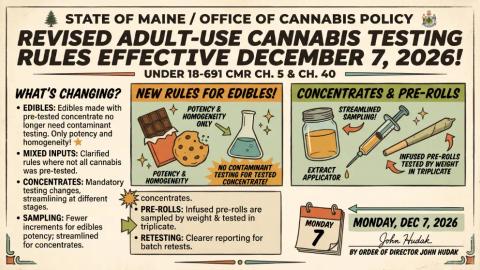
The law behind it. Colorado's Marijuana Enforcement Division sets the child-resistant packaging rules. It reported no adverse events and told consumers not to rely on the affected packaging. Oregon's investigation can lead to licence action. Rhode Island has postponed its extra pesticide controls. Maine's revised adult-use testing rules take effect on 7 December.
The exposure. An edibles maker that relies on a single packaging supplier, or on retailer intake checks to catch defects: severity 3, likelihood 3, score 9, yellow. A cultivator in Oregon or any state widening its pesticide panel: severity 3, likelihood 3, score 9, yellow. Make sure your recall plan names who notifies the regulator, and within what time.
The register
| Risk | Who it touches | Severity | Likelihood | Score | Date or trigger |
|---|---|---|---|---|---|
| Federal hemp ban removes intoxicating products | Hemp brands, distributors, retailers, delivery platforms | 5 | 4 | 20 red | 11 December (RI quarantine 4 December) |
| Federal courts refuse to enforce cannabis supply contracts | Growers and brands with offtake deals in the Sixth Circuit; others by influence | 4 | 4 | 16 red (new) | Rehearing petition in Hello Farms |
| DEA supply-chain restriction for registrants and timely applicants | Medical operators trading with unregistered partners | 4 | 3 | 12 orange (was 16; stay granted 25 November) | D.C. Circuit ruling on the stay motions; 29 November |
| TGA advertising enforcement | Australian clinics, telehealth platforms, suppliers and their executives | 4 | 3 | 12 orange (new) | Federal Court orders on the Cannatrek penalty |
| Price compression from oversupply | US operators in over-licensed states | 3 | 4 | 12 orange (new) | Ongoing |
| German telemedicine and flower prescribing curbs | Importers and telemedicine platforms in Germany | 4 | 3 | 12 orange | MedCanG amendment |
| Counterparty risk in creditor protection and takeovers | Suppliers, landlords, lenders to Canadian LPs | 3 | 3 | 9 yellow (new) | 23 December votes; Simply Solventless CCAA to February |
| Packaging and pesticide recalls | Edibles makers, cultivators | 3 | 3 | 9 yellow (new) | OLCC investigation; Maine testing rules 7 December |
| Diligence on distressed clinic purchases | Buyers of Australian clinics and patient books | 3 | 3 | 9 yellow (new) | Naturecan–Cannim completion |
| Dutch supply gap after Bedrocan | Dutch and German pharmacies, importers | 3 | 4 | 12 orange (carried forward; brand now with Becanex) | Dutch tender, December 2026 |
| Georgia medical cannabis by mail | Georgia licensees shipping to patients | 3 | 2 | 6 yellow (carried forward) | Any USPS statement |
What to watch
- 29 November: the DEA's supply-chain date, as narrowed by the D.C. Circuit's stay.
- 1 December: MyEden moves into MyQuest; Sweden ends medical cannabis reimbursement; Queensland doubles drug-driving penalties.
- 4 December: Rhode Island hemp stock quarantine and listing deadline; Curaleaf's offer for Aurora, as last reported.
- 7 December: Maine's revised adult-use testing rules take effect.
- 8 December: OMMA's proposed permanent rules (comments close, hearing held); Texas hemp hearings.
- 10 December: comments close on the DEA's proposed 2027 production quotas.
- 11 December: federal hemp redefinition takes effect; New Jersey and Missouri hemp beverage rules start.
- 21 and 23 December: proxy deadline and shareholder votes on Organigram–Aurora.
- Undated: the Sixth Circuit's answer to the Hello Farms rehearing petition; the Federal Court's orders on Cannatrek; any vote on the Hemp Guardrails Act or a spending-bill rider.
This is information, not legal advice, and the scores are a starting point for a company's own register, not a substitute for it.
Sources
TGA, Cannatrek Group and former CEO agree nearly $8 million penalty (27 November 2026); Colorado Department of Revenue via Cannabis Business Times, Wana voluntary recall (23 November); OMMA, Sol Terra recall; Reuters (Westlaw Today), Sixth Circuit ruling puts cannabis supply contracts at risk (24 November); League of Minnesota Cities, Bipartisan Senate bill aims to prevent Dec. 11 hemp-THC ban; The Marijuana Herald, Organigram and Aurora set December 23 votes and eight companies urge court to block DEA restrictions; Marijuana Moment, GOP-led states take businesses' side and DoorDash lobbies Congress; Cannabiz, LGP Cannatrek shuts Myeden, Naturecan named as buyer of Cannim assets and Vitura forecasts upturn; Cantourage, Q3 2026 results; Newsweed, MediPharm inhaler in Europe and German pharmacists' pilot proposal; Curaleaf International, Cannabis-Based Medicines Association; MMJ Daily, Theory Wellness drive-through; The Marijuana Herald, SNDL buyback, Scotts' Vireo stake and Whitney Economics on oversupply; StratCann, Simply Solventless CCAA extension.
Information, not legal advice. Check the primary source before relying on it.