Illinois: Bourbonnais sets a 3% local cannabis tax from 1 January 2027
From 1 January 2027, adult-use dispensaries in Bourbonnais pay a 3% municipal cannabis tax. That’s the highest rate a village can set. It comes on top of the existing state taxes.
By Neil Cartwright · · 3 min read
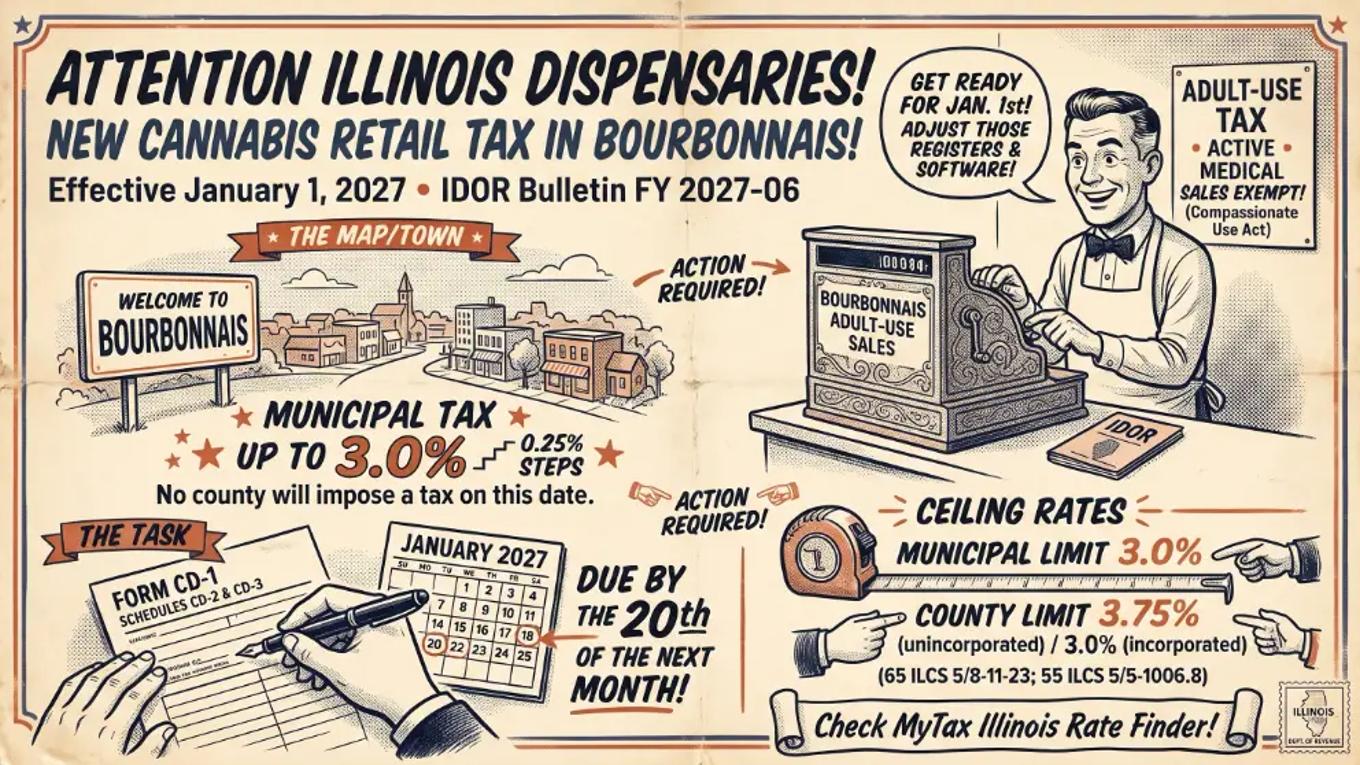
From 1 January 2027, adult-use dispensaries in Bourbonnais pay a 3% municipal cannabis tax. That’s the highest rate a village can set. It comes on top of the existing state taxes.
In short
- Bourbonnais (Kankakee County) will charge a Municipal Cannabis Retailers’ Occupation Tax of 3% of gross receipts on adult-use sales made on or after 1 January 2027.
- Medical cannabis sales are excluded.
- Dispensaries pay the tax to the Illinois Department of Revenue (IDOR), not to the village.
- No county starts a new county cannabis tax on that date.
What changed
IDOR’s Informational Bulletin FY 2027-06 lists Bourbonnais among the local governments with tax changes from 1 January 2027, but it doesn’t give the rate. The rate is in the village’s own Ordinance No. 26-2559, adopted on 8 September 2026. It adds Sec. 32-70(a) to the village code and sets the tax “at the rate of 3% of the gross receipts” from adult-use sales. Under state law (65 ILCS 5/8-11-23), a municipality can charge up to 3%, in 0.25% steps, so Bourbonnais has gone to the maximum.
What this means
A Bourbonnais dispensary’s adult-use sales will carry:
- the 6.25% state retailers’ occupation tax;
- the new 3% Bourbonnais cannabis tax;
- any local general sales taxes that apply at the store’s address;
- the cannabis purchaser excise tax (410 ILCS 705/65-10), which customers pay at 10%, 20% or 25% depending on the product and its THC level.
Cultivators also pay a 7% cultivation privilege tax further up the supply chain.
Take the lowest excise tier and leave out local general sales taxes, and cannabis taxes alone add up to 19.25% of the price (6.25% + 3% + 10%). The real total at a given store will be higher once its local sales taxes are added. Get the exact combined rate from the Tax Rate Finder (see below).
What you need to do
- Who is affected: adult-use dispensaries in the Village of Bourbonnais. Medical sales under the Compassionate Use of Medical Cannabis Program Act are excluded.
- What changes and from when: a new 3% municipal cannabis tax, for sales on or after 1 January 2027.
- The numbers: 3% municipal cannabis tax (Ordinance No. 26-2559, Sec. 32-70(a)), on top of the 6.25% state tax and any local sales taxes. Look up the combined rate for the store’s address in the MyTax Illinois Tax Rate Finder and select January 2027 rates.
- Filing: report and pay the tax to IDOR on Form CD-1. Businesses with more than one site also file Schedules CD-2 and CD-3. Returns are due by the 20th of the month after the reporting period.
- Medical opt-in licences: dispensaries that sell both medical and adult-use cannabis must report the two separately on Form CD-1. Only adult-use receipts carry the new tax.
- Systems: IDOR says dispensaries must update their registers and point-of-sale software for 1 January 2027. The ordinance lets retailers show the tax as a separate line on receipts.
Where to check
- MyTax Illinois Tax Rate Finder: the rate lookup tool. Enter the dispensary’s address and select January 2027 rates. The Tax Rate Finder link inside IDOR’s bulletin points to a mistyped address and doesn’t work, so use this one.
- Village of Bourbonnais Ordinance No. 26-2559: on Municode (PDF). It sets the 3% rate and the 1 January 2027 start date.
- IDOR Informational Bulletin FY 2027-06: the bulletin listing the January 2027 local changes.
- IDOR cannabis taxes: state and local cannabis taxes, returns and forms.
Sources: Village of Bourbonnais Ordinance No. 26-2559; IDOR Informational Bulletin FY 2027-06; 65 ILCS 5/8-11-23; 55 ILCS 5/5-1006.8; 410 ILCS 705/65-10; IDOR cannabis taxes page.
This is general information, not legal, tax or financial advice. Check the ordinance and the Tax Rate Finder before changing registers or software.
Based on FY 2027-06, Municipal and County Cannabis Retailers' Occupation Tax Rate Changes (Illinois Department of Revenue (IDOR)).
Information, not legal advice. Check the primary source before relying on it.