Massachusetts changes how cannabis is tested for mould, by bulletin, effective the same day
On 13 November the Cannabis Control Commission told labs to read yeast and mould tests within 60 to 72 hours, with no comment period and no start date. The subject was flagged for two years; the rule itself arrived without warning, and only the labs were told.
By Neil Cartwright · · 7 min read
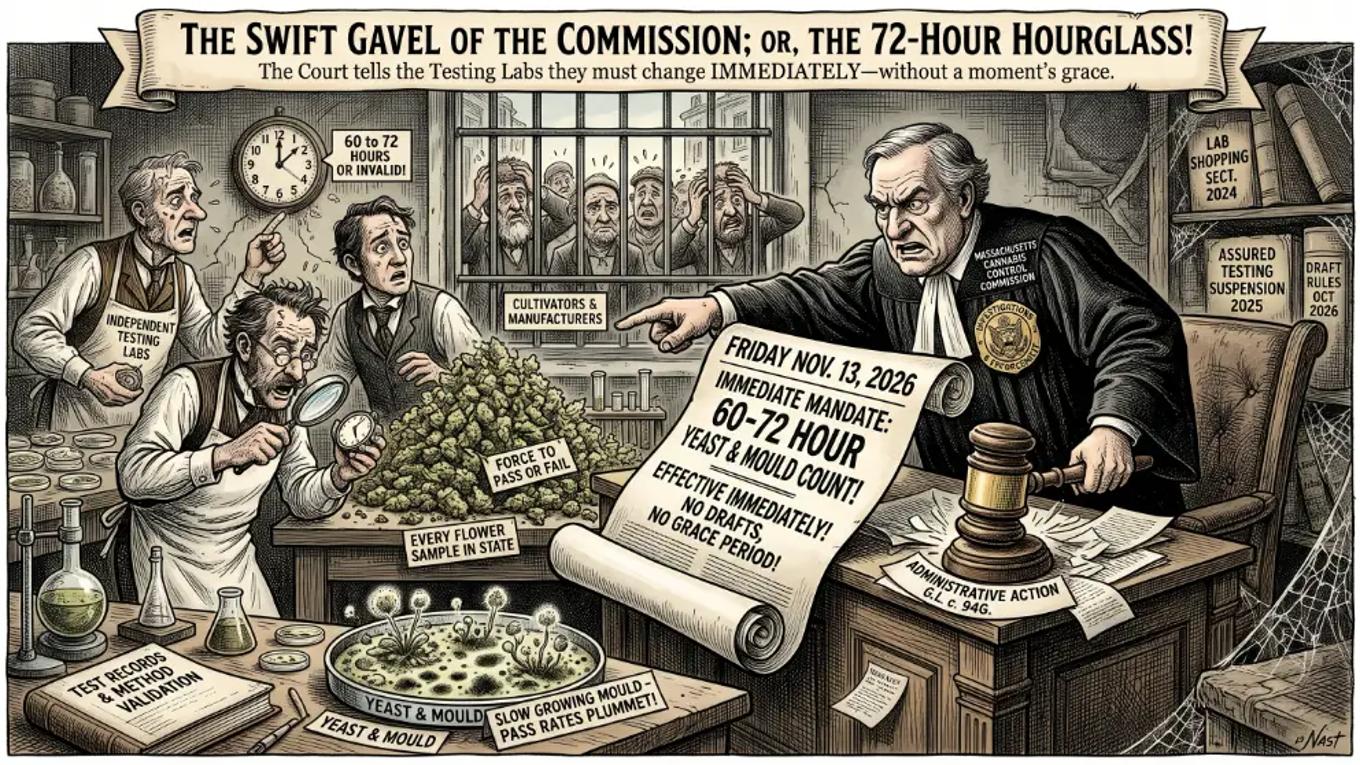
On Friday 13 November 2026 the Massachusetts Cannabis Control Commission told the state's independent testing laboratories that culture-based yeast and mould tests must be incubated and counted within a window of 60 to 72 hours, effective immediately. It came in a bulletin from the Commission's Investigations and Enforcement Department. There was no draft, no comment period and no start date. Every flower sample tested in the state since then is covered.
The change sounds technical. It is also commercial: moulds that grow slowly show up on a plate left for three days that might not show on a plate read earlier. If any lab was reading earlier, its clients' pass rates are about to fall.
The change in one place
- What: culture-based yeast and mould enumeration must be incubated and counted within 60 to 72 hours.
- Also: every microbiological method must be validated for the product type being tested, and labs must use the sample size set by the published method unless a different size has been validated by an equivalence study.
- Records: test records must show the method requirements and the bulletin's expectations were followed.
- Sanction: results from an unvalidated method "may be deemed invalid", and the Commission may take administrative action under G.L. c. 94G.
- Who it is addressed to: independent testing laboratories only. Cultivators and manufacturers were not the named audience, though their products bear the consequences.
- When: issued 13 November 2026, in force the same day.
Did anyone see it coming?
The direction, yes. The date and the detail, no.
Massachusetts has been arguing about its testing labs for two years. The record is long enough that nobody in the market can claim surprise at the subject:
- September 2024: the Boston Globe reported that, between April 2021 and December 2023, one lab failed 16.4% of samples for yeast and mould while another failed 3.3% and a third fewer than 1%, and that cultivators moved their business towards the labs that failed least. The Commission replied that its labs "are held to some of the highest standards in the nation".
- November 2024: the Commission held a listening session with labs at its Worcester headquarters.
- March 2025: Administrative Order No. 4 required licensees to send one sample package to a single lab for all compliance testing, a measure aimed at "lab shopping".
- June 2025: the Commission suspended Assured Testing Laboratories, the first suspension of a cannabis lab in the state. According to the suspension order as reported, Assured had failed 10 of 17,565 samples for yeast and mould, a fail rate about 90 times lower than the state average. The lab denied wrongdoing and reopened in September after paying a $300,000 fine. The same month, Administrative Order No. 5 required labs to upload a digital certificate of analysis after every test.
- April 2026: two bulletins corrected microbial action limits, each effective on the day it was issued. The Commission already makes testing changes this way.
- September to November 2026: the Commission began its largest revision of the regulations, released draft testing rules on 22 October and advanced them on 12 November.
What nobody saw was the window itself. The draft rules voted on the day before talk about compliance testing before every sale, automatic retests of failures, labels for remediated products and a move to targeted testing for specific dangerous organisms. They take effect six months after they are formally issued, tentatively in April 2027, after a comment period that opens in January. The incubation window was not put out for comment. It arrived the next afternoon, separately, by bulletin.
What law does it rest on?
The Commission did not amend a regulation. It interpreted the ones it has.
- G.L. c. 94G: the statute that gives the Commission its authority over licensees and the power to take administrative action.
- 935 CMR 500.160 and 501.160: the adult-use and medical testing provisions, which require testing under the Commission's protocols.
- The Sampling and Analysis Protocol, section 7.4: requires methods for counting microbes to be "consistent with" US Pharmacopeia chapters <61> and <62>.
- USP <61>: says suitability "must be confirmed" when a change in the test or the product may affect the result. The Commission reads this as requiring cannabis-specific validation.
- ISO 17025:2017: the lab accreditation standard, which already obliges labs to follow their validated methods.
- Chapter 65 of the Acts of 2026: the April 2026 act that restructured the Commission and set off the current rule-writing round, which will move testing into a new 935 CMR 503.000.
The bulletin's own case for 60 to 72 hours is candid. It cites three AOAC studies on dried flower: one supported a 60-to-72-hour read, one 72 hours, and one five days. It then says the studies "do not establish a single incubation period" for every method or product, and that the window is the Commission's expectation, not a USP requirement. Put plainly, the Commission chose a number the evidence permits rather than one the evidence demands.
That leaves a question for lawyers. Massachusetts agencies normally change binding standards through notice and comment under G.L. c. 30A. The bulletin calls itself a clarification of existing expectations, but it uses "must", takes effect at once and threatens to invalidate results. Whether that is guidance or a rule in all but name has not been tested. A lab whose results are thrown out under it would be the one to test it.
Did the State tell anyone?
It told the labs. The bulletin is addressed "To: Independent Testing Laboratories" and was posted on the Commission's website on the afternoon of Friday 13 November. Those subscribed to the Commission's notice lists would have received it. There was no separate notice to cultivators, manufacturers or retailers, whose batches pass or fail on the result, and no transition period for samples already on the bench.
The April action-limit corrections, by contrast, were addressed to licensees generally. Trade press, not the Commission, carried this one to most operators.
How Massachusetts compares
No other large market writes an incubation time into its rules. States set a limit and leave the method to validation. Massachusetts now does both.
| State | Total yeast and mould on flower | Named moulds | Set incubation window? |
|---|---|---|---|
| Massachusetts | 10,000 CFU/g (as widely reported) | Targeted testing proposed for 2027 | Yes: 60 to 72 hours, from 13 November 2026 |
| California | No total count required | A. fumigatus, flavus, niger, terreus not detected in 1 g | No |
| Colorado | 10,000 CFU/g | Aspergillus species; oral and topical products exempt | No |
| Michigan | 100,000 CFU/g adult use; 10,000 medical | Four Aspergillus species not detected in 1 g | No |
| Nevada | Under 10,000 CFU/g | Four Aspergillus species not detected | No |
The comparison shows two schools. California dropped the total count and tests only for the moulds that make people ill. Michigan allows ten times more mould in adult-use flower than in medical. Massachusetts keeps the total count and is now tightening how it is read, while proposing to add targeted testing in 2027. A business operating in several states cannot assume a pass in one means a pass in another.
What to do if you advise or run a cannabis business
Cultivators and manufacturers
- Now: ask your lab in writing which yeast and mould method it uses, its incubation time before 13 November, and whether it has changed.
- Now: ask whether the method is validated for each of your product types. The AOAC studies the Commission cites covered dried flower only; pre-rolls, kief and concentrates need their own support.
- This month: plan for a higher fail rate if your lab was reading earlier than 60 hours, and for results arriving later. The window governs the plate, not sample pickup or reporting, so turnaround may lengthen.
- This month: review your written policy for failed batches, retests and remediation, and the cost of a failed 15-pound batch. The proposed rules will require labels on remediated products.
- Contracts: check whether your lab agreement deals with results later invalidated by the Commission and who pays for retesting.
- January 2027: comment on the draft testing rules when the period opens.
Laboratories
- Now: compare every yeast and mould SOP against the window and the published sample size. Stop any practice the validation does not support.
- Now: start equivalence studies for any reduced sample size and matrix-extension work for non-flower products.
- Ongoing: keep incubation start and read times in the record for every sample. That is what an inspector will ask for.
The reading
The Commission has a fair case. Two years of evidence suggested that how a lab ran a mould test could matter more than what was in the jar, and a fixed read window removes one way to tilt the result. But it chose to make the change by bulletin, on a Friday afternoon, the day after voting on rules that will take six months to arrive. Those who pay for a failed batch were not the ones told. For anyone advising a cannabis business, the lesson is general: in Massachusetts, testing law is made in bulletins as well as in regulations, and the bulletins take effect on the day they are posted.
This article is information, not legal advice.
Sources
- Cannabis Control Commission: Bulletin, Microbiological Compliance Testing, 13 November 2026
- Cannabis Control Commission: Commission Advances New Testing Regulations, 12 November 2026
- Cannabis Control Commission: Bulletin, Updated Action Limits 2, April 2026
- Cannabis Control Commission: Bulletin No. 3, Chapter 65 of the Acts of 2026
- mg Magazine: Massachusetts yeast and mold testing
- Boston Globe: flawed lab testing practices, September 2024
- MJBizDaily: Assured Testing Laboratories suspension, December 2025
- California DCC regulations, January 2026
- Michigan CRA: Sampling and Testing Technical Guidance
- Nevada Cannabis Compliance Regulations
- Colorado MED: Final Rule Revisions, November 2023
Information, not legal advice. Check the primary source before relying on it.