Massachusetts Question 8: the first vote to repeal a legal cannabis market, and what it would do
On 3 November Massachusetts decides whether to dismantle the adult-use market it voted for in 2016. One funder, a four-way legal fight to reach the ballot, a 14-month run-off to 2028, and six polls that all point the same way. Here is the history, the sponsors' case, the legal mechanics, and the numbers.
By Neil Cartwright · · 11 min read
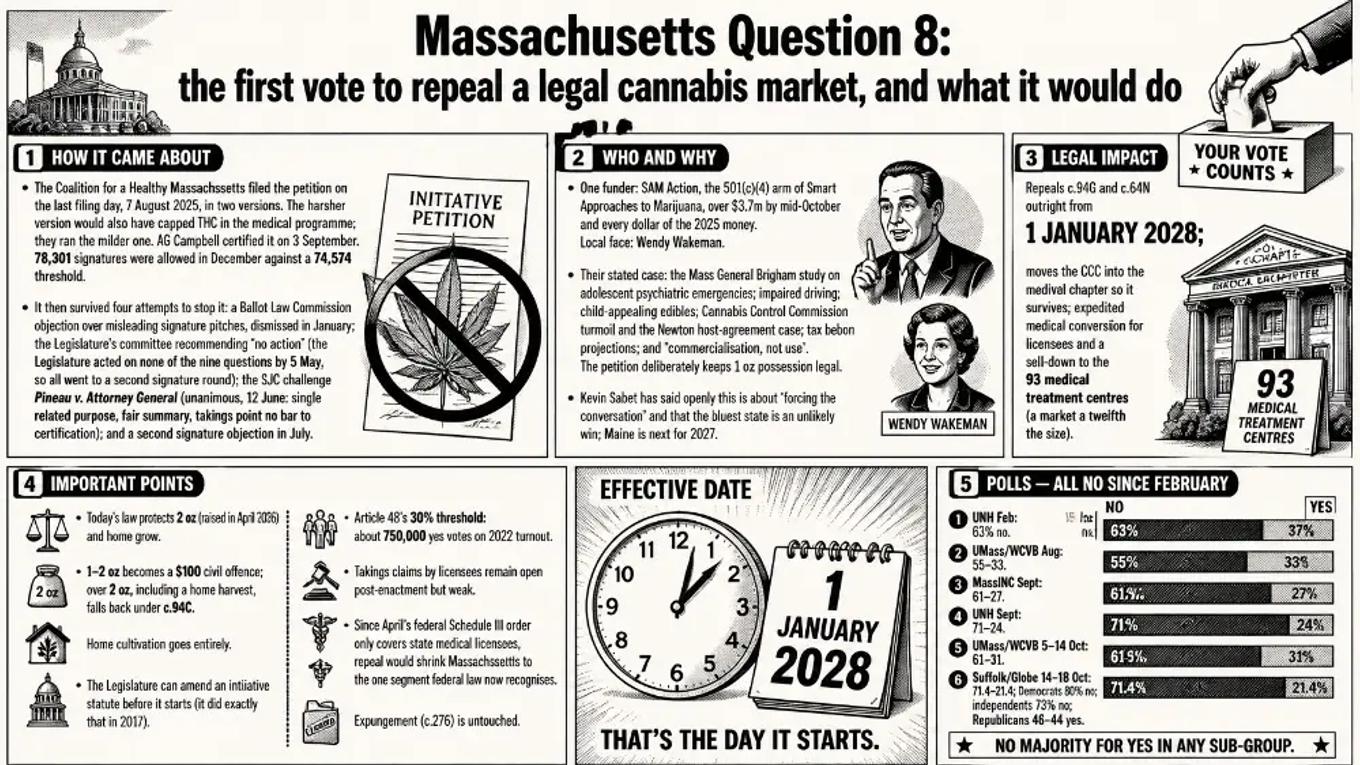
On 3 November, Massachusetts votes on Question 8, "An Act to Restore a Sensible Marijuana Policy". A yes vote repeals the two chapters of state law that license and tax adult-use cannabis, with effect from 1 January 2028. No US state has ever taken a licensed, taxed, voter-approved cannabis market back off the statute book. Massachusetts, which opened New England's first adult-use shops in November 2018, is the first to be asked.
Every poll says it will say no. The Governor, the Mayor of Boston, more than sixty state legislators, the ACLU of Massachusetts and the Legislature's own committee on initiative petitions have all come out against it. The question still matters, for two reasons. The campaign that put it on the ballot has said it is the first of several. And the way the measure is drafted tells lawyers in other states what a repeal would actually do to a mature market.
How it got here
Massachusetts legalised adult use by initiative in November 2016 (Question 4, 54 to 46). The Legislature rewrote parts of that law in 2017 (Chapter 55 of the Acts of 2017), creating the Cannabis Control Commission, and the first shops opened two years later. By 2025 the state had 388 active adult-use retailers, 754 licensees cleared to open, 93 medical treatment centres, and sales of $1.65 billion in the calendar year. Cumulative adult-use sales passed $10 billion this summer. In fiscal 2025 the state took about $280 million in cannabis tax and towns about $50 million.
The repeal petition was filed with Attorney General Andrea Campbell on 7 August 2025, the last day for filing, in two versions. The stricter version would also have capped THC potency in the surviving medical programme; the sponsors advanced the milder one. The Attorney General certified it on 3 September 2025. Under Article 48 of the state constitution, her certification is a narrow check (one related subject, not excluded matter, not substantially the same as a recent question), not a view on the merits.
The timeline from there:
| Date | Step |
|---|---|
| Sep to Dec 2025 | Signature drive. 74,574 needed; 79,420 submitted; 78,301 allowed by the Elections Division on 18 December |
| 2 Jan 2026 | Objection by Thomas Kiley, a drafter of the 2016 law: paid collectors allegedly pitched the petition as being about fentanyl, housing or parks. Dismissed by the Ballot Law Commission on 22 January: the allegation "rings hollow given that absolutely no admissible evidence has been presented or offered" |
| 23 Mar 2026 | Hearing before the Legislature's Special Joint Committee on Initiative Petitions (Initiative Petition 25-10, House 5002) |
| April 2026 | Licensees and social-equity entrepreneurs sue in the Supreme Judicial Court to block the question |
| 4 to 5 May 2026 | Committee majority recommends the General Court "take no action"; the Legislature acts on none of the nine questions before the 6 May deadline, so all go back for a second round of signatures |
| 12 Jun 2026 | Pineau v. Attorney General, SJC-13927: unanimous court (Dewar J) upholds certification and summary. The question stays on the ballot |
| 9 Jul 2026 | Second-round signatures: 12,429 needed; 12,551 certified |
| 21 Jul 2026 | Second objection (Kevin Gilnack, Equitable Opportunities Now, for Stop the Repeal: illegible or fraudulent signatures) largely rejected. Numbered Question 8 |
| 3 Nov 2026 | Vote |
Who proposed it, and why
The petitioner is the Coalition for a Healthy Massachusetts Inc., a Beverly-based group whose chair and spokesperson is Wendy Wakeman, a long-time Republican campaign operative. The "In Favor" argument in the state voter guide is signed by Dr Jeffrey Morgan, a retired oncologist.
The money is from one place. Smart Approaches to Marijuana Action Inc., the 501(c)(4) arm of the Virginia-based group founded in 2013 by Patrick Kennedy, Kevin Sabet and David Frum, supplied every dollar of the campaign's $1.55 million raised in 2025 and had given more than $3.7 million by mid-October 2026, according to Office of Campaign and Political Finance filings. As a (c)(4) it does not disclose its own donors. SAM Action also put $2 million into a Maine repeal petition that missed its 2026 deadline and is aimed at 2027. Sabet has described Massachusetts as about "forcing the conversation" and has acknowledged that the bluest state is an unlikely place to win it.
The reasons the sponsors give, in their own words and from their filings:
- Youth mental health. A 2025 Mass General Brigham study found cannabis use and cannabis-related disorders rose sharply among 12-to-17-year-olds seen in psychiatric emergency care after commercialisation, with no significant change among adults. The voter-guide argument says concentrates and edibles "have been linked to mental health conditions like psychosis, severe anxiety, and schizophrenia" in young adults. (The study's senior author has said publicly he neither supports nor opposes Question 8, and doubts repeal would remove high-THC products from the market.)
- Roads. The argument says marijuana is "the most common drug found in fatal car accidents" in Massachusetts and that over half of users drive within an hour of use; police have no reliable roadside test.
- Children and packaging. Edibles resembling sweets and rising poison-centre calls.
- The regulator. Wakeman calls the Cannabis Control Commission "a disaster", citing years of internal turmoil (the Governor replaced its chair and appointed new commissioners in May 2026) and the Newton host-community-agreement case, where a court ordered the city to repay millions collected from licensees.
- Money. Tax revenue below the projections made in 2016. "Promises made are not promises kept." The argument claims $4.50 of social cost for every $1 of tax.
- Commercialisation, not use. Sabet: the measure "is simply about the commercialization of marijuana" and compares the industry's conduct to tobacco's. The petition deliberately keeps personal possession legal.
What a yes vote would do
The full text is short and blunt. Section 3 repeals Chapter 64N (the cannabis excise). Section 6 repeals Chapter 94G (the whole adult-use law). Section 7 moves the Cannabis Control Commission into the medical chapter, 94I, because repealing 94G would otherwise abolish the regulator. Section 10 sets the effective date, 1 January 2028. Everything else is consequential.
| Today | From 1 Jan 2028 if yes | |
|---|---|---|
| Licensed adult-use sales | Legal; 388 active retailers, 754 licensees cleared | End. Chapters 94G and 64N repealed |
| Possession, 21+ | 2 ounces in public (raised from 1 ounce on 19 April 2026); 10 ounces at home | 1 ounce, of which no more than 5 g concentrate, protected from any penalty or disqualification; may be gifted to another adult. 1 to 2 ounces: civil offence, $100 and forfeiture. Over 2 ounces, including at home: ordinary criminal possession under Chapter 94C, as the 10-ounce home allowance goes with 94G |
| Under 21 | Civil penalty up to 1 ounce | Up to 2 ounces: $100, forfeiture, drug awareness programme and community service; parents notified if under 18; penalty can rise to $1,000, parents jointly liable, if not completed within a year |
| Home cultivation | 6 plants per adult, 12 per household | Gone with 94G. Only medical hardship cultivation under 94I survives (new §1A(h) asks the Commission for guidelines on it) |
| Medical programme | 93 treatment centres; about $88 million of sales so far in 2026 | Continues under 94I; Commission regulates it alone |
| Existing licensees | Licensed under 94G | Expedited route to medical licences; may sell remaining adult-use stock to medical treatment centres (Section 8) |
| Taxes | 10.75% state excise, up to 3% local, plus sales tax; about $330 million a year | Excise repealed; sales tax base disappears with the sales |
| Host community agreements, social equity programme, local-control rules | In 94G | Repealed with the chapter |
| Severability | Section 9: if a part falls, the rest stands |
Note the possession numbers. The sponsors say personal possession stays legal, and up to 1 ounce it does. But today's law protects 2 ounces in public and 10 at home; under Question 8 an adult carrying between 1 and 2 ounces commits a $100 civil offence, and anyone with more than 2 ounces anywhere, including a home-grower's harvest, is back under the ordinary criminal possession statute in Chapter 94C.
The legal questions that would follow
The Legislature could change it before it starts. An initiative statute in Massachusetts is an ordinary statute once passed. The General Court amended the 2016 law root and branch in 2017, delaying the market by six months and rewriting the tax. It could do the same here between November 2026 and January 2028: narrow the repeal, delay it, or repeal the repeal, though the last would be a political act against a fresh popular vote. The Governor, the nine legislators who signed the initiative committee's majority report, and more than sixty others are already on record against the measure. A yes vote would open a State House fight, not close one.
The 30 per cent rule. Under Article 48, an initiative law needs a majority of those voting on the question and yes votes equal to at least 30 per cent of all ballots cast in the election. On 2022 turnout (about 2.5 million), that is roughly 750,000 yes votes.
The takings argument has been heard once and will be heard again. The plaintiffs in Pineau argued that scrapping the social-equity programme (grants, technical assistance, training built on licence fees) was a taking without compensation, and that the Attorney General's summary hid the measure's effects. The court said the petition's parts "all relate to the common purpose of restricting the use of recreational marijuana through a new integrated scheme", that the summary was fair, and that the takings point did not bar certification. That was a pre-election ruling on whether the question could be put. If it passes, licensees who invested on the strength of a state licence would test the same theories as substantive claims. Massachusetts law treats a licence as a privilege rather than property, and the federal illegality of the product has defeated most such claims elsewhere; the 14-month run-off to 2028 is partly there to blunt them.
Federal timing cuts the other way. Since 28 April 2026, cannabis "subject to a state medical marijuana license" is in federal Schedule III and the DEA has started registering state medical operators. Adult-use product stayed in Schedule I. Question 8 would push Massachusetts's market into the one segment federal law now recognises, and shrink it to about a twelfth of its current size in the process. Medical treatment centres that hold or obtain DEA registration would be the only legal sellers left.
Records and convictions are not touched. The 2018 expungement provisions sit in Chapter 276, not 94G, and expunged or sealed records stay that way. Nothing in the petition recriminalises past conduct. What it does is remove the "shall not be arrested, prosecuted, penalized" shield for conduct above 1 ounce, and the new §32L says possession of 2 ounces or less must not be treated as criminal offender record information.
Towns lose their bargain. Host community agreements, the community-impact fees the Commission has spent two years reining in, and the 3 per cent local-option tax all live in 94G or 64N. Municipalities that zoned and planned around cannabis revenue would have to unwind it; the Executive Office of Administration and Finance notes in the voter guide that cannabis tax supports the state budget from which local aid for schools is paid.
Who is against it
The organised opposition is "No on 8: Stop the Repeal", run through the Committee to Protect Cannabis Regulation and chaired by Ryan Dominguez of the Massachusetts Cannabis Coalition. It launched on the State House steps on 25 June, two weeks after the SJC ruling, and had raised about $2.3 million by early October, including six-figure gifts from three industry groups and the Retailers Association of Massachusetts. Its case: tested, age-gated, labelled product versus an untested street market; police time; the ACLU's finding that Black residents were arrested for possession at four times the rate of white residents despite similar use; about 20,000 jobs (industry estimates run to 27,000); and $330 million a year.
Beyond the industry: Governor Maura Healey has urged a no vote; so have Boston Mayor Michelle Wu, Congresswoman Ayanna Pressley, 63 state senators and representatives, the Worcester City Council (6 to 0 on 20 October) and eleven social-justice organisations led by the ACLU of Massachusetts. The majority report of the Legislature's initiative committee, signed by nine members, said the petition "lacks sufficient detail regarding implementation and enforcement mechanisms" and would "remove or substantially alter existing public health and safety safeguards".
The polls
| Poll | Fieldwork | Sample | Yes | No |
|---|---|---|---|---|
| UNH Survey Center, Bay State Poll | February 2026 | — | about 20% | 63% |
| UMass Amherst / WCVB | 5 to 12 August 2026 | 800 registered voters | 33% | 55% |
| CommonWealth Beacon / MassINC Polling Group | September 2026 | likely voters | 27% | 61% |
| UNH Survey Center, Bay State Poll | September 2026 | likely voters | 24% | 71% |
| UMass Amherst / WCVB | 5 to 14 October 2026 | 800+ registered voters | 31% | 61% |
| Suffolk University / Boston Globe | 14 to 18 October 2026 | 500 likely voters, ±4.4 | 21.4% | 71.4% (5.8% undecided) |
Two readings of the same numbers. Opposition dipped from 63 per cent in February to 55 per cent in August, before either side had spent much, and the sponsors took that as room to work with. Since the campaign started it has gone back to the 60s and 70s. Support has never reached a majority in any sub-group: the Suffolk poll has Democrats 80 per cent against, independents 73 per cent against, and Republicans split 46 to 44 in favour. The UMass co-director Raymond La Raja put it this way: "A decade after legalization, Massachusetts voters show little appetite for going back."
The one caution is the ballot itself: nine questions, the longest since 1994, with Question 8 near the bottom. Drop-off and a low-information no-by-default vote are both plausible, and both help the no side.
What to watch on the night and after
- The margin, and whether yes clears 30 per cent of all ballots cast. A yes share under a third of voters on the question would be read nationally as a verdict on repeal as a strategy, not only on this measure.
- SAM Action's next move. Maine is the stated target for 2027; the Massachusetts result will decide whether the money follows.
- If it passes against the odds: the Legislature's response before 1 January 2028, licensee litigation on takings and contract theories, and the Commission's rules for converting adult-use licences to medical ones under Section 8.
- If it fails: whether the Legislature takes up any of the sponsors' points on its own (potency, packaging, the Commission's governance), which is the outcome Sabet has described as the point of the exercise.
This is information, not legal advice. Green Ark will update this article with the result.
Sources
- Secretary of the Commonwealth, Information for Voters 2026, Question 8: Attorney General's summary, fiscal statement, arguments, committee majority report and full text of the proposed law
- Pineau v. Attorney General, SJC-13927 (12 June 2026), reported by Bloomberg Law and the Boston Globe
- M.G.L. c. 94G § 7, current possession and cultivation limits
- High Times analysis, 3 September 2026: filing, signature and funding history, market figures
- CommonWealth Beacon ballot-question guide
- Boston.com explainer, 5 October 2026 (Wakeman and opposition quotes)
- WBUR, 9 October 2026 (Sabet, Dominguez, Mass General Brigham study, campaign finance)
- Cannabis Business Times, 21 October 2026 (endorsements, SAM Action total, the four autumn polls)
- Suffolk University / Boston Globe poll marginals, 20 October 2026
- UMass Amherst / WCVB poll, October 2026
- The Marijuana Herald on the Suffolk poll
Information, not legal advice. Check the primary source before relying on it.


