Organigram Briefing: Canada's largest cannabis producer is buying Aurora with shares Nasdaq says are too cheap
A profile of Organigram: how a Moncton grower became Canada's biggest licensed producer, bought Germany's Sanity Group, and agreed to buy Aurora, and where its opportunities and risks now lie.
By Neil Cartwright · · 11 min read
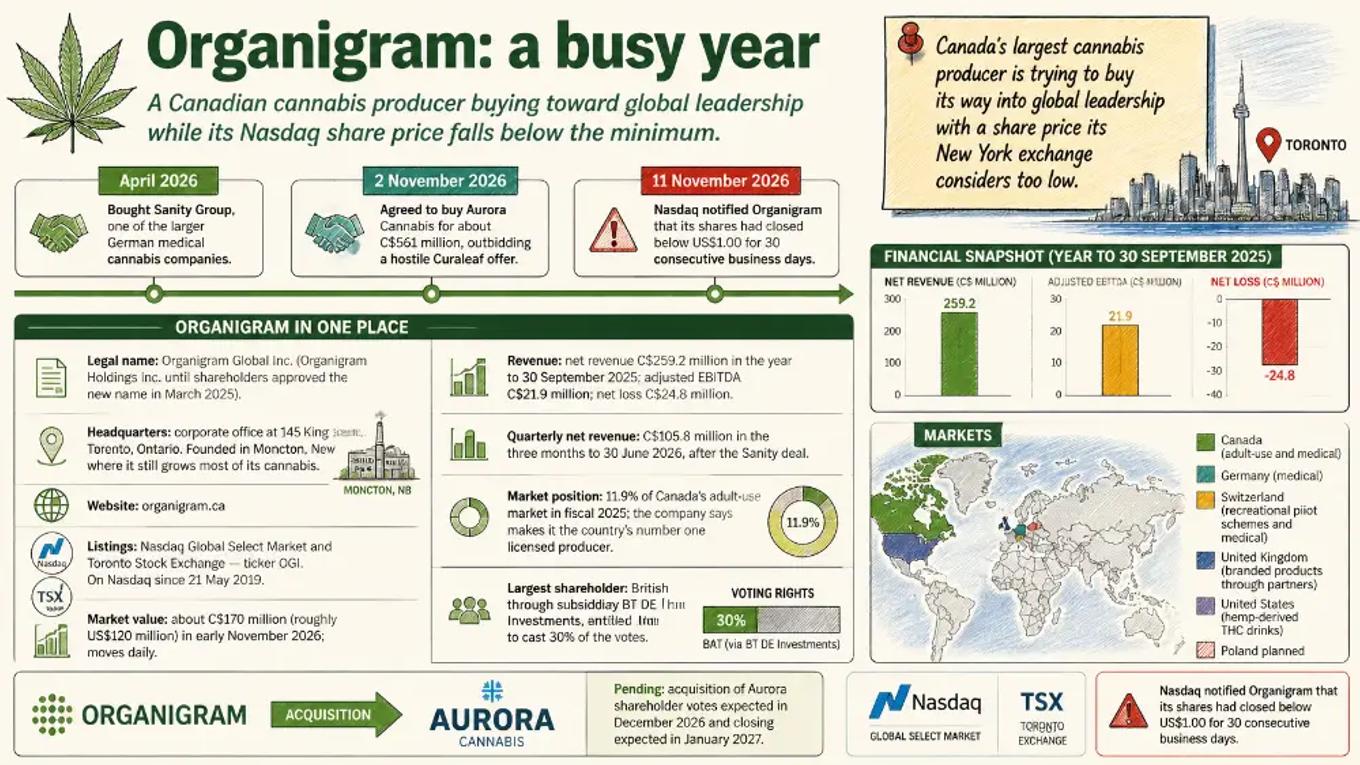
Organigram has had a busy year. In April it bought Sanity Group, one of the larger German medical cannabis companies. On 2 November it agreed to buy Aurora Cannabis for about C$561 million, outbidding a hostile offer from Curaleaf. On 11 November Nasdaq told it that its shares had closed below US$1.00 for 30 business days in a row. A company that calls itself Canada's largest cannabis producer is trying to buy its way into a global leadership position, and is doing it with a share price that its New York exchange considers too low. This profile sets out who Organigram is, how it got here, where it has fallen foul of regulators, and where its opportunities lie.
Organigram in one place
- Legal name: Organigram Global Inc. (Organigram Holdings Inc. until shareholders approved the new name in March 2025).
- Headquarters: corporate office at 145 King Street West, Toronto, Ontario. The company was founded in, and still grows most of its cannabis at, Moncton, New Brunswick.
- Website: organigram.ca
- Listings: Nasdaq Global Select Market and Toronto Stock Exchange, both under the symbol OGI. On Nasdaq since 21 May 2019.
- Market value: about C$170 million (roughly US$120 million) in early November 2026, according to market data services. The figure moves daily.
- Revenue: net revenue of C$259.2 million in the year to 30 September 2025, with an adjusted EBITDA of C$21.9 million and a net loss of C$24.8 million. Quarterly net revenue reached C$105.8 million in the three months to 30 June 2026, after the Sanity deal.
- Market position: 11.9% of Canada's adult-use market in fiscal 2025, which the company says makes it the country's number one licensed producer.
- Largest shareholder: British American Tobacco (BAT), through its subsidiary BT DE Investments, which is entitled to cast 30% of the votes.
- Markets: Canada (adult-use and medical), Germany (medical), Switzerland (recreational pilot schemes and medical), the United Kingdom (branded products through partners) and the United States (hemp-derived THC drinks). Poland is planned.
- Pending: acquisition of Aurora Cannabis, with shareholder votes expected in December 2026 and closing expected in January 2027.
Who they are
Organigram is a Canadian licensed producer: it grows cannabis, makes it into flower, pre-rolls, vapes, edibles, extracts and drinks, and sells it to the provincial wholesalers that supply Canada's legal shops. That business is still the core. What has changed in the past two years is that it has become a holding company with a foreign arm. After the Sanity acquisition, international sales rose to about 35% of revenue, from about 10% before the deal, according to the company's third-quarter figures.
Its distinguishing feature is its shareholder register. BAT, one of the world's largest tobacco companies, put money in when other investors would not, and the two run a joint product development centre. It is an unusual alliance in an industry where tobacco money is often viewed with suspicion, and it is the main reason Organigram can afford to buy companies while its own shares trade below a dollar.
How it formed
Organigram was founded in Moncton in 2013, when Canada moved medical cannabis supply from home growers and designated producers to licensed commercial producers. It received its Health Canada licence in March 2014, one of the early licences issued under the new medical regime, and it built its early reputation on organic certification.
That reputation was tested in late 2016. Testing found low levels of two pesticides not authorised for cannabis, myclobutanil and bifenazate, in its medical products. It recalled five lots in December 2016 and 69 in January 2017, and lost its organic certification for a time. The episode is set out below.
Canada legalised adult-use cannabis on 17 October 2018, and Organigram became one of the producers supplying the new provincial wholesalers. It listed on Nasdaq in May 2019, during the boom in Canadian cannabis shares.
How the growth was achieved
The short answer is cheap products, patient money and acquisitions.
- Value brands. Its best-known brands, SHRED (pre-milled flower) and Big Bag O' Buds (large bags of flower), were built for price-conscious buyers when much of the industry was chasing premium shoppers. In a market where the legal product must undercut the illegal one, that was the right bet.
- Patient money. BAT agreed a C$221 million investment in 2021 and a further C$124.6 million in November 2023, the second paid in three tranches and partly placed into a fund called Jupiter for acquisitions and international investments. The company said BAT provided "significant funding" when capital for the industry was scarce. BAT is putting up another £100 million to fund the cash part of the Aurora deal.
- Acquisitions. Organigram bought an edibles maker in Winnipeg (2021), a Quebec grower (2021), Motif Labs in Ontario (December 2024, which took it to first place by Canadian market share), the drinks company Collective Project (2025) and Sanity Group (2026). Aurora would be the largest yet.
- Product development. It has invested in formulation, including a fast-acting soluble technology for edibles and drinks, and in plant genetics through a stake in Phylos Bioscience.
The weakness behind the growth is profit. Organigram reported an adjusted EBITDA profit for fiscal 2025 but a net loss, and a market data service's analysis in November pointed to negative operating margins and continuing cash burn. Revenue has grown faster than earnings.
Timeline
| Date | Event |
|---|---|
| 2013 | Founded in Moncton, New Brunswick |
| March 2014 | Licensed by Health Canada as a medical cannabis producer |
| Dec 2016 – Jan 2017 | Voluntary recalls of 74 lots of medical cannabis over unauthorised pesticides |
| October 2018 | Canada's adult-use market opens |
| 21 May 2019 | Shares begin trading on Nasdaq as OGI |
| March 2021 | BAT strategic investment (C$221 million) and product development collaboration |
| April 2021 | Buys The Edibles and Infusions Corporation, Winnipeg (C$22 million plus earnout) |
| December 2021 | Buys Laurentian Organic, Lac-Supérieur, Quebec |
| June 2022 | Settles the pesticide recall class action for C$2.31 million |
| November 2023 | BAT follow-on investment of C$124.6 million; Jupiter investment pool created |
| March 2024 | Health Canada rules its Edison Jolts lozenges are edibles, not extracts |
| June 2024 | Minority investment in Sanity Group, Berlin (€14 million) |
| 6 December 2024 | Buys Motif Labs (C$50 million cash); becomes Canada's largest producer by market share |
| March 2025 | Renamed Organigram Global; buys Collective Project and enters the US hemp THC drinks market |
| 14 April 2026 | Completes the Sanity Group acquisition (€107.3 million upfront) |
| August 2026 | Record quarterly net revenue of C$105.8 million |
| 2 November 2026 | Agrees to buy Aurora Cannabis at C$7.80 a share |
| 11 November 2026 | Nasdaq minimum bid price notice |
Products and brands
- Canada, adult-use: SHRED, Big Bag O' Buds, Edison, Monjour (edibles), Tremblant, Trailblazer, BOXHOT, DEBUNK and Collective Project (drinks). The range covers flower, pre-rolls including infused pre-rolls, vapes, hash, gummies and drinks.
- Europe, through Sanity Group: Vayamed and avaay (German medical cannabis; avaay was estimated in 2024 to be the second-largest medical brand in Germany), ZOIKS (medical), Endosane Pharmaceuticals (finished medicines), VAAY (CBD wellbeing) and Grashaus Projects (shops in Swiss recreational pilot schemes, described as Europe's first two legal cannabis specialty stores).
- United States: Collective Project hemp-derived THC drinks, sold in about ten states, and edibles under the happly name.
Where it operates
- Moncton, New Brunswick: the main cultivation and production campus.
- Lac-Supérieur, Quebec: flower cultivation and hash.
- Winnipeg, Manitoba: edibles manufacturing.
- Aylmer, Ontario: extraction, minor cannabinoids and infused pre-rolls.
- London, Ontario: labelling, packaging and national fulfilment.
- Germany: Sanity Group's Berlin head office and a storage site near Frankfurt; in 2024 Sanity worked with more than 2,000 pharmacies.
- Switzerland: pilot-scheme shops, and a first Swiss medical sale in 2026.
Organigram completed an EU-GMP audit in November 2024 and was still awaiting confirmation in October 2025. EU-GMP certification is the standard most European medical importers require. Aurora already operates EU-GMP-certified sites, which is one of the reasons it fits.
Where it fell foul of regulators
We found no record of a fine against Organigram in the public sources we searched. We found these episodes.
- The 2016–17 pesticide recalls. Health Canada's recall notice says five lots tested positive for low levels of unauthorised pesticides in December 2016; 69 more lots followed in January 2017. Organic certification was withdrawn and restored in 2018. Patients brought a class action in Nova Scotia. The courts dismissed the claims that the products had caused illness, finding the health evidence "too generic", and the Supreme Court of Canada declined to hear an appeal in 2020. Organigram settled the remaining refund claims in 2022 for C$2.31 million, having already refunded many customers. The recalls were also one reason Health Canada began random testing of licensed producers' products.
- Edison Jolts. Health Canada decided that Organigram's Jolts lozenges were edibles, which are capped at 10 mg of THC per package, rather than extracts, which may contain more. A Federal Court ruled in 2023 that the department had breached its duty of procedural fairness and sent the decision back. Health Canada reached the same conclusion on redetermination in March 2024, and Organigram stopped making the product in that format.
- A labelling recall in 2024. One lot of Big Bag O' Buds was recalled in Ontario in May 2024 because the label understated the THC content. 138 units had been sold and no complaints were reported.
- The Nasdaq notice. This is not a regulatory breach. It is a listing rule: shares on the Global Select Market must close at or above US$1.00. Organigram has until 10 May 2027 to close at or above that price for ten business days in a row, may then get a further 180 days if it moves to the Nasdaq Capital Market, and faces possible delisting proceedings only after that. Its Toronto listing is unaffected. Companies in this position commonly consolidate their shares; Organigram has not said what it will do.
The Aurora deal
Aurora shareholders can take C$7.80 a share in cash, 5.8626 Organigram shares, or a mix of C$3.75 cash and 3.0431 shares, subject to proration. The price is a 93% premium to Aurora's share price before Curaleaf announced its bid on 11 August, and 21% above the value of Curaleaf's offer as amended in October. Aurora's board recommends the Organigram deal and has rejected Curaleaf's. Aurora shareholders would own about 35% of the combined company and hold 42% of the votes.
- Financing: a £100 million (C$187.5 million) private placement by BAT at C$1.33 a share, cash on hand, and credit facilities from ATB Financial of up to C$210 million.
- Approvals: two-thirds of votes cast by Aurora shareholders, and a majority of Organigram shareholders excluding BAT, plus court and regulatory approvals. BAT has signed an irrevocable agreement to vote in favour.
- Synergies claimed: more than C$50 million a year, from cross-selling, purchasing, distribution and routing international orders to the cheapest site.
- The competing bid: Curaleaf says it has all the competition clearances it needs, including Germany's foreign investment approval, and its offer is open until 4 December 2026.
The deal also explains the share price problem. Organigram will issue up to about 206 million shares to Aurora holders and about 141 million to BAT. That is a lot of new stock for a company whose shares already trade around a dollar.
Where the opportunities are
If we were advising Organigram, these are the openings we would point to, given the laws in force and the bills we can see coming.
- Germany is moving toward extracts and finished products, which suits a pharmaceutical supplier. Since 30 July 2026 German statutory health insurance no longer pays for cannabis flower, only standardised extracts and dronabinol or nabilone medicines. Sanity's Endosane arm and Aurora's EU-GMP extraction capacity are well placed for the reimbursed side of the market, while flower moves fully to private prescriptions.
- Germany's telemedicine bill is a risk and an opening. The pending amendment to the Medical Cannabis Act (Bundestag printed paper 21/3061) would require an in-person consultation before a first prescription and would end postal delivery, reported to apply to flower. It has not passed. If it does, sales would shift from online platforms to bricks-and-mortar pharmacies and doctors, and a company with Sanity's network of pharmacy relationships would be better placed than platform-led competitors.
- Swiss pilots and the next European openings. Sanity already runs pilot-scheme shops in Switzerland. Pilot experience is the credential for further pilots, including any regional pilots Germany may permit, and for whatever permanent framework Switzerland adopts. The company has named Poland, France, Spain, Portugal and the Netherlands as targets.
- Australia and New Zealand, through Aurora. Aurora brings an existing medical business and pharmacy and patient network in Australia, New Zealand and Europe. These are prescription markets where EU-GMP supply and clinical relationships matter more than brand.
- Canadian changes recommended but not yet made. The 2024 expert panel review of the Cannabis Act recommended letting pharmacies distribute cannabis to medical patients and reviewing the excise tax model, possibly with higher duties on higher-THC products. Neither has been adopted. A pharmacy route would suit a producer with a medical range; a potency-based excise would favour lower-THC formats such as drinks and edibles, where Organigram has invested.
- Drinks. Collective Project gives it a Canadian drinks business, a category it has called "on the cusp of growth".
The honest limits: the US hemp THC business is being closed down by law. Synthetic cannabinoids lost federal hemp status on 12 November 2026, and the 0.4 mg per container limit that would end most hemp THC drinks takes effect on 11 December unless Congress acts. Organigram warned in December 2025 that it may have to sell, wind down or restructure that business. US federal rescheduling of marijuana would not by itself let a Nasdaq- and TSX-listed company sell state-legal cannabis in the US. And the company is integrating Sanity while trying to absorb a company whose shareholders would own about 35% of the result, with a net loss and a share price below the exchange minimum.
What to watch
- 4 December 2026: Curaleaf's offer for Aurora expires unless extended.
- December 2026: Organigram and Aurora shareholder meetings; Organigram's fiscal 2026 results.
- 11 December 2026: the second stage of the US hemp redefinition, affecting Collective Project's US sales.
- January 2027: expected closing of the Aurora deal.
- 10 May 2027: Nasdaq deadline to regain the US$1.00 minimum bid price.
- Undated: the German Medical Cannabis Act amendment (21/3061); the EU-GMP decision on Organigram's Canadian sites; any Canadian government response to the Cannabis Act review.
Sources
- Organigram, Organigram Provides NASDAQ Listing Update (13 November 2026)
- Organigram and Aurora, Organigram to Acquire Aurora and Establish a Global Cannabis Leader (3 November 2026)
- Organigram, Record Fourth Quarter and Fiscal 2025 Results (16 December 2025)
- MJBizDaily, European acquisition leads to record revenue for Organigram Global (12 August 2026)
- StratCann, Organigram finalizes acquisition of Germany's Sanity Group (April 2026)
- New Cannabis Ventures, Organigram Global to Buy Sanity Group (18 February 2026)
- Organigram, Organigram Invests in Sanity Group (24 June 2024)
- Organigram, Fourth Quarter and Fiscal 2024 Results (SEC filing)
- MJBizDaily, Organigram buys way into US hemp-derived THC market (2 April 2025)
- Health Canada, Recall of Cannabis for Medical Purposes – Organigram Inc. (2017) and recall RA-75499 (10 May 2024)
- StratCann, Organigram reaches settlement in pesticide-related class action (24 June 2022)
- MJBizDaily, Organigram 'assessing options' after ruling on cannabis edibles (25 March 2024)
- Cannabis Business Times, Curaleaf receives all required competition law clearances (November 2026)
- The Globe and Mail / TipRanks, Organigram Announces Agreement to Acquire Aurora Cannabis (market value)
- Green Ark Cannabis Knowledge Base: Germany (MedCanG, statutory insurance change of 30 July 2026, bill 21/3061); Canada (Cannabis Regulations, 2024 legislative review); US hemp redefinition
This article is information, not legal or investment advice.
Information, not legal advice. Check the primary source before relying on it.


