Washington bans the cannabinoids the plant cannot make. The list of what it can make is nine months late
From 12 November 2026, section 781 of Public Law 119-37 takes any product containing a cannabinoid "not capable of being naturally produced" by the cannabis plant out of the federal definition of hemp; the total-THC test and the 0.4 mg per container cap follow on 11 December. Britain and Switzerland moved on the same molecules this month, by name and by structure; the FDA has still not said which molecules the plant can make.
By Neil Cartwright · · 14 min read
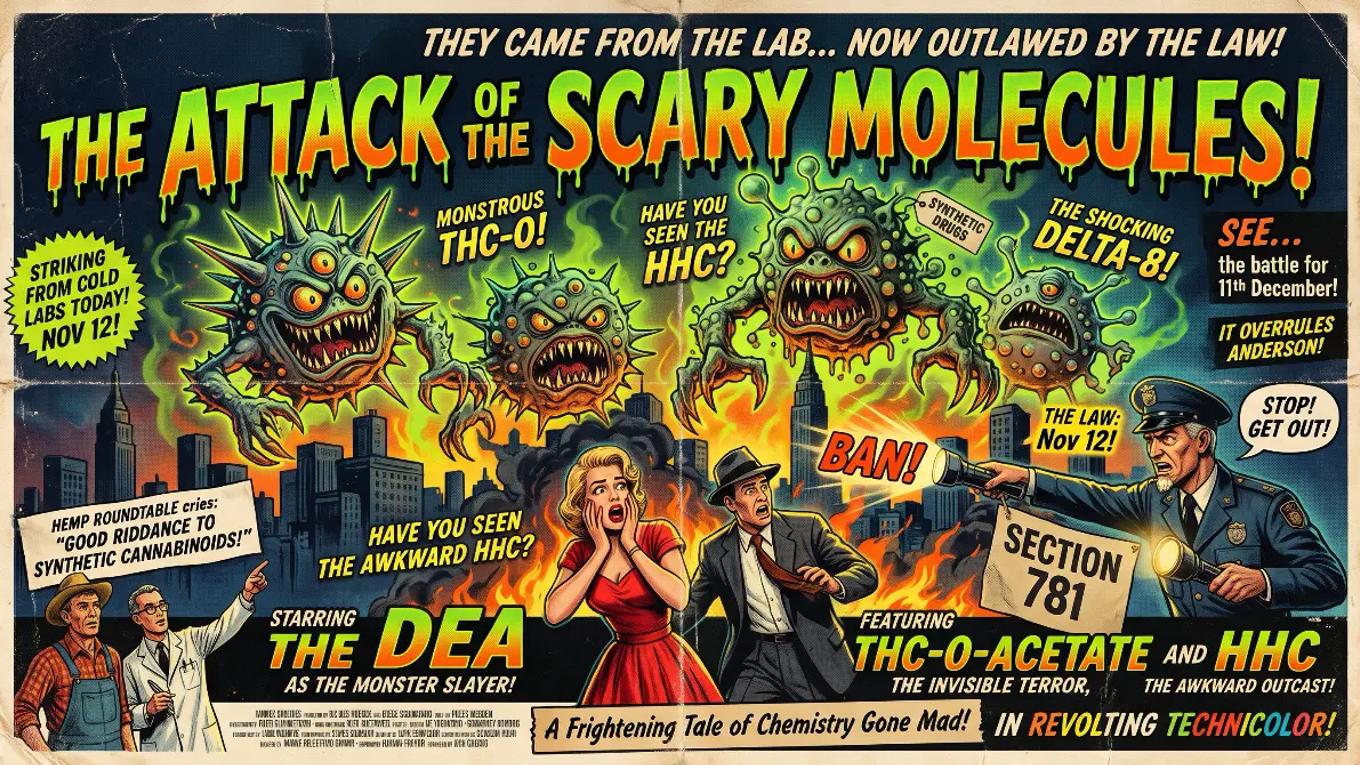
From 12 November 2026, a hemp product that contains a cannabinoid the cannabis plant cannot make is not hemp under federal law. It is marijuana, and the Controlled Substances Act applies to it. That is the first of two dates written into section 781 of Public Law 119-37, the agriculture appropriations law of 12 November 2025; the second, 11 December, brings the total-THC test and the 0.4 milligram per container cap that will reach most of the intoxicating hemp market. The same law told the Food and Drug Administration to publish, within 90 days, a list of the cannabinoids the plant can make. That list was due on 10 February. It has not appeared. The ban on what the plant cannot make is therefore in force without an official statement of what the plant can.
Britain and Switzerland moved on the same molecules in the same fortnight. Switzerland's ordinance took effect on 10 November; the UK's draft Order is before Parliament. The three countries have chosen three different ways to write the same ban, and a company selling across all three now has three definitions to reconcile.
What changed on 12 November, in one place
- The law: section 781 of Public Law 119-37 rewrote the definition of hemp in 7 U.S.C. § 1639o with effect 365 days after enactment, which is today. Section 2019 of Public Law 119-103, the continuing resolution of 2 September 2026, provides that until 11 December the amendments "shall only apply with respect to" two of the new exclusions.
- What is excluded today: intermediate and final hemp-derived cannabinoid products containing "cannabinoids that are not capable of being naturally produced by a Cannabis sativa L. plant" (paragraphs (1)(C)(ii)(I) and (1)(C)(iv)(I)).
- What is not excluded until 11 December: cannabinoids the plant can make but that "were synthesized or manufactured outside the plant"; intermediate products over 0.3% combined total THC and similar-effect cannabinoids; final products over 0.4 mg combined total THC per container; viable seeds from plants over 0.3% total THC; and the switch from delta-9 THC to total THC including THCA for the plant itself.
- Consequence: a product outside the definition is not protected by the 2018 Farm Bill's removal of hemp from the Controlled Substances Act. It falls back into the definition of marijuana, Schedule I, and its tetrahydrocannabinols are controlled.
- Who decides what the plant can make: nobody, yet. The FDA list required by section 781(3), "as reflected in peer reviewed literature", is nine months overdue. The Congressional Research Service confirmed on 28 September that none of the four required publications had appeared, and Marijuana Moment reported the same on 12 November.
- Elsewhere today: Missouri's Intoxicating Cannabinoid Control Act took effect; Illinois's equivalent is on hold in litigation; Philadelphia's ordinance on "intoxicating substances", which bans the sale of anything federal law excludes from hemp, also starts today (as reported by one outlet).
What the statute says
The new paragraph (1) of section 297A of the Agricultural Marketing Act of 1946 has three parts. Subparagraph (A) keeps hemp as "the plant Cannabis sativa L. and any part of that plant, including the seeds thereof and all derivatives, extracts, cannabinoids, isomers, acids, salts, and salts of isomers", but moves the test to "a total tetrahydrocannabinols concentration (including tetrahydrocannabinolic acid) of not more than 0.3 percent on a dry weight basis". Subparagraph (B) brings in industrial hemp (fibre, grain, microgreens, research, seed for those uses), which is then spared the product rules. Subparagraph (C) lists the exclusions, and it is the structure of (C) that makes today's date narrower than the headlines.
Exclusions (ii) and (iv) each have three limbs. Limb (I) is cannabinoids "not capable of being naturally produced" by the plant. Limb (II) is cannabinoids that "are capable of being naturally produced" but "were synthesized or manufactured outside the plant". Limb (III) is the THC arithmetic: 0.3% for intermediates, 0.4 mg per container for final products, counting "any other cannabinoids that have similar effects (or are marketed to have similar effects) on humans or animals as a tetrahydrocannabinol (as determined by the Secretary of Health and Human Services)". Section 2019 of the continuing resolution switched on limb (I) alone for the first month. Congress, in other words, has banned the molecules that are foreign to the plant, and given itself until 11 December to decide what to do about the ones that are native to it but made in a reactor.
"Container" has its own definition: "the innermost wrapping, packaging, or vessel in direct contact with a final hemp-derived cannabinoid product", with bulk shipping containers and non-essential outer wrapping excluded. A bottle of thirty gummies is one container. Drugs approved under section 505 of the Food, Drug, and Cosmetic Act are outside the whole scheme.
Which molecules went today: readings in a range
The statute names no molecule. It sorts cannabinoids by whether the plant can make them, a question of botany and analytical chemistry that the FDA was asked to settle in writing and has not. Until it does, three readings are in circulation.
- Clearly out: THC-O-acetate and the other acetylated and esterified compounds, which do not occur in the plant and require a reagent to make. The DEA said as much in a letter of February 2023, on the ground that THC-O "can only be obtained synthetically"; the Fourth Circuit took the other view in Anderson v. Diamondback Investment Group (2024), holding that hemp-derived THC-O fitted the 2018 definition. Section 781 overrules Anderson for these compounds from today. Cannabis News lists THC-O as the clearest casualty of the date.
- Arguably in, for a month: delta-8 THC, delta-10 THC and THCP occur in the plant in small amounts and are made commercially by converting CBD. On the words of the statute they are limb (II) compounds, "capable of being naturally produced" but "synthesized or manufactured outside the plant", and limb (II) does not apply until 11 December. Marijuana Moment reads the first phase the same way: it "does not cover converting naturally occurring cannabinoids, such as CBD, into delta-9 THC, delta-8 THC, or related isomers".
- HHC, the awkward case: hexahydrocannabinol is made by hydrogenating THC or CBD. Marijuana Moment points to a 2023 paper in Current Neuropharmacology and a 2024 paper in Scientific Reports reporting trace HHC in the plant, and notes that some in the industry conclude HHC survives the first phase on that basis. The reading is academic for a US seller, because the DEA has already listed HHC in Schedule I by its own rule (below). It matters for the question of what the plant can make, which is now a legal question with no official answer.
The practical reading, then, is that the 12 November date removes a small and already disreputable corner of the market. The American Trade Association for Cannabis and Hemp, which speaks for state-licensed marijuana businesses, said "few products on the market" are affected by the first phase. Jonathan Miller of the U.S. Hemp Roundtable said his group "has long called for the banning of synthetic cannabinoids". Jim Higdon of Cornbread Hemp said "good riddance to synthetic cannabinoids". The industry's fight is about 11 December, not today.
What the regulator has done with it
Nothing, on the day. No federal agency published guidance for 12 November, and no enforcement action under the new definition has been reported. The record of what the agencies had done before today is more telling.
- DEA, 4 May 2026: a final rule (91 Fed. Reg. 23913, docket DEA-1632) gave HHC its own Schedule I listing and drug code 7220, effective the same day, prompted by a letter of 9 June 2025 from the UN Secretariat recording that HHC had been added to Schedule II of the 1971 Convention. The rule states that "tetrahydrocannabinols produced through chemical conversion, even when hemp derived[,] are considered synthetically produced for purposes of the CSA". Two hemp companies petitioned for review in June (Bluestar Operations in the Fourth Circuit, IHC Investments in the Ninth); the Fourth Circuit refused a stay; DEA's brief of 12 August argued that Bluestar lacked standing and that HHC would be Schedule I even without the rule. No court has vacated it. The DEA's position on converted cannabinoids was therefore binding before section 781 arrived, and is wider than section 781's first phase.
- FDA: required by section 781(3) to publish four things within 90 days of 12 November 2025: the cannabinoids the plant can make, the THC-class cannabinoids that occur naturally, the other cannabinoids with THC-like effects, and detail on "container". None published. ATACH said the list, once issued, "will settle the edges of this category". Until then the edges are settled by litigation.
- USDA: has not amended the hemp production rule at 7 CFR Part 990 for the total-THC definition, according to the Congressional Research Service.
- State attorneys general: several wrote to Congress opposing any further delay, saying states had already aligned their laws with the new definition (CRS, 28 September).
- Private enforcement: Ian Stewart of Wilson Elser wrote in December 2025 that "the biggest immediate enforcer may come in the form of a civil lawsuit rather than a badge": product liability, consumer class actions for mislabelling, unfair-competition claims, and insurers repricing or excluding the products. That is the reading the day's silence from the agencies supports.
11 December and what Congress is doing about it
The second phase is the one with the money in it. From 11 December a gummy with 5 mg of THC, a 10 mg drink and a jar of THCA flower are all outside the hemp definition, unless Congress acts first. The CRS lists the bills; Marijuana Moment names the sponsors of the newest.
| Approach | Bills | What they do |
|---|---|---|
| Delay | H.R. 7024, H.R. 7010, S. 3686 | Push the new definition back by two years |
| Repeal | H.R. 6209 | Undo section 781 |
| Raise the limit | S. 2112; H.R. 9830 | 1% delta-9 THC; 1% total THC with an FDA framework |
| Defer to states | S. 4315 | Federal law follows each state's definition of hemp |
| Regulate instead | H.R. 7212, H.R. 10079, S. 3474; and 2026 proposals from Reps Barr, Comer, Van Duyne and Landsman, and Griffith and Veasey | Age 21, testing, packaging, labelling and tax rules for hemp cannabinoid products; Van Duyne and Landsman would treat THC drinks like alcohol |
| Expected | Sens Sheehy and Klobuchar | A regulation bill, which advocates hope to attach to a must-pass vehicle before 11 December |
The House-passed FY2027 agriculture appropriations bill, H.R. 8646, carries no delay. The House farm bill, H.R. 7567, passed on 30 April and keeps the new definition; the Senate committee's version failed to advance in August. Marijuana Moment reports that the administration is working with lawmakers on a regulatory alternative, and that it is "unclear" whether anything will be attached in time. Four weeks is not long in a town where a 90-day deadline has now run for nine months.
Three countries, three ways to ban a molecule
The United States is not alone. The UN added HHC to Schedule II of the 1971 Convention in 2025, and three governments have since written semi-synthetic cannabinoids into their drug law. They did it by three different methods, and the method decides who is caught.
| United States | United Kingdom | Switzerland | |
|---|---|---|---|
| Instrument | Section 781, Public Law 119-37; section 2019, Public Law 119-103 | Draft Misuse of Drugs Act 1971 (Amendment) Order 2026, before Parliament | Ordinance of 13 October 2026, Fedlex eli/oc/2026/613 |
| Method | By nature: cannabinoids "not capable of being naturally produced" by the plant (today), then those "synthesized or manufactured outside the plant" (11 December) | By name: twelve compounds (HHC, HHCP, HHCH, their hydroxylated forms, HHC-C8, HHC-C9, 11-OH-THC, THCA-A and B) to Class B, plus a widened definition of "cannabinol derivatives" | By structure: a pyrazole group added as entry 321 to a list that now runs to 323 entries; entries 265 and 303 on cannabinoids amended |
| In force | 12 November 2026, then 11 December 2026 | 28 days after the Order is made; not yet made | 10 November 2026, 10:00 |
| Carve-outs | Industrial hemp; approved drugs; the plant itself until 11 December | The compounds when contained in cannabis or cannabis resin; the 1 mg "exempt product" limit untouched | Industrial and scientific use; hemp under 1% THC stays outside the Narcotics Act |
| Who says what is caught | FDA list (unpublished); DEA's reading; the courts | The Order's schedule; the Home Office has announced no guidance | The Fedlex list, structure by structure |
| Impact statement | None in the appropriations law | None: "no significant impact" foreseen | Communiqué only |
The British method is the easiest to apply and the easiest to evade: a chemist reads the twelve names and makes a thirteenth. The Swiss method, a structural group, is harder to evade and harder for a retailer to read; checking a certificate of analysis against a pyrazole definition is a job for a chemist. The American method is the only one that turns on a fact about the plant rather than a fact about the molecule, which is elegant until the agency asked to state the fact does not. The numbers also sit side by side: Britain lets a CBD product carry 1 mg of a controlled cannabinoid per container; from 11 December the United States allows 0.4 mg of total THC per container. Two of the largest CBD markets will have, between them, the two tightest per-container limits.
What it means for businesses
- Makers of hemp cannabinoid products: anything containing THC-O or another compound with no natural occurrence is now a controlled substance in federal law, wherever the starting material came from. Delta-8, delta-10 and THCP products made by conversion have until 11 December on the hemp definition, and no time at all on the DEA's May rule, which treats converted cannabinoids as synthetic already. The two authorities disagree about the date; neither is on the seller's side.
- CBD brands: today changes nothing for a product made of plant-derived CBD. 11 December does: 0.4 mg of total THC per container will catch most full-spectrum products at their present strength, and the "similar effects" limb puts CBN and CBG products in the hands of the Secretary of Health and Human Services. Reformulation to isolate or broad-spectrum, and a change of container size, are the two levers.
- Retailers and smoke shops: the enforcement risk today is local and civil, not federal. Philadelphia's ordinance bans the sale of anything federal law excludes from hemp, fines up to $2,000 a day and sets a permit regime ($300, fixed storefronts, 500 feet from schools and parks, about 180 corridors off limits) that waits on city regulations; sponsor Majority Leader Katherine Gilmore Richardson called the products "illegal, unregulated, and harmful". Missouri now treats higher-potency hemp cannabinoids as marijuana. A shop's exposure is whichever of federal, state and city law reads most widely.
- State-licensed cannabis operators: the first phase removes competitors that were never in the licensed market. The second phase, if it holds, removes the hemp drink and gummy aisle in states that have not already done so. ATACH's reading is that today changes little; its members' interest is in 11 December holding.
- Laboratories: a certificate of analysis that reports delta-9 THC alone is obsolete on 11 December; one that cannot distinguish a naturally occurring cannabinoid from a converted one cannot answer the limb (II) question at all. Expect buyers to ask for synthesis-route documentation as well as potency.
- Banks, payment processors and insurers: the question since 12 November 2025 has been when, not whether, to re-paper hemp clients. Wilson Elser's reading, that coverage will "tighten, get repriced, or exclude specified products altogether", is the one to plan on.
- Exporters and UK and EU importers: a product compliant in the US after 11 December (0.4 mg total THC per container, natural cannabinoids only) is close to compliant with the UK's 1 mg exempt-product rule, but not the same: Britain counts THCA under the draft Order; the US counts THCA already. Switzerland's 1% hemp threshold is the most generous of the three for the plant and the strictest for the molecule.
What to do
- If you advise a manufacturer (today): pull any SKU containing a cannabinoid with no reported natural occurrence (THC-O and its relatives) from interstate commerce; document the synthesis route of every other cannabinoid in the range, because limb (II) is four weeks away and the DEA's rule is already here.
- If you advise a CBD brand (by 11 December): calculate total THC per container, not per serving, on every product; decide between reformulation and a smaller container; read the "similar effects" limb against any CBN or CBG claim on the label.
- If you advise a retailer (this week): check the city and state before the federal law. Philadelphia and Missouri bite today; Illinois is stayed; the federal agencies have said nothing.
- If you advise a licensed cannabis operator (by 11 December): watch the must-pass vehicle. A regulation bill attached before 11 December reopens the hemp drink market; nothing attached closes it.
- If you advise a UK or Swiss business (now): the UK Order is not made; the Swiss list is in force. Check certificates of analysis for HHC-type compounds and isolated THCA against the UK's twelve names and the Swiss structural entries, and keep the 1 mg and 0.4 mg figures apart in any product sold into both markets.
- Everyone (watch): the FDA lists, whenever they come; the Fourth and Ninth Circuit HHC petitions; the Sheehy-Klobuchar bill; and whether 11 December arrives with a delay, a framework, or neither.
Sources
- Public Law 119-37, Division B, section 781 (enacted 12 November 2025); 7 U.S.C. § 1639o as amended
- Public Law 119-103, Continuing Appropriations and Extensions Act, 2027, section 2019 (enacted 2 September 2026)
- Congressional Research Service, IF13136, Changes to the Statutory Definition of Hemp (updated 28 September 2026)
- DEA, Specific Listing for Hexahydrocannabinol, 91 Fed. Reg. 23913 (4 May 2026)
- Marijuana Moment, First phase of renewed federal hemp product ban takes effect (12 November 2026)
- Cannabis News, Federal synthetic hemp cannabinoid ban and the Philadelphia ordinance (12 November 2026; the ordinance's penalty and permit detail is from this outlet)
- Philadelphia Inquirer, City Council passes kratom and hemp bills (5 June 2026)
- Ian A. Stewart, Wilson Elser, How enforceable is the new federal ban on intoxicating hemp products? (9 December 2025)
- Green Ark, UK move to ban HHC, THCA and 10 other molecules as Class B drugs (10 November 2026)
- Green Ark, Switzerland bans synthetic cannabinoids from 10 November 2026 (11 November 2026)
- Green Ark, The hemp ban, explained (3 November 2026)
This article is information, not legal advice.
Information, not legal advice. Check the primary source before relying on it.


