The hemp ban, explained: what the 0.4 milligram rule catches, why CBD is in it, and what it has to do with rescheduling (nothing)
From 11 December any hemp product with more than 0.4 mg of total THC in the container stops being hemp and becomes Schedule I marijuana. That is nearly every full-spectrum CBD oil and gummy sold outside a dispensary. It is not rescheduling, it is a definition in the farm code, and the agency that was told to explain it has not.
By Neil Cartwright · · 9 min read
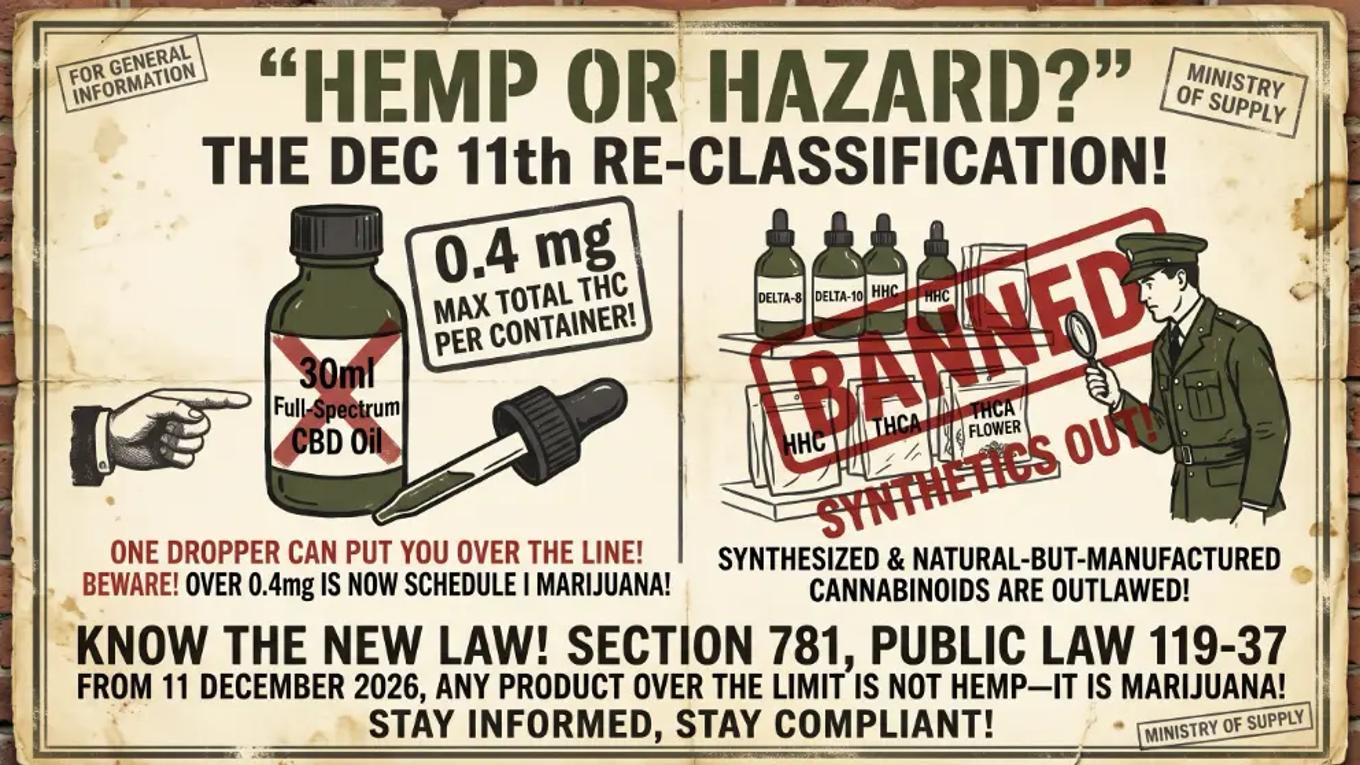
On 11 December 2026 the United States changes the legal definition of hemp, and with it the status of most of the CBD oils, gummies and drinks sold outside licensed dispensaries. The product does not have to contain much THC to be caught. It has to contain more than 0.4 milligrams in the whole container, which a 30 ml bottle of full-spectrum CBD oil has in a single dropper. From that date, anything over the line is not hemp. It is marijuana, in Schedule I of the Controlled Substances Act, where it sat before 2018.
The confusion in the coverage comes from four separate things being discussed as one. Here they are, separated.
What the law actually does
Section 781 of Public Law 119-37, the agriculture appropriations act passed last November to end the government shutdown, rewrites 7 U.S.C. § 1639o, the definition of hemp from the 2018 farm bill. The old test was delta-9 THC at not more than 0.3 per cent of dry weight. The new test is in three parts.
First, total THC replaces delta-9 THC, and the total includes THCA, the acid the plant makes before heat turns it into THC. That ends "THCA flower", which was marijuana sold as hemp on a technicality. Second, any product containing a cannabinoid "not capable of being naturally produced" by the plant, or one that is natural but was "synthesized or manufactured outside the plant", is excluded. That is delta-8, delta-10, HHC and the rest of the gas-station shelf. Third, a finished product is hemp only if it contains no more than 0.4 milligrams of total THC "and other cannabinoids with similar effects" per container, the container being "the innermost packaging in direct contact with" the product. Intermediate products get 0.3 per cent instead.
Congress delayed most of this once already. The statute said 12 November; Public Law 119-103, passed in August, moved the total-THC test and the 0.4 mg cap to 11 December, and left the synthetic-cannabinoid exclusion on the original date. So there are two dates, and the one next week is the easy one.
The Act also told the FDA to publish, within 90 days, four lists: the cannabinoids the plant can make, the THC-class cannabinoids, the cannabinoids with "similar effects", and guidance on what counts as a container. The 90 days ended in February. As of the Congressional Research Service's last update in August, and as of this week, none has been published. The industry is being asked to comply with a definition whose terms the regulator has not yet defined.
Does it catch CBD?
CBD is not named anywhere in the section, and nothing in it schedules CBD. What the law controls is THC, and it controls it by the container rather than by the dose. A product is caught if the sum of THC across everything in the packet exceeds 0.4 milligrams, whatever it is sold as.
So the answer depends on which CBD. Pure CBD isolate, and "broad-spectrum" products with the THC removed, stay hemp if the maker can show the total under the cap, which is a laboratory question, not a legal one. "Full-spectrum" products, which keep the plant's trace THC on purpose because their makers and many of their users believe it works better that way, are caught almost without exception. The chief executive of Charlotte's Web, the company that built the CBD market on an epilepsy story, told CNN it is "virtually impossible" to make a full-spectrum product under 0.4 milligrams a bottle, and called such products "collateral damage". A lawyer at Vicente, Shawn Hauser, put the arithmetic plainly: a standard 30 ml tincture or a multipack of gummies "easily contains several milligrams of total THC across the whole package".
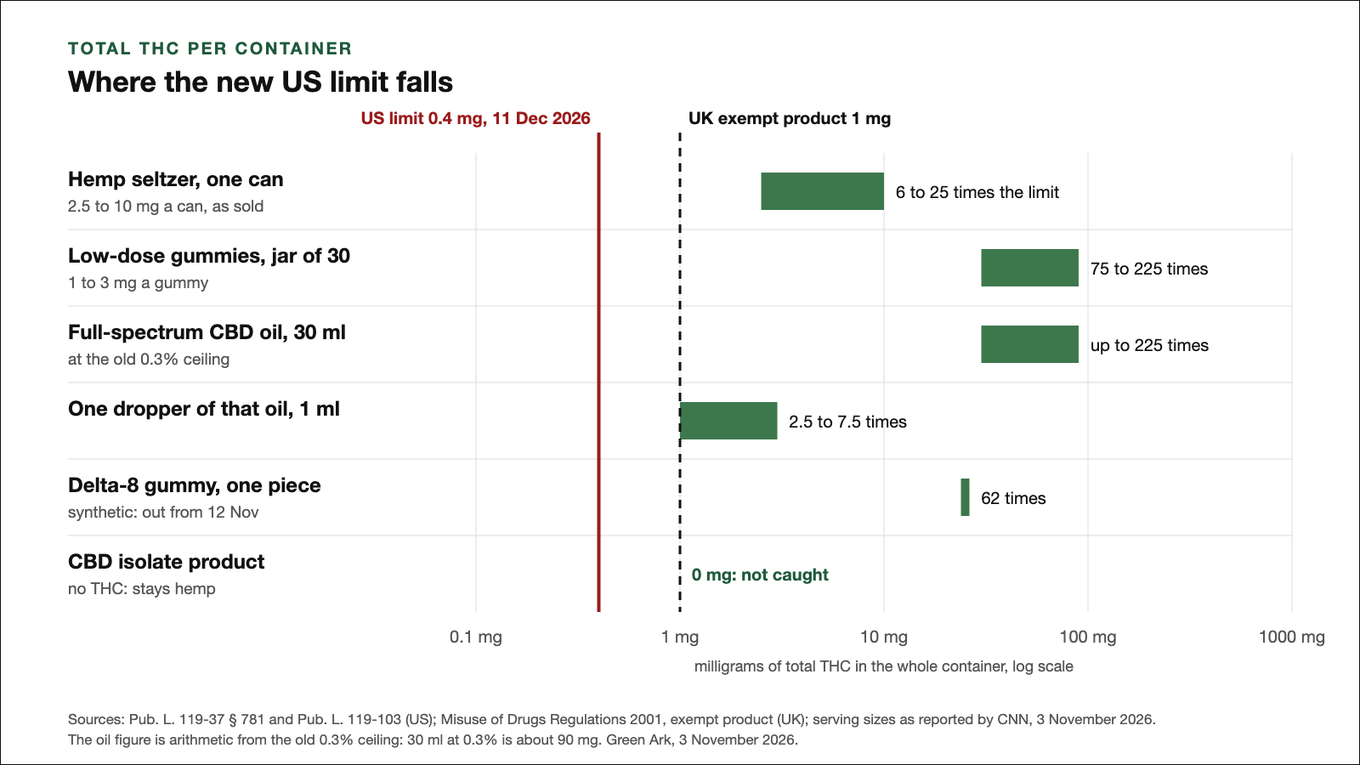
The arithmetic from the statute itself is starker. A 30 ml oil at the old ceiling of 0.3 per cent THC holds about 90 milligrams, 225 times the new limit. A gummy with 1 to 3 milligrams a serving, the "non-intoxicating" low-dose kind, is over the line on its own; a jar of thirty is over it thirty times. A 5 milligram hemp seltzer is over it twelve times a can.
Who was selling them
Everyone except the dispensaries. The 2018 farm bill took hemp out of the Controlled Substances Act and left the FDA to regulate the products; the FDA's position since 2018 has been that CBD cannot lawfully be a food or dietary supplement because it is the active ingredient of an approved drug, Epidiolex, and in January 2023 asked Congress for a new pathway, which Congress has not provided. The result was a market with no federal product rules at all. CBD went into chemists' topicals, grocery gummies, pet treats, pharmacy shelves and, this year, a new Medicare programme for seniors. Hemp-derived THC went further: 2.5, 5 and 10 milligram seltzers in liquor stores and on tap in bars in Minnesota, delta-8 vapes and 25 milligram gummies in smoke shops and petrol stations, and a great deal of everything online, shipped across state lines because, as hemp, it could be. Total Wine disclosed $510,000 of lobbying on THC beverages this quarter. The National Beer Wholesalers Association and the National Restaurant Association disclosed their own.
The licensed cannabis industry, which pays state excise, tests every batch and cannot ship anything anywhere, has watched this for seven years. Some of its trade groups support the ban. Ohio, which pushed hemp THC out of unlicensed shops this year, saw licensed cannabis sales rise 25 per cent.
Why 0.4 milligrams, and why now
The provision's chief sponsor is Senator Mitch McConnell of Kentucky, who also wrote the 2018 hemp provisions and has said since that the market they produced was not the one he intended. The stated purpose is the intoxicating products: delta-8, high-dose edibles in snack-brand packaging, poison-centre calls about children. The number 0.4 is not explained anywhere in the record; it is low enough to catch everything that is not isolate, which may be the point. The provision's loudest critic is the state's other senator. Rand Paul called it "the most thoughtless, ignorant proposal to an industry that I've seen in a long, long time", and has a bill with Amy Klobuchar that would let states opt out. Bills to raise the limit to 1 per cent THC, to delay for two years, to repeal the section, and to hand the products to the FDA with a real framework all exist. None has passed, and the attorneys general of several states have written to Congress asking that the date not move again, because their states have already aligned their own laws to it.
That is the thing to understand about the "backwards step". The United States is not tightening a regulated CBD market. It never had one. It is closing an unregulated one and, so far, offering nothing in its place.
Is this rescheduling?
No. Rescheduling is the Attorney General moving a substance between the schedules of the Controlled Substances Act, under 21 U.S.C. § 811, at the President's direction, through the DEA. The hemp change is Congress editing a definition in the agriculture code, under 7 U.S.C. § 1639o, by appropriations rider. Different statute, different branch, different politics: the first is the White House's project, the second is Senator McConnell's.
They touch at one point, and it runs the wrong way for CBD. The April order put cannabis "subject to a state medical marijuana license" in Schedule III. A hemp gummy that fails the 0.4 milligram test is not subject to any such licence. It becomes marijuana, and marijuana without a state medical licence is still Schedule I. So the products rescheduling helps are the ones sold by licensed medical operators, and the products the hemp law catches are precisely the ones that never had a licence. CBD did not get caught up in rescheduling. It got caught in a different law entirely, and rescheduling cannot rescue it.
How Britain and the EU do it
Differently, and for once not obviously worse.
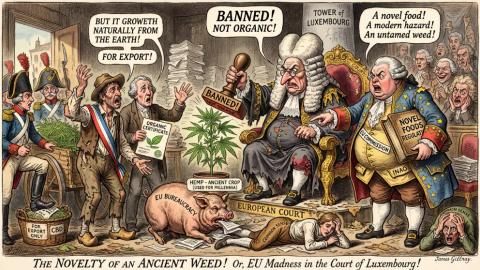
In the United Kingdom CBD in food is a novel food: it needs pre-market authorisation from the Food Standards Agency on safety evidence before it can be sold, and the controlled-drug side is handled by the Home Office, whose exempt-product rule allows no more than 1 milligram of a controlled cannabinoid per container. The FSA's provisional acceptable daily intake is 10 milligrams of CBD a day. The process has not been quick: applications opened in 2021, about 3,000 products linked to just three of those applications have been sitting on a public list on sufferance, and the first three authorisations, all for isolate of 98 per cent purity or more, were recommended to ministers in September 2026. In the European Union CBD foods need the same authorisation under the novel food regulation, EFSA paused its assessments in 2022 for want of safety data, and in February 2026 set a provisional safe level of 0.0275 milligrams per kilogram of body weight a day, about 2 milligrams for a 70 kg adult. THC in hemp foods is governed by maximum levels in the contaminants regulation. The Court of Justice ruled in 2020 that CBD is not a narcotic.
The comparison, then. Britain's THC ceiling is 1 milligram a container; America's from 11 December is 0.4. The numbers are closer than the rhetoric. What differs is what sits beside them. Britain pairs its ceiling with a food-safety route to market, slow and expensive but real, and treats the controlled-drug question as a question of purity. America pairs its ceiling with Schedule I and no route to market, because the agency that would run one has spent seven years saying it cannot. A UK full-spectrum oil over 1 milligram is unlawful in the same way an American one over 0.4 milligrams will be; the UK isolate under the line can be authorised as food; the American isolate under the line remains, in the FDA's view, an unlawful food ingredient that nobody prosecutes.
What is actually going to happen on 11 December
Nobody knows, and the honest answers from both sides say so. The DEA has given no indication it intends to raid CBD shelves; it has its hands full registering medical dispensaries. The FDA, which has not published the lists, is unlikely to begin enforcing a definition it has not finished. The practical enforcement will be private: UPS requires THC testing documentation on hemp shipments from 11 December, payment processors have begun telling hemp merchants which products they will no longer process, according to industry advisers, and insurers and landlords follow. The products most exposed are the ones that cross state lines by post, because interstate shipment of a Schedule I substance is the one thing the federal government reliably prosecutes. In states with their own hemp programmes, or with licensed dispensaries that can take the products in, the shelf may look much the same in January.
What to watch: the midterm result today, which decides whether a lame-duck Congress takes up Paul-Klobuchar or a 1 per cent bill before 11 December; the FDA's four lists, if they ever appear, because the "similar effects" list decides whether CBN and CBG products are caught; and the first indictment, which will tell everyone what the government thinks the law means.
This is information, not legal advice.
Sources
- Congressional Research Service, "Changes to the Statutory Definition of Hemp and Implications for Agricultural Policy", IF13136, updated 17 August 2026
- Public Law 119-37, Division B, § 781; Public Law 119-103 (the December delay)
- CNN, 3 November 2026 (Charlotte's Web, Vicente, Rand Paul and cbdMD quotes)
- Food Standards Agency, CBD novel food applications: recommendations to ministers on first authorisations, September 2026 board paper
- MJBizDaily on Ohio's licensed sales after its hemp ban
- Green Ark, THC caps for hemp drinks in every US state (the state-by-state sheet and the federal timeline)
Information, not legal advice. Check the primary source before relying on it.