German cannabis evaluation to test alcohol and nicotine effects, final report due April 2028
Two researchers on Germany's official evaluation say early figures show no rise in alcohol use after legalisation, with nicotine analysis still to come. Set against US experience, the commentary shows how much of the evidence is still to be gathered.
By Neil Cartwright · · 4 min read
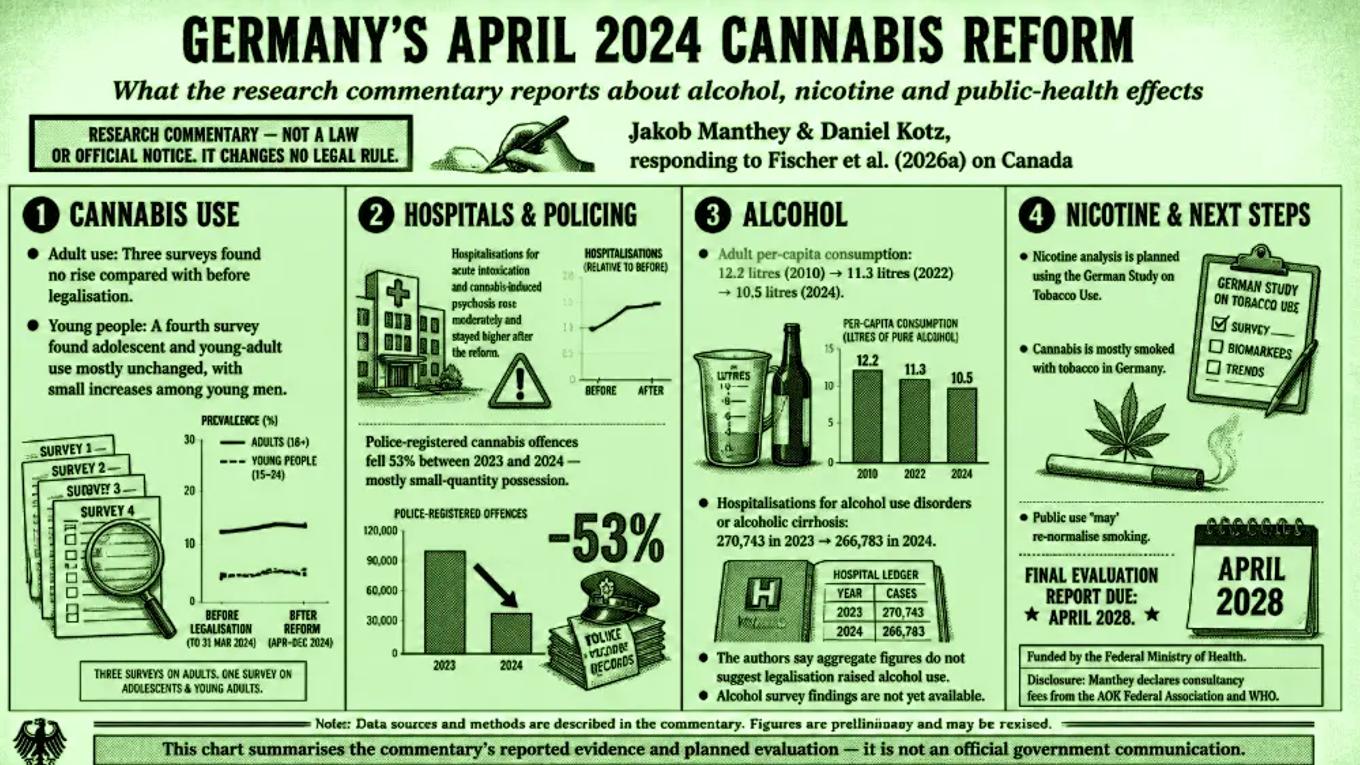
This is a research commentary by Jakob Manthey and Daniel Kotz, written in response to Fischer et al. (2026a) on Canada. It is not a law or an official notice and changes no legal rule. It explains how the law-mandated evaluation of Germany's April 2024 reform will assess effects on alcohol and nicotine.
What it reports
- Three surveys found no rise in adult cannabis use compared with before legalisation. A fourth found adolescent and young-adult use mostly unchanged, with small increases among young men.
- Hospitalisations for acute intoxication and cannabis-induced psychosis rose moderately and stayed higher after the reform. Police-registered cannabis offences, mostly small-quantity possession, fell 53% between 2023 and 2024.
- Alcohol: adult per capita consumption fell from 12.2 litres (2010) to 11.3 litres (2022), then to 10.5 litres in 2024. Hospitalisations for alcohol use disorders or alcoholic cirrhosis were 270,743 in 2023 and 266,783 in 2024. The authors say the aggregate figures do not suggest legalisation raised alcohol use. Alcohol survey findings are not yet available.
- Nicotine: analysis is planned using the German Study on Tobacco Use. The authors flag that cannabis is mostly smoked with tobacco in Germany, and that public use "may" re-normalise smoking.
The final evaluation report is due in April 2028. The work is funded by the Federal Ministry of Health. Manthey declares consultancy fees from the AOK Federal Association and WHO.
What this means
Germany's first-year crime fall (53%) is real but early. Colorado's record shows longer series, yet the US evidence we hold says nothing on alcohol or tobacco.
- Crime figures are not like for like. Colorado's Division of Criminal Justice reports marijuana arrests falling 82% from 2012 to 2022. Germany's 53% covers one year and police-registered offences. Our analysis: the periods and offence definitions differ, so the figures should not be ranked.
- Youth and driving need long series. Colorado reports high-school past-30-day use falling from 19.7% (2013) to 13.6% (2021), about 31% (6.1 ÷ 19.7). Germany's one-year youth data show no fall. Colorado also reports drivers in fatal crashes testing positive for a cannabinoid rising from 16% to 29% (2013 to 2022), but cautions this "is not an indicator of impairment". Germany has set a 3.5 ng/mL THC limit under § 24a(1a) StVG since 22 August 2024. Lawyers should treat positive-test statistics and impairment as separate questions.
- Alcohol is the gap. The commentary's alcohol data show a fall of 1.5% in hospitalisations from 2023 to 2024 ((270,743 − 266,783) ÷ 270,743), against a 19% fall from 2019 (330,304) to 2024. That is a continuing downward trend, which is why the authors stress testing for disruption of pre-existing trends. We hold no US alcohol or tobacco outcome data, so no comparison is possible. The authors also note Ontario's 2024 alcohol liberalisation as a confounder in Canada.
- Measuring supply. Washington's JLARC study reports that the state's data system was "missing one-third of the sales captured by LCB's tax unit", and that RAND estimated 30–40% of cannabis consumed came from non-retail sources. Germany's commercial pillar is not in force, so its only commercial scale is medical. About 201 tonnes were imported in 2025, per secondary reporting. Since 30 July 2026, statutory insurance no longer covers flower (§ 31(6) SGB V). That is a further change in the medical channel that the authors say may feed non-medical demand.
| Place | Public consumption rule | Source |
|---|---|---|
| Germany | Allowed except near under-18s, within 100 m sightline of schools and similar sites, and in pedestrian zones 7.00–20.00 | KCanG § 5 |
| Washington | Unlawful in public view; civil infraction, $50 maximum | RCW 69.50.445 |
| California | Not allowed in public places or within 1,000 ft of schools while children are present; local lounges possible | Health & Safety Code § 11362.3 |
| Colorado | Public-consumption offence, with licensed hospitality premises excepted where the locality allows | C.R.S. § 18-18-406(5)(b) |
Our analysis: the authors' re-normalisation concern turns on where smoking is visible. The US states we cover restrict public use more tightly than Germany's section 5 list. This suggests public-use rules are a variable to track in the evaluation. This is information, not legal, tax or financial advice.
Limits
- The commentary gives no publication date and says 2025 alcohol data are preliminary and unpublished. Alcohol survey and nicotine results are not yet available.
- Colorado's report says most series end in 2021 or 2022, and a February 2026 corrigendum affected its traffic figures, which we have not checked against the corrected text.
- The US and German figures use different measures and periods. Nothing here shows cause and effect.
Sources
- Manthey and Kotz, commentary, Nordic Studies on Alcohol and Drugs
- KCanG § 5
- § 24a StVG
- Colorado DCJ, Impacts of Marijuana Legalization in Colorado (2025)
- Washington JLARC Cannabis Market Study (Report 25-05)
- RCW 69.50.445
- California DCC, What's legal
- Colorado HB 19-1230
- Deutsches Ärzteblatt report on medical cannabis imports (secondary)
- SGB V § 31
Based on Use of Alcohol and Nicotine in the Context of Cannabis Legalization: Considerations from a German Perspective (Jakob Manthey and Daniel Kotz, Nordic Studies on Alcohol and Drugs (Sage Journals)).
Information, not legal advice. Check the primary source before relying on it.


