Germany's cannabis year, read from the German press: the biggest market in Europe is growing, going bust and being defunded at once
Imports doubled, three companies failed in a month, the insurer stopped paying for flower, and the clubs that were meant to replace the dealers have permits in one state and nothing in the ground in another. What the German trade and patient press reported this autumn.
By Neil Cartwright · · 12 min read
Germany legalised cannabis for adults on 1 April 2024 and became, in the same stroke, the largest medical cannabis market in Europe. Two and a half years on, the German-language press is reporting a market that is growing at one end and going bust at the other, a government that has spent 2026 trimming what it inherited rather than building on it, and cultivation clubs that have permits but, in one large state, nothing in the ground. Most of this never reaches English-language readers. Below is what the German trade and patient press reported between April and 5 November 2026, read against the law as it stands.
First the law, for anyone arriving cold. Then the news, in one place. Then what connects it.
How Germany's cannabis law works, in six bullets
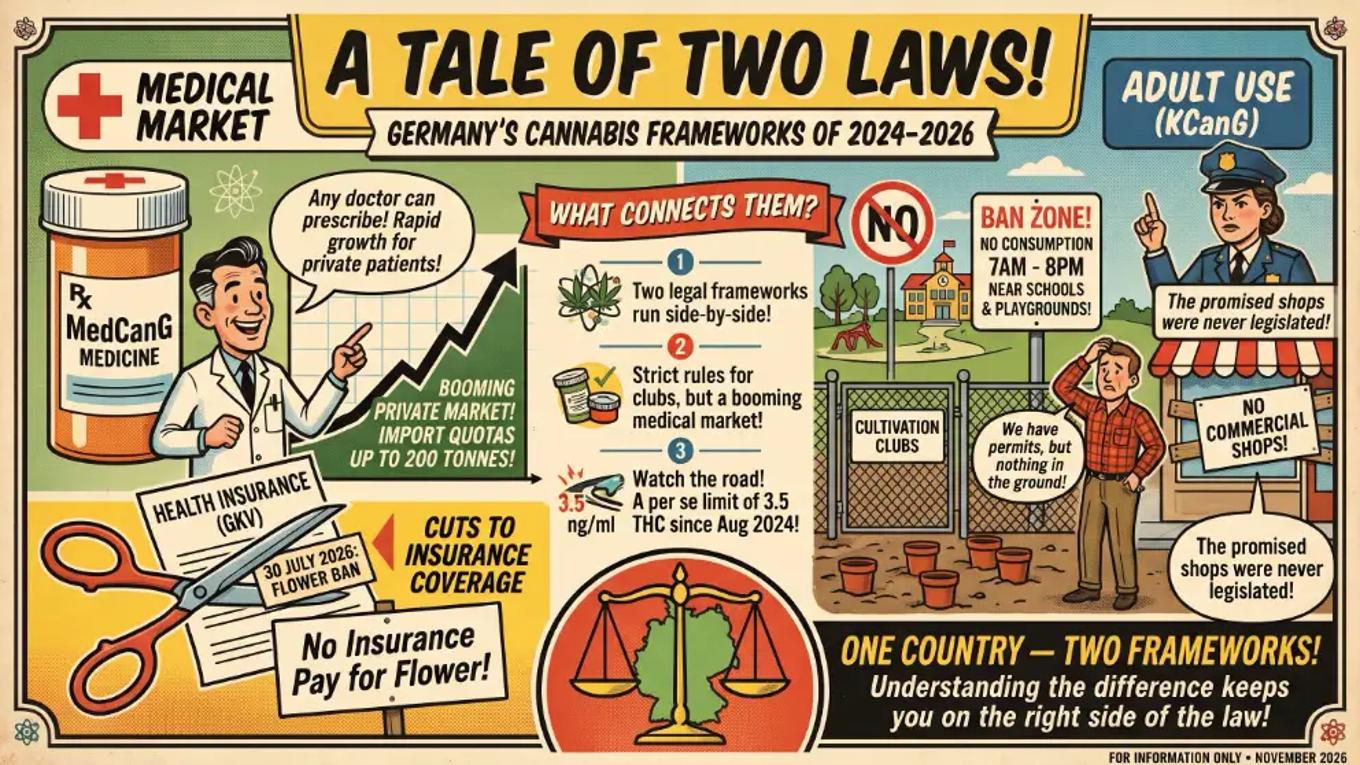
Germany runs two legal regimes side by side, and almost every story below belongs to one or the other.
- The Cannabisgesetz (CanG), in force 1 April 2024, took cannabis out of the Narcotics Act and split it into two laws: the KCanG for adults' own use and the MedCanG for medicine.
- Adult use (KCanG): adults may carry 25 g in public, keep 50 g at home and grow three plants. Consumption is banned near schools, playgrounds and sports grounds, and in pedestrian zones between 7am and 8pm. There are no shops. The only legal supply beyond home growing is a non-profit cultivation association (Anbauvereinigung, or "cannabis social club") of up to 500 members, licensed by the Land (state) authority, with no consumption on the premises and no advertising.
- No "second pillar." The commercial shops the previous government promised were never legislated. The current government told the Bundestag in September 2025 that its coalition agreement does not include them and that it would evaluate the law instead.
- Medical (MedCanG): any doctor except a dentist or a vet may prescribe, on an ordinary e-prescription, with no prior approval from the regulator. A private prescription needs no proof that other treatments failed; the patient pays. That is why German imports went from about 73 tonnes in 2024 to about 200 tonnes in 2025, and why the import quota had to be raised to 192.5 tonnes last autumn after it ran out in September.
- Statutory health insurance (GKV) is the other route: under § 31 Abs. 6 SGB V an insurer pays where the illness is serious, standard treatment is unavailable or unsuitable, and the insurer has approved the first prescription. Since 30 July 2026 it no longer pays for flower at all, only for standardised extracts and dronabinol or nabilone medicines.
- Driving: a per se limit of 3.5 ng/ml THC in blood serum since 22 August 2024, with an exemption for prescribed medicine taken as directed.
Still pending, and important for the business stories: a government bill to amend the MedCanG (Bundestag printed paper 21/3061) that would require an in-person consultation before a first prescription and end postal dispatch of flower. It had its first reading in December 2025 and has sat in the Health Committee since. The industry association BvCW told Hanf Magazin on 30 October it does not expect the bill to pass in its current form.
The news in one place
Five German outlets, 122 items analysed, April to November. The ones that change a reader's position:
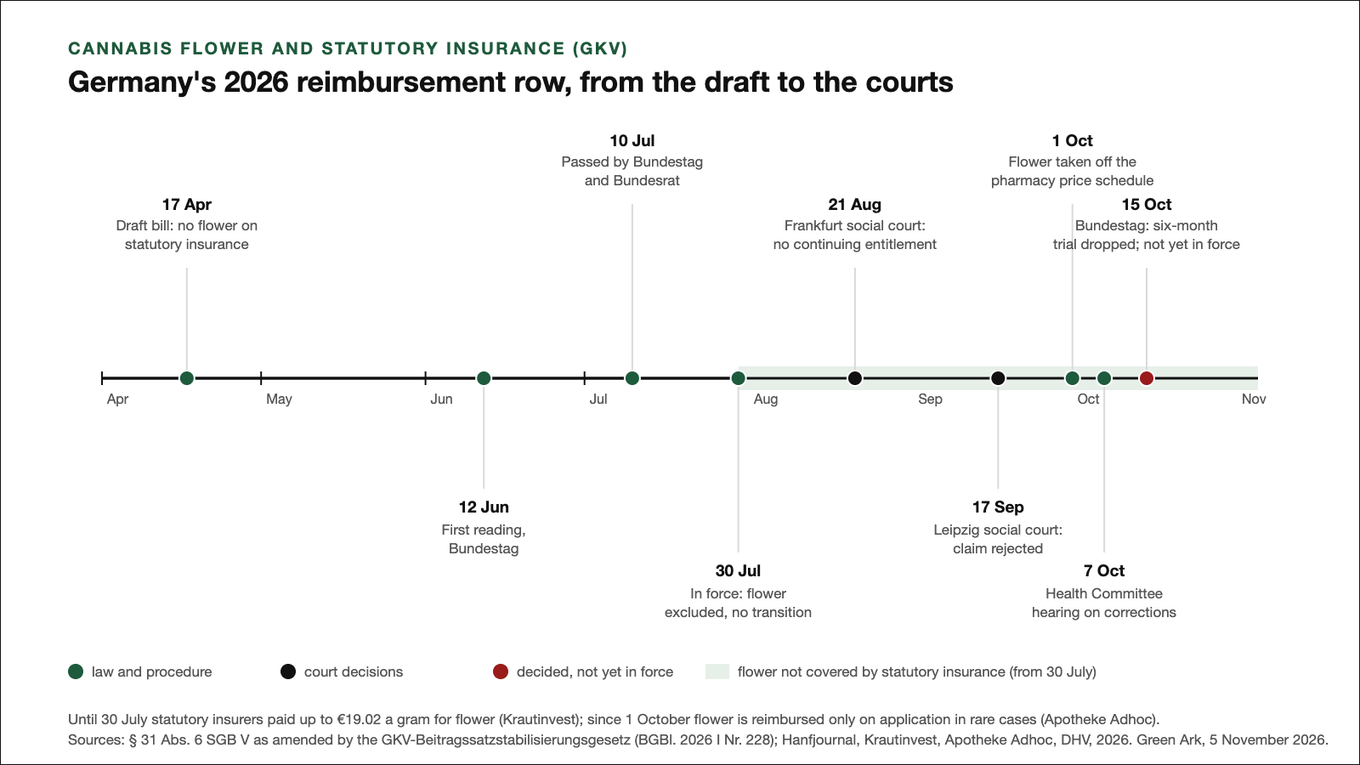
- 15 October, the Bundestag softened its own July law. In July it had required a six-month trial of an approved finished cannabis medicine before an insurer would pay for an extract, even where the medicine was not approved for the patient's condition (the "Off-Label-Zwang"). Last month it limited that priority to the medicine's approved indications, dropped the fixed six months and let existing patients keep their extracts. It is decided, not in force; Cannamedical warned the old rule applies until it is (Krautinvest, 21 October). The flower exclusion was not touched.
- The courts have backed the insurers. Social courts in Frankfurt (21 August, S 14 KR 409/26 ER), Leipzig (17 September) and Hamburg (reported by Apotheke Adhoc) refused to keep flower flowing to patients who had open-ended approvals before July; Landshut went the other way on an insurer's procedural slip (22 September). None is a final appellate ruling.
- Three insolvencies in a month. Synbiotic, the listed hemp and medical cannabis group, said it would file after two subsidiaries failed in July; Lux 99, a cannabis pharmacy, filed and blamed the flower exclusion in terms (Apotheke Adhoc); and Bedrocan's Dutch companies were declared insolvent on 9 October after losing their contract with the Dutch state supplier, which had bought about 4,500 kg a year from them, 3,800 kg of it for export, mostly to Germany (Krautinvest).
- Prices went two ways. German pharmacy flower averaged €6.55 a gram in April against €7.78 in the UK; German extracts €22.35 a millilitre against €4.89 (converted) in the UK, on a product mix that makes the second comparison rough (Business of Cannabis via Hanfjournal, 19 October). Pharmacy prices for flower ran €7 to €15 a gram in September, mostly €8 to €9. Until July insurers had been paying up to €19.02.
- Deals: Curaleaf's offer for Aurora rose to a calculated $5 a share on 6 October and Aurora is resisting; Red White & Bloom took a majority of Grünhorn, the Leipzig pharmacy group, in September; Vertanical signed Viatris to sell its new cannabis painkiller Exilby; Aurora doubled its Leuna production hall; Cantourage launched a raw extract and a distillate aimed, in its own words, at self-payers.
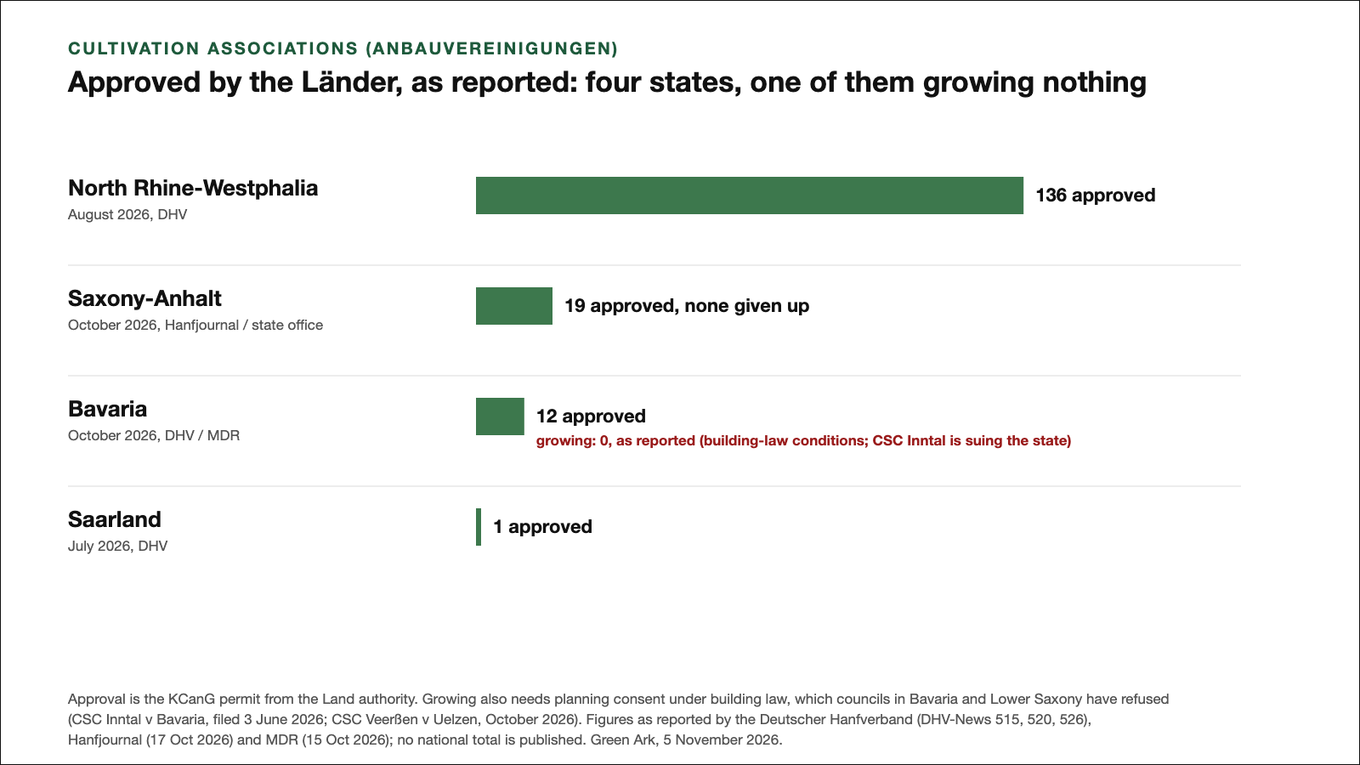
- Clubs: approved, not growing. North Rhine-Westphalia had approved 136 associations by August; Saxony-Anhalt 19 by October, none of them folded; Bavaria 12, none growing, because councils refuse planning consent under building law; Saarland one. Baden-Württemberg's administrative court backed clubs in a ruling DHV reported on 30 October; a Bavarian club has moved its growing to Thuringia; CSC Inntal is suing Bavaria, with DHV paying; CSC Veerßen is suing Uelzen over parking spaces. CSC Dortmund reported 54.2 kg handed to members in three years with no failed lab sample.
- Politics: Bavaria's premier Markus Söder called for a cannabis tax (DHV, 25 September), on a product that cannot legally be sold; the CDU's party conference adopted a motion from its women's wing in February to end the CanG (DHV, 27 February); a Greens bill to raise the hemp THC limit to 1 per cent and scrap the "misuse clause" came before the Bundestag on 14 October; the EU Council's agriculture committee agreed on 19 October to treat hemp flowers and leaves as farm produce, with an opening Berlin asked for (Hanf Magazin); and the Deutscher Hanfverband, the lobby that fought for all of this, said on 23 October its funding may halve after a change of legal form lost it half its donors' consents.
- Enforcement and evidence: the 2025 police statistics show cannabis proceedings fell again (DHV, 21 April); the RKI found no rise in young people's use after the CanG (DHV, 3 July); the government's own second EKOCAN evaluation landed 1 April; the Federal Court of Justice ruled on 26 March that a doctor-matching portal describing what cannabis treats was unlawful advertising; and Düsseldorf's regional court held on 16 September that THC vape cartridges are finished medicines needing a marketing authorisation.
The flower row: a saving the government itself does not expect
The one-line summary: the Bundestag cut flower from insurance in July to save money, has spent the autumn repairing the collateral damage, and has not restored the flower.
- What was cut. Flower had been a statutory benefit since 2017. The GKV-Beitragssatzstabilisierungsgesetz, a cost-cutting law for the insurance funds, removed it from 30 July with no transition. Existing approvals died with it; Barmer said it would pay only for prescriptions presented at a pharmacy before the date (as reported by the regional doctors' associations). From 1 October flower was taken off the pharmacy price schedule altogether, so reimbursement is now "only on application in emergencies" (Apotheke Adhoc).
- What it saves. Hanfjournal reported on 7 October that the federal government, asked about the finished-medicine priority, expected "no appreciable financial effect" from it. The DHV's submission to the June consultation argued the change would cost more, because extracts are dearer per milligram of THC than flower; Krautinvest's 7 October hearing report carried the same arithmetic: flower is the cheapest form.
- Who pays now. Patients. Bloomwell's survey of 7,913 patients (Hanf Magazin, 29 October) found nearly 97 per cent rate pharmacy cannabis above the illegal market and warned of a drift back to it; the patients' association wrote to the government and the G-BA on 4 November asking how inhaled therapy is to be covered at all, three months on, since no rule yet exists for high-dose extracts (Apotheke Adhoc). The G-BA was asked in September to decide "promptly".
- Who else pays. Pharmacies. The cannabis pharmacists' association warned of price dumping in self-pay sales and falling margins; one pharmacy, Lux 99, has gone under citing the law by name.
The repair on 15 October fixes the thing that was plainly absurd, a six-month trial of a medicine not licensed for the patient's illness. It does not fix the thing that costs patients money. The BvCW's reading, to Hanf Magazin, is that putting flower back "in this legislative period" is unlikely. The next Bundestag election is due in 2029.
Business: the biggest market in Europe is shaking out
The one-line summary: demand is up, prices are down, the insurer has left the room, and the companies built for the old margins are the ones failing.
- Bedrocan was the original: the Dutch state's contracted grower, and the first name a German pharmacist learned. Its Dutch and Danish sites both sold mostly to Germany. It lost the Dutch supply contract at the start of the year and was insolvent by October. The Danish site, with 2,200 kg a year of capacity, is unaffected, the company says (Krautinvest, 22 October).
- Synbiotic had bought about ten companies in CBD, hemp and medical cannabis since 2020. The CBD side has been flat since the EU's novel-food decision of 2019, and the hemp side is squeezed by the misuse clause, which makes hemp flowers risky to sell. It is filing at Münster.
- Tilray reported record revenue of $257 million for the quarter while its cannabis sales shrank; beer and pharmaceutical distribution carried it (Hanfjournal, 9 October). Tilray also recalled a batch of its THC5:CBD20 extract in September for an off-specification THC content.
- Who is buying in: Red White & Bloom (Grünhorn), Aurora (Leuna, staff from 45 to 55), Organigram (Aurora, if it can). Who is launching: Cantourage, Vertanical with Viatris. The common thread is extracts, finished medicines and distribution, the parts of the market the insurer still pays for, rather than flower.
- Theft is a line item now: a pharmacy break-in in Neubrandenburg aimed at the cannabis store (21 September), 25 kg taken in an earlier one, a trainee in Hamburg on trial for selling 20 g from his employer's stock. Customs burned 632 kg of seized cannabis in July.
The clubs: licensed by one authority, blocked by another
The one-line summary: the federal law created the clubs, the Länder license them, and the councils decide whether they can build, which in Bavaria means they cannot.
- A cultivation association needs a KCanG permit from the Land. It then needs premises, and premises need planning consent. Bavaria's councils have refused it in commercial zones (a court agreed, DHV, 25 September), so Bavaria has 12 permitted clubs growing nothing; one has moved its plants to Thuringia (MDR, 15 October).
- The pattern is spreading north: Lower Saxony's CSC Veerßen is in court with Uelzen (14 October); Thuringia tightened its club rules in April and quarrelled with its clubs in August; Saarland has had a single approved club since at least July.
- Where the state is willing, the model works as drafted: 136 approvals in North Rhine-Westphalia by August; 19 in Saxony-Anhalt, inspected regularly, none given up; Dortmund's club with 92 tested batches and no failure; a club in a former bank in Mönchengladbach that started handing out on 4 November.
- What the clubs cannot do is replace the black market. The Bad Nauheim club told Hanfjournal on 2 November that demand outside the club has not gone away, and the DHV's own line is that the seizures show the illicit trade still has customers. The interior minister said the black market had grown; the DHV disputed his figures (DHV, 18 September).
What the German press is saying that the English press is not
Five patterns across the 122 items.
- The reform is being administered, not reversed. The CDU conference adopted a motion to repeal the CanG in February; Bavaria's minister wants it "completely withdrawn"; the transport minister wants it gone. None of it has reached a bill. What has reached the statute book is a cost-cutting measure in a health-insurance law. Germany is not undoing legalisation; it is defunding the medical side of it and letting the recreational side stall on planning law.
- Flower is the fault line. Every row this year runs through the same product: the insurer will not pay for it, the price schedule has dropped it, the extracts that replace it cost more per milligram, the pharmacies that stocked it are failing, and the pending MedCanG bill would stop it being posted. Companies have read this: the launches are extracts and finished medicines.
- Private pay is the market. Two hundred tonnes of imports and no shops means almost all of it is going out on private prescriptions. That market is price-sensitive (€8 to €9 a gram wins), telemedicine-dependent, and now the only route for flower. The MedCanG bill would restrict both telemedicine and postal supply. The industry's bet is that it will not pass.
- The Länder are the regulator that matters for adult use. The same federal law produces 136 clubs in one state and none growing in another. For anyone advising a club or a landlord, the relevant law is the Bauordnung, not the KCanG.
- The evidence is running ahead of the politics. Police proceedings down, youth use flat, 97 per cent of patients preferring the pharmacy, 54.2 kg distributed by one club with no failed test. The government's own evaluation is out. The decisions of 2026 were taken on the insurance budget, not on any of that.
How to read it if you advise or run a cannabis business
- Model Germany as a self-pay market with an insurance side-line. Price flower for the €8 to €9 shelf; budget extracts against the G-BA decision on high-dose products, which has no date.
- The 15 October correction is not in force. Until it is, the six-month finished-medicine trial applies to new insured patients. Watch the Bundesgesetzblatt.
- Supply contracts with Bedrocan entities: the Dutch companies are in insolvency; the Danish one says it is trading. Check which entity you buy from.
- Clubs and their landlords: get the building-law position in writing from the council before the KCanG application, not after. In Bavaria assume no.
- Telemedicine and postal models: the MedCanG bill (21/3061) is stalled, not dead. A contingency for in-person first consultations and courier-only delivery is the prudent cost of doing business until it is withdrawn.
- Marketing: the BGH's March ruling means a portal that lists what cannabis treats is advertising a prescription medicine to the public. Vape cartridges with THC are medicines needing authorisation, per Düsseldorf.
- Hemp: the EU Council mandate of 19 October and the 1 per cent bill are the two things that could unlock hemp flower in Germany. Neither is law. The misuse clause still is.
This is information, not legal advice. Green Ark reads the German press so that you do not have to; the law summarised above is as recorded in our Germany entries, with the dates of the changes.
Sources
- German feed in Green Ark's news desk, 122 items, 27 February to 5 November 2026: Deutscher Hanfverband (DHV-News 499 to 528 and press releases), Hanfjournal, Apotheke Adhoc (Medizinisches Cannabis), Hanf Magazin, Krautinvest.
- The October correction: Krautinvest, 21 October 2026; Hanfjournal, 16 October 2026 (the Frankfurt ruling, S 14 KR 409/26 ER); Hanfjournal, 7 October 2026.
- Insolvencies: Krautinvest, 22 October 2026; Apotheke Adhoc on Synbiotic; Hanfjournal on Bedrocan.
- Prices: Hanfjournal, 19 October 2026 (Business of Cannabis market comparison, April; ACM pharmacy prices, September).
- Clubs: DHV-News 526; Hanfjournal on Saxony-Anhalt; DHV on CSC Inntal v Bavaria; Hanfjournal on CSC Dortmund.
- Industry and politics: BvCW interview, Hanf Magazin, 30 October 2026; Hanf Magazin on the EU Council hemp mandate; DHV-News 527.
- The law: KCanG §§ 1, 5, 32; MedCanG §§ 3, 4, 12; § 31 Abs. 6 SGB V as amended by the GKV-Beitragssatzstabilisierungsgesetz (BGBl. 2026 I Nr. 228); § 24a StVG; BGH I ZR 74/25 (26 March 2026); Bundestag printed papers 21/3061 and 21/2116; BfArM import figures as reported.
Information, not legal advice. Check the primary source before relying on it.