Nepal's Supreme Court gives the government three months to license cannabis cultivation
A newly published judgment orders rules for licensed cannabis growing, processing and trade for medical, scientific and industrial use, but leaves recreational use to Parliament. Cannabis stays illegal until the rules exist.
By Neil Cartwright · · 3 min read
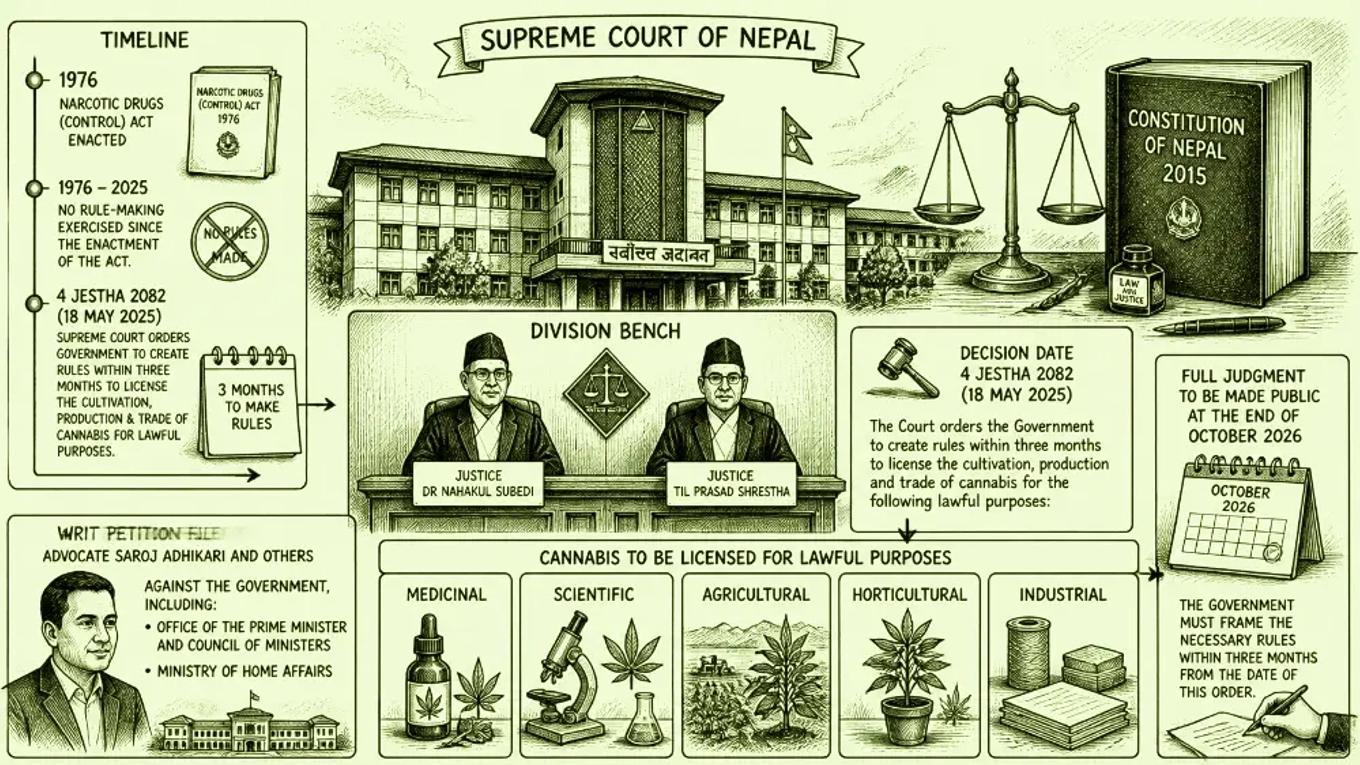
Nepal's Supreme Court has ordered the government to put in place, within three months, the rules needed to license the cultivation, production and trade of cannabis for medicinal, scientific, agricultural, horticultural and industrial purposes. The government has not exercised that rule-making power since the Narcotic Drugs (Control) Act was passed in 1976.
A division bench of Justices Dr Nahakul Subedi and Til Prasad Shrestha decided the case on 4 Jestha 2082 (18 May 2025). The full text of the judgment was only made public at the end of October 2026. The writ petition was brought by advocate Saroj Adhikari and others against the government, including the Office of the Prime Minister and Council of Ministers and the Ministry of Home Affairs.
What the court ordered
The court issued a writ of mandamus under Article 133(2) and (3) of the Constitution. Within three months of receiving the order, the government must:
- frame the regulations, standards and procedures needed to implement the Narcotic Drugs (Control) Act 2033 (1976);
- set up a licensing system covering cultivation, production, processing, storage, use, sale, distribution, import and export of cannabis for medicinal, scientific, agricultural, horticultural and industrial purposes;
- build a strict regulatory and monitoring mechanism that allows licensed activity and stops unlicensed growing, production and sale;
- keep the rules consistent with the 1976 Act and the 1961 UN Single Convention on Narcotic Drugs, in particular Articles 23 and 28, which govern the control of cannabis cultivation.
Why the court acted
The 1976 Act already allows licensed activity. The proviso to section 4 and sections 5 and 6 provide for cannabis to be used for medical and research purposes under licence or on a doctor's recommendation. Those provisions have never worked, because the government never made the rules to implement them. The court held that this long failure to use the power Parliament delegated to it amounted to a failure to perform a legal duty. It also noted that the government had commissioned studies on the issue, including from the Policy Research Institute and the Nepal Health Research Council, without acting on them.
What it did not order
The court refused the petitioners' request to open up recreational and religious use. It found that the 1976 Act does not clearly provide for recreational use, and that decriminalising conduct the law prohibits is a matter for the legislature, tied to public health and social policy. Instead, it asked the Office of the Prime Minister and Council of Ministers to consider broad consultation with experts and stakeholders, taking account of Nepal's social, economic and cultural context, before any amendment to the law.
What this means now
Nothing is legal yet. Until the government makes the rules and issues licences, cultivating, producing, selling, possessing and consuming cannabis remain offences under the 1976 Act. CBD products are also treated as illegal, and visitors should not bring cannabis or CBD into Nepal.
The deadline runs from when the government received the order, a date that has not been made public. If it was served when the full text was released, rules would be due around early 2027. The government has missed past commitments: bills to legalise cannabis were filed in Parliament in 2020 and 2021, the 2023 budget proposed a feasibility study on medicinal cultivation, and the finance minister announced in May 2024 that medicinal cannabis would be legalised. None produced a licensing scheme.
What to watch
- The rules. Look for draft regulations from the Ministry of Home Affairs or the Ministry of Health and Population, and for who will issue licences.
- A national cannabis agency. Article 23 of the Single Convention, which the court told the government to follow, requires a country that licenses cannabis cultivation to set up a government agency. That agency designates where cannabis may be grown, licenses the growers and takes physical possession of the crop. Expect state control of the wholesale market rather than an open one.
- Hemp and industrial use. The order covers industrial and horticultural purposes, which could open a hemp fibre and seed industry. Under the Single Convention, industrial and horticultural uses fall outside its controls.
- Compliance with the deadline. If the government misses the three months, the petitioners can return to the court.
- Recreational use. Any change needs Parliament to amend the 1976 Act, after the consultation the court asked for.
For companies, the opportunity is in licensed medical and industrial supply, most likely through a state-controlled buyer. Any investment should wait for the rules: who may hold a licence, whether foreign ownership is allowed, and whether export is permitted.
Information, not legal advice. Check the primary source before relying on it.