New South Wales switched medicines laws today: what the Medicines, Poisons and Therapeutic Goods Act 2022 changes for cannabis
The 1966 Act is repealed from 5 November 2026. Compounded Schedule 8 cannabis no longer needs a state approval, unregistered products are out of the urgent-supply route, licences and penalties are rebuilt, and NSW Health's cannabis pages still cite the old law. What changed, what did not, and what to do.
By Neil Cartwright · · 5 min read
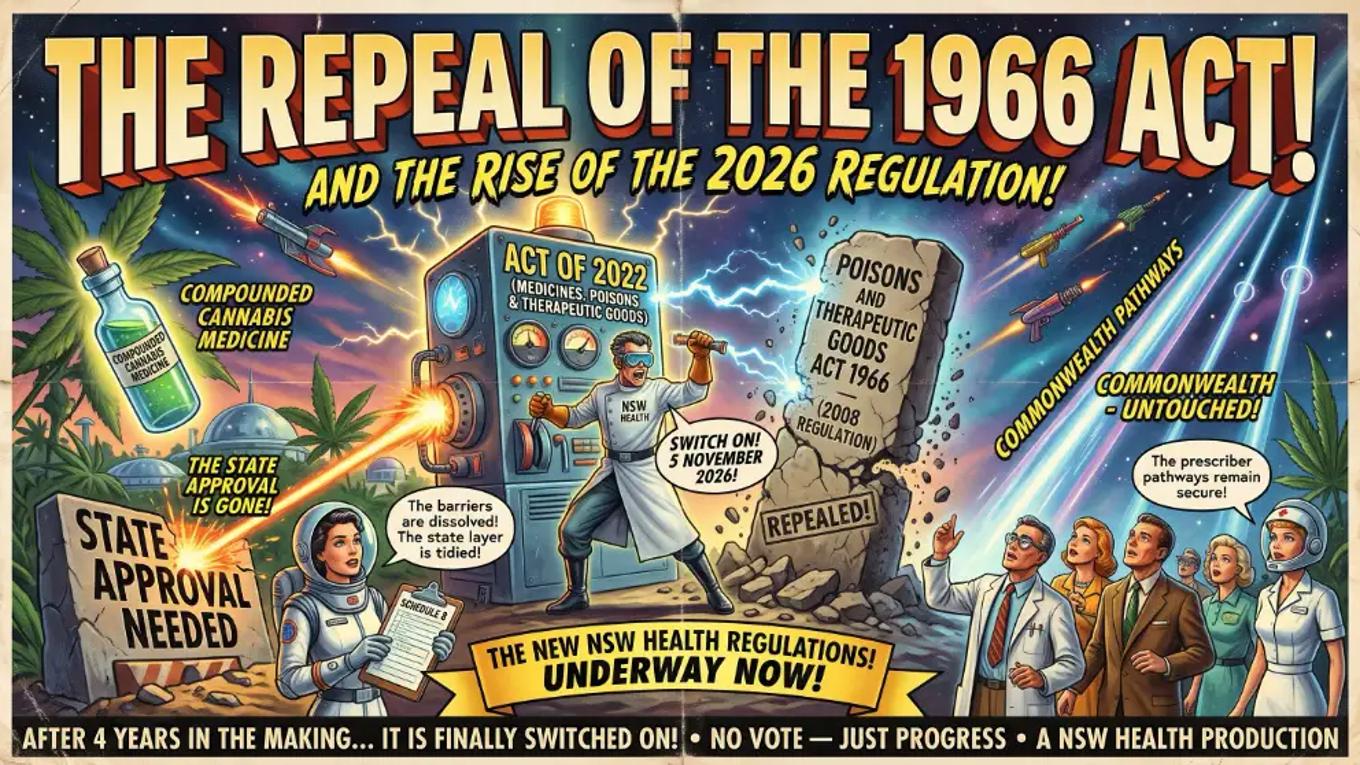
From today, 5 November 2026, New South Wales regulates medicines under the Medicines, Poisons and Therapeutic Goods Act 2022 and its 2026 Regulation. The Poisons and Therapeutic Goods Act 1966 and the 2008 Regulation, the laws that governed every Schedule 8 cannabis prescription, every compounded cannabis oil and every wholesale licence in the state, are repealed. There was no vote this week: Parliament passed the Act in November 2022, and it has taken a Regulation, a round of consultations and almost four years to switch it on.
For cannabis the headline is modest and useful. The state approval that compounded Schedule 8 cannabis medicines needed is gone; the rest of the state layer is tidied rather than rebuilt; and the Commonwealth pathways that actually get a patient a prescription are untouched. The detail below is from NSW Health's own guidance, which is where the changes are spelled out.
What changes today, in one place
- Compounded Schedule 8 medicines no longer need NSW Health approval. Under the 1966 rules an extemporaneously compounded cannabis product needed a state approval on top of the TGA pathway, and only a medical practitioner could hold one. NSW Health's pharmacist guidance now lists "S8 unregistered compounded medicines (approval for these medicines is no longer required)"; the doctors' page says they "generally no longer need approval, unless another approval category applies".
- Approval numbers come off prescriptions. Where an approval is still required, the number need not appear on the script, and a missing number does not invalidate it. Pharmacists "are not expected to confirm whether a prescriber has obtained a medicine approval"; they can see approvals in SafeScript NSW. The prescriber carries the responsibility.
- Approval still needed for a patient with substance dependence, for any Schedule 8 medicine, cannabis included. Dependence is now defined by ICD-11 or DSM-5. Up to three days of urgent pain relief is exempt.
- Unregistered products cannot be supplied as urgent-use medicines. A pharmacy may supply a prescriber only registered Schedule 4 and 8 medicines for urgent or emergency use, on a signed written order kept for two years. Unregistered cannabis products, which is nearly all of them, must come through a wholesaler in the ordinary way.
- Prescriptions: one Schedule 8 script may list several strengths of the same substance (not a combination product alongside a single-ingredient one); handwritten scripts must be legible; Schedule 4D scripts run 12 months instead of six.
- Nurse practitioners may apply for approvals. Designated registered nurse prescribers "cannot prescribe, supply, administer, or issue a direction to supply or administer unregistered scheduled medicines", which keeps them out of cannabis.
- Drug registers: Schedule 8 balances recorded at least every three months, not just March and September; the Medicines Storage Standards and Electronic Drug Register Standards become mandatory for Schedule 8 and 4D; explained losses no longer have to be reported to Pharmaceutical Services, unexplained ones go to the Secretary on an online form from today.
- Samples of Schedule 8 and 4D medicines are banned, and prescribers may no longer self-prescribe them or obtain them wholesale for their own use.
- Licences come in three kinds: wholesale (Schedules 2, 3, 4, 8, 7J, 9 and 10, from NSW premises, with an on-site inspection for Schedule 4D, 8 or 9), retail and "obtain". Processing "can take up to 90 days"; an application left incomplete for six months is cancelled; wholesale records are kept for two years. Application forms for the new licences and approvals "will be available in late 2026", which is to say after the law that requires them.
- Penalties now sit in five tiers: 20 to 400 penalty units for individuals and 100 to 2,000 for corporations. At the NSW penalty unit of $110 that is up to $44,000 and $220,000. NSW Health says detail "will be provided later" and that compliance "will focus on education, guidance and support" first.
What does not change
- How a patient gets cannabis. The TGA's Special Access Scheme and Authorised Prescriber pathways are Commonwealth law and carry on. Only Epidyolex and Sativex are registered; everything else is unregistered and needs the TGA step first.
- The offences. The Drug Misuse and Trafficking Act 1985 is untouched. Adult use remains illegal; possession, cultivation and supply remain offences, and the police cautioning scheme for small amounts carries on.
- Driving. Any THC in the body is still an offence for patients. The voluntary patient register passed Parliament on 17 September and is not yet in force; Transport for NSW rewrote its page on 2 November to say registered patients get warning letters, not penalties, for a first or second detection under the limit. No start date has been published.
- Hemp. Low-THC hemp stays with the Department of Primary Industries under the Hemp Industry Act 2008.
The gap between the law and the guidance
The one-line summary: the law commenced on time; the paperwork and the cannabis-specific pages did not.
- NSW Health's cannabis medicines pages, including "Access and approvals for cannabis medicines", are "current as at 20 June 2024" and still define approval by reference to the 1966 Act. Until they are rewritten, a prescriber reading the cannabis page and a prescriber reading the new-law page will get different answers on compounded products.
- Whether licences and approvals issued under the 1966 Act carry over, and for how long, is not stated on any of the new-law pages. The Act's transitional provisions govern this; the pages refer readers back to the old licensing page for "current requirements". We have not been able to read the Regulation's savings schedule directly, so treat carry-over as unconfirmed until Pharmaceutical Services says so in writing.
- New application forms arrive "late 2026"; licence processing is up to 90 days. A wholesaler whose licence falls due in the next quarter is applying under a law whose forms do not yet exist.
What to do if you prescribe, dispense or supply in NSW
- Prescribers: stop adding approval numbers to compounded cannabis scripts; keep applying for approval for any patient with substance dependence; note the three-month register count and the end of samples.
- Pharmacies: do not treat a missing approval number as a defect; do not supply unregistered cannabis products as urgent-use stock to a prescriber; adopt the storage and electronic register standards now, since they are mandatory from today.
- Wholesalers and manufacturers: write to Pharmaceutical Services (MOH-PharmaceuticalServices@health.nsw.gov.au) this week to confirm in writing that an existing 1966 Act licence remains valid until its expiry, and when the new forms will be issued. Keep two years of supply records from today.
- Everyone: read the penalty tiers when NSW Health publishes them; the corporate maximum of 2,000 penalty units is new.
This is information, not legal advice.
Sources
- NSW Health, Pharmaceutical Services: Frequently asked questions on the new Medicines, Poisons and Therapeutic Goods legislation; Legislation changes for medical practitioners (8 September 2026); Legislation changes for pharmacists (29 September 2026); Medicine approvals (6 July 2026); Licences under the Medicines, Poisons and Therapeutic Goods Act 2022 (27 August 2026); Access and approvals for cannabis medicines (20 June 2024, still citing the 1966 Act).
- Medicines, Poisons and Therapeutic Goods Regulation 2026 (NSW legislation website; not readable by automated tools, cited through NSW Health's guidance).
- Transport for NSW, Medical cannabis and driving (updated 2 November 2026).
- Green Ark's New South Wales entry: the Poisons and Therapeutic Goods Act 1966 position, the Schedule 8 approval cases, the DMTA quantity bands and the driving scheme as passed on 17 September 2026.
Information, not legal advice. Check the primary source before relying on it.


