Oklahoma moved THC to Schedule I to catch gummy traffickers. It also caught patients who drive
Senate Bill 1257, in force since 1 November, redefines marijuana to include THC and lists THC in Schedule I, so 25 lb of edibles is trafficking. The same words make any THC in a driver's blood an offence without proof of impairment, and the bill that would have spared patients did not pass.
By Neil Cartwright · · 9 min read
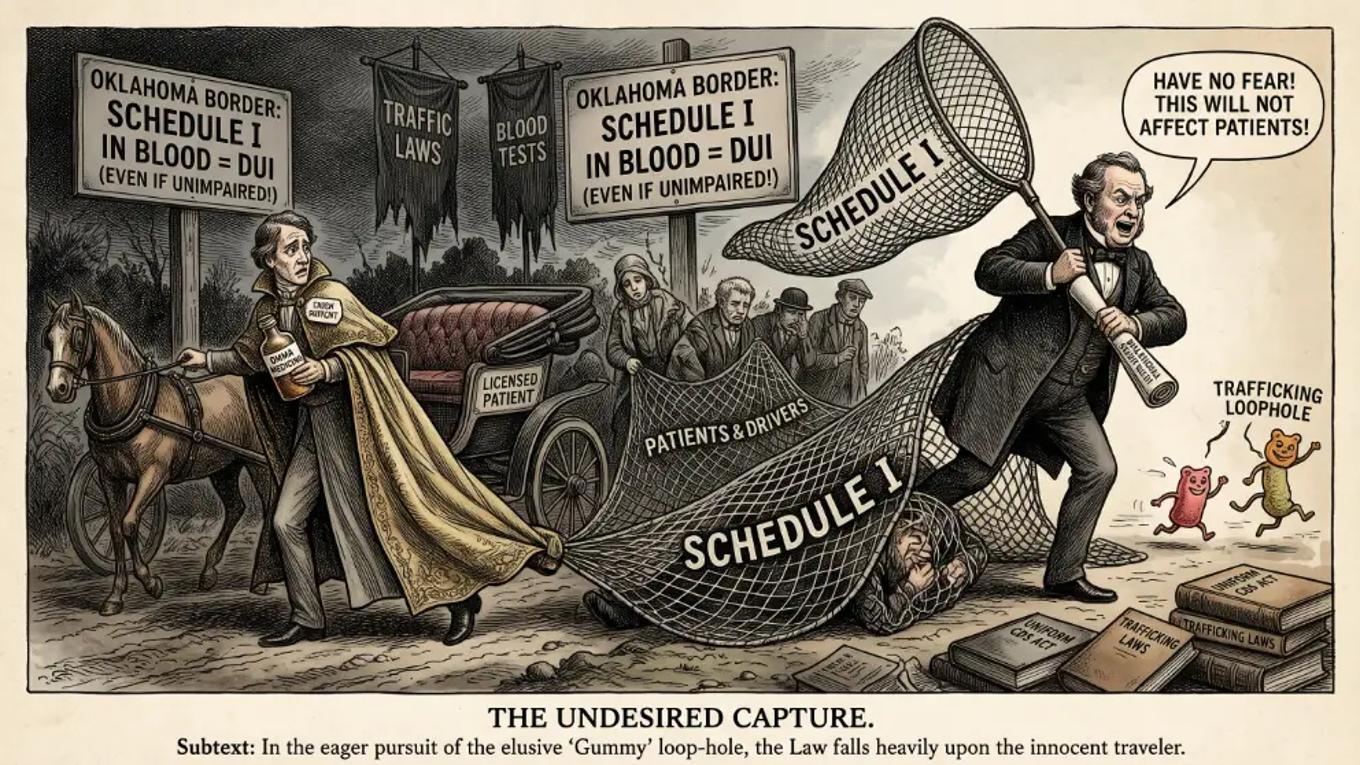
Oklahoma's Senate Bill 1257 took effect on 1 November 2026. It rewrites the definition of "marijuana" in the Uniform Controlled Dangerous Substances Act to include tetrahydrocannabinols, lists THC in Schedule I, and takes it out of Schedule III. The Attorney General sold it as closing a trafficking loophole, and it does. The same two edits also change what a blood test means for anyone who drives after using cannabis, because Oklahoma's drink-driving statute does not ask whether you were impaired; it asks whether any amount of a Schedule I substance, or its metabolite, was in you. The Attorney General's statement that the bill "will not affect patients or businesses" licensed by the Oklahoma Medical Marijuana Authority is true of the drug statute and silent on the driving one.
What the Act does, in one place
Four sections, no fiscal impact statement, and the usual spelling of "tetrahydrocannibinols" in the old Schedule III entry.
- Marijuana redefined (63 O.S. § 2-101): the plant, its resin and every preparation of it, and now also "tetrahydrocannabinols, neutral compounds, and their corresponding acids, including synthetic equivalents" and isomers "with similar chemical structure and pharmacological activity". Mature stalks, seed oil, sterilised seed and certain CBD products stay out.
- THC redefined (§ 2-101(49)): "tetrahydrocannabinols" now "includes", rather than "means", substances synthesised to emulate the THC of marijuana, "specifically including any tetrahydrocannabinols derived from industrial hemp".
- Hemp retested: industrial hemp is now hemp only if its combined delta-9 THC and THCA is 0.3% or less "as tested using post-decarboxylation or other similarly reliable methods". A total-THC test, in other words.
- Schedule I (§ 2-204): item 98, "Tetrahydrocannabinols", added to the hallucinogen list beside item 12, marijuana.
- Schedule III (§ 2-208): the THC entry deleted; dronabinol, the prescription synthetic, stays.
- Effective: 1 November 2026.
The loophole, as described by the people who closed it
Oklahoma's trafficking statute works by weight and by drug. Under 63 O.S. § 2-415, possessing "twenty-five (25) pounds or more of a mixture or substance containing a detectable amount of marijuana" is trafficking: a fine of $25,000 to $100,000 and up to 20 years for a first offence. Below that weight, and since State Question 780 in 2016, simple possession of any controlled substance is a misdemeanour. THC, until 1 November, was a separately listed Schedule III substance, so a defendant with a pallet of gummies made from distillate could argue the gummies were "tetrahydrocannabinols", not "a mixture containing marijuana", and that the trafficking weights did not apply. We found no published appellate decision deciding the point either way; the Attorney General's office says the argument was being made.
- Attorney General Gentner Drummond, 26 February 2026: "drug traffickers have exploited a gap in our state law to downgrade serious felony crimes into misdemeanors"; "THC is marijuana, and it should be treated the same under the law."
- Representative Tim Turner, the bill's House author, to KFOR, 10 November: "What it is, is to align that if you're going to have 25lbs of edibles, and you're trafficking those illegally without proper permits you should be able to not skirt the law with a misdemeanor."
Read against § 2-415, the sentence parses: 25 pounds is the marijuana trafficking threshold, "edibles" are the product that escaped it, "without proper permits" distinguishes a licensed processor from a trafficker, and "a misdemeanor" is what State Question 780 left for simple possession. The grammar is the speaker's; the logic is the statute's.
Who Tim Turner is
- Representative for House District 15 (parts of Haskell, Le Flore, McIntosh, Muskogee and Pittsburg counties), Republican, elected in 2024 to succeed Randy Randleman; won the primary outright with 52.6%.
- A career in drug enforcement: 911 dispatcher in 2003; reserve deputy; police chief; from 2007 to 2016 a district attorney's task-force officer with the US Drug Enforcement Administration; Haskell County Sheriff from 2017 to 2022, elected as a Democrat, the Oklahoma Sheriffs' Association's Sheriff of the Year in 2021, with a record that included closing illegal marijuana farms; appointed to the OSBI Commission by Governor Stitt in March 2022; then the Department of Corrections and District Attorney Jack Thorp's office.
- His own account of his work: the House biography describes "multi-state illegal marijuana grow operations" and "foreign meddling in Oklahoma's medical marijuana market".
- Legislates by schedule: his House Bill 3767, adding substances to Schedules I and IV, passed the House 95 to 1 and was approved on 12 May 2026, eight days before SB 1257. On 18 September he announced a bill for the 2027 session to put kratom compounds in Schedule I: "It is time to stop treating this like just another product on a convenience store shelf."
A former DEA task-force officer who became a sheriff, who became a legislator, and who reaches for the drug schedules as the tool. That is the context for a bill whose stated purpose was trafficking and whose text never mentions driving.
How it passed
- 16 December 2025: prefiled by Senator Warren Hamilton; "aligns with federal classification" in the Senate's own summary.
- 10 February 2026: Senate Public Safety Committee, do pass; Turner added as principal House author.
- 25 February: Senate, 43 to 3. The Attorney General's press release followed the next day.
- 8 and 16 April: House Alcohol, Tobacco and Controlled Substances subcommittee and Health and Human Services Oversight Committee, do pass with a committee substitute.
- 28 April: House, 68 to 13. Representative Jacob Rosecrans voted no: "What we intend at the legislature is not really what happens on the ground."
- 14 May: Senate accepted the House changes, 41 to 7. 20 May: approved by Governor Stitt. 1 November: in force.
- What did not pass: House Bill 3018, by Representative Andy Fugate, would have excluded marijuana and its derivatives from the any-amount driving offence. It was not enacted.
The debate, as far as the public record shows it, was about traffickers, hemp-derived THC and keeping dronabinol available for cancer patients. The driving statute is a different title of the Oklahoma code and was not amended, which is exactly why it matters.
What it does to drivers
In short: the risk for patients who drive existed before 1 November; the bill removed the best argument against it.
- The offence: 47 O.S. § 11-902(A)(3): driving with "any amount of a Schedule I chemical or controlled substance" or "one of its metabolites or analogs" in blood, saliva, urine or any other bodily fluid, measured by a test within two hours of arrest. No concentration, no proof of impairment. Subsections (A)(4) and (5) are the separate impairment offences.
- No patient defence: § 11-902(B): being lawfully entitled to use the substance is not a defence. The medical statute's protection for compliant patients, 63 O.S. § 427.8, is in a different title and does not mention driving.
- What changed: marijuana was already Schedule I, so a THC metabolite from smoked flower was already arguable as "a metabolite of marijuana". Until 1 November a defence could answer that THC itself sat in Schedule III, and the state's theory had a gap. Item 98 closes it.
- The practical effect, from a defence lawyer: David Hamel, to KFOR: "If you have a schedule one narcotic in your system, you are presumptively, guilty of a DUI"; and "laws like this make attorneys like myself tell people to not do the tests."
- What a refusal costs: refusing a blood test after arrest brings a licence revocation under the implied-consent law; a blood draw without consent needs a warrant (Stewart v. State, 2019 OK CR 6). A medical card does not remove the smell of cannabis as a ground for a search (State v. Roberson, 2021 OK CR 16).
Three readings of what prosecutors will do with it. Generous: district attorneys keep charging patients under the impairment subsections and use (A)(3) only where driving was plainly bad; nothing changes for a patient who drives sober. Middle: (A)(3) becomes the charge of convenience where impairment evidence is thin, because it needs only a lab result, and patients plead to it. Worst: a positive THC metabolite days after use, with no bad driving, is enough for an arrest, and the licence consequences follow the arrest. Ten days in, there is no reported prosecution under the new wording to choose between them. The regulator's conduct so far is a press release.
What the rest of the dossier says
Oklahoma is the design the Northern Ireland proposal is written to avoid: a presence offence that borrows its scope from the controlled-drug schedules, with no threshold, no impairment element and no patient exemption. The states that run the same model and have had to deal with patients did it one of three ways.
| Place | The rule | The patient |
|---|---|---|
| Oklahoma | Any amount of a Schedule I substance or metabolite (47 O.S. § 11-902(A)(3)) | No defence (§ 11-902(B)); the medical statute is silent |
| Pennsylvania | Any amount of a Schedule I substance or metabolite (75 Pa.C.S. § 3802(d)(1)) | No defence; SB 63 (2025-26), which would add one, not enacted |
| Michigan | Any amount of a Schedule 1 substance (MCL 257.625(8)) | People v. Koon (2013): the prosecution must prove a registered patient was under the influence |
| Arizona | Any impairing drug or metabolite (A.R.S. § 28-1381(A)(3)); carboxy-THC excluded | A.R.S. § 36-2802(D): not under the influence solely because of components in insufficient concentration; affirmative defence (Dobson, 2015) |
| Illinois | 5 ng/mL blood within two hours (625 ILCS 5/11-501(a)(7)) | The per se limit does not apply to a registered patient unless impaired; the card alone is not reasonable suspicion (11-501.9) |
Michigan's court, Arizona's legislature and Illinois's statute each put impairment back into the case for patients. Oklahoma's Legislature was offered the chance, in HB 3018, and did not take it. A scheduling change for traffickers then did the rest.
What to do
- If you advise patients (now): the card is not a defence to § 11-902(A)(3) and never was; what is new is that the Schedule III argument is gone. The questions that remain are the stop, the warrant, the two-hour window and the toxicology. Tell clients what a refusal costs before they are asked.
- If you advise licensed processors or dispensaries (now): the trafficking weights are measured on the whole "mixture or substance", so inventory of edibles is counted by the pound of product, not the gram of THC. Licensed activity is protected by the medical statute; anything moved outside the licence, including by an employee, is now a Schedule I weight.
- If you advise hemp businesses (before the next harvest): compliance is now total THC, delta-9 plus THCA after decarboxylation. Crops and extracts that passed on delta-9 alone may not.
- If you advise employers (separately): House Bill 3127, also in force from 1 November, lets an employer act on a positive test under a written policy. It is a different bill with a different author and is not covered here.
- If you lobby in Oklahoma City (by 14 January 2027, the bill-filing deadline): the fix is a patient subsection in § 11-902, on the Arizona or Michigan model. HB 3018 is the starting text. The Attorney General has already said patients are unaffected, which is the sentence to hold him to.
Sources
- SB 1257, bill information and history, Oklahoma Legislature; enrolled text (§§ 2-101, 2-204, 2-208; effective date)
- Drummond applauds Senate passage of bill closing drug trafficking loophole, Office of the Attorney General, 26 February 2026
- New state law raises concern and questions for card-carrying medical marijuana users, KFOR, 10 November 2026 (Turner, Rosecrans and Hamel quotations)
- 63 O.S. § 2-415, Trafficking in Illegal Drugs Act; 47 O.S. § 11-902
- Representative Tim Turner, Oklahoma House of Representatives (biography; kratom release 18 September 2026); Wikipedia, citing NonDoc, the Oklahoma Sheriffs' Association and KJRH
- Senator Hamilton advances critical legislation package, Oklahoma Senate, 2 April 2026
- OMMA Executive Advisory Council, 2026 legislation handout, 27 February 2026 (HB 3018, HB 3767)
- THC moved to Schedule I in Oklahoma: impact on a DUI, Urbanic Law, October 2026 (Stewart, Roberson; no controlling decision found)
- Three Oklahoma marijuana laws take effect November 1, Marijuana Herald, October 2026
This article is information, not legal advice.
Information, not legal advice. Check the primary source before relying on it.