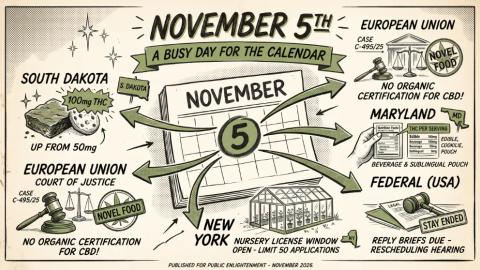
US rescheduling, in two tracks: what has changed, what is still waiting, and the dates that matter
Medical cannabis has been in Schedule III since 28 April. The DEA issued its first 900 federal registrations on 30 October, with a four-page guidance note and a 29 November supply-chain date. The wider move for all cannabis is paused in the DEA's own hearing. Here is the calendar, and the four places people are getting mixed up.
By Neil Cartwright · · 7 min read
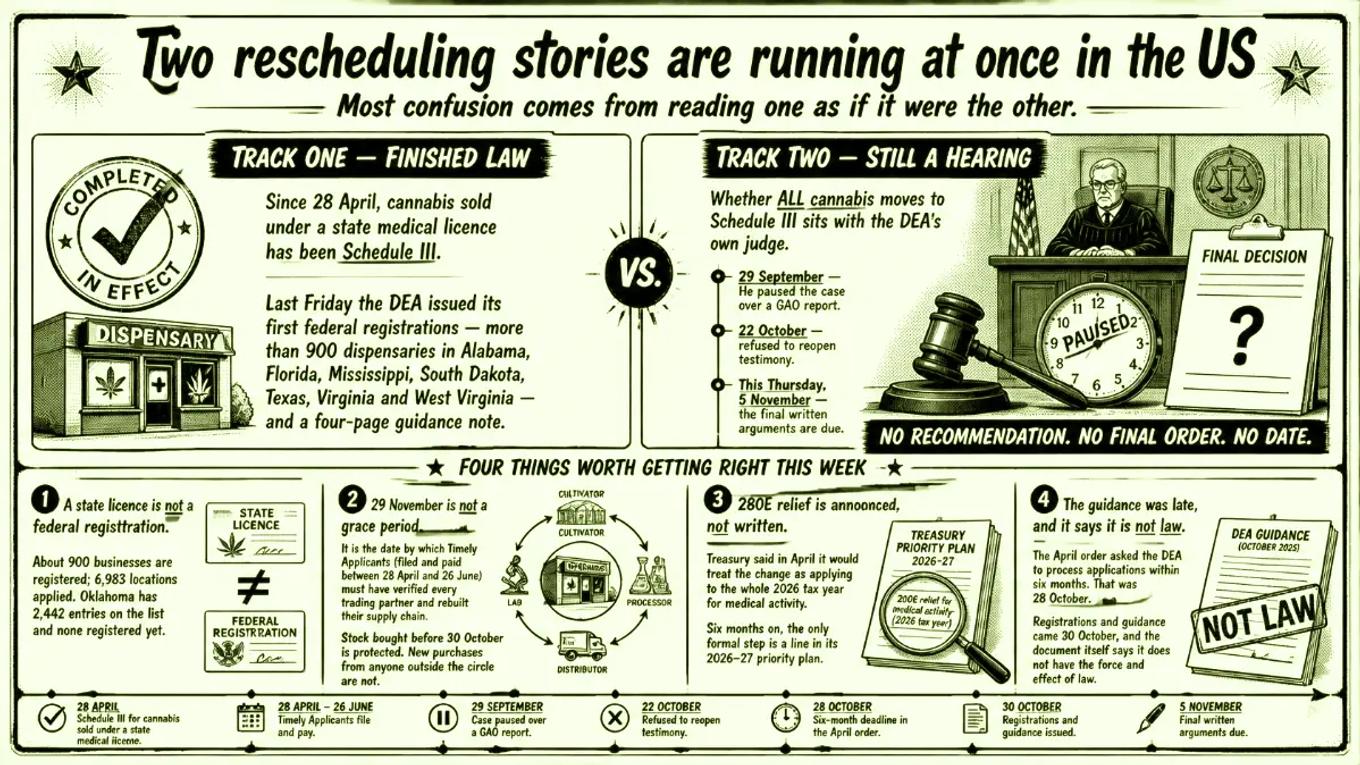
There are two rescheduling stories running at once in the United States, and most of the confusion comes from reading one as if it were the other.
The first is finished law. On 23 April 2026 the Acting Attorney General issued a final order moving two things from Schedule I to Schedule III: cannabis in an FDA-approved drug, and cannabis "subject to a state medical marijuana license". It took effect on 28 April, when it was published in the Federal Register (91 Fed. Reg. 22714), using the treaty provision in 21 U.S.C. § 811(d) that allows a scheduling change without notice and comment. Everything else, including every adult-use product, stayed in Schedule I.
The second is still a hearing. The same day, the DEA opened an expedited proceeding on whether all cannabis should move to Schedule III. Testimony ran from 29 June to 15 July. The judge's recommendation has been on hold since 29 September, and the last written arguments are due on 5 November.
What happened on 30 October
The medical track moved. The Department of Justice announced that the DEA had granted federal registrations to more than 900 dispensaries in Alabama, Florida, Mississippi, South Dakota, Texas, Virginia and West Virginia: the first phase, covering businesses that applied inside the order's 60-day window (28 April to 26 June) and passed a pre-registration check. Manufacturers and distributors are still being reviewed. Those need inspections, production controls and quota decisions, and no date was given.
The April order had asked the DEA to "make every effort" to process applications within six months. That date was 28 October. The registrations, the list of applicants and the guidance arrived two days later, and the dedicated application forms for manufacturers, distributors and laboratories, promised "in the coming weeks" over the summer, only went live in early October. That lateness is one reason businesses have been working from secondhand summaries rather than from the documents.
The guidance itself is a four-page DEA paper, Activities of Entities Holding State Medical Marijuana Licenses Who Applied for DEA Registration. It says what it is: "The contents of this document do not have the force and effect of law and are not meant to bind the public in any way." What it describes is how the DEA reads the existing rules during the transition.
- A Timely Applicant is a business that filed a complete application and paid the fee between 28 April and 26 June 2026, still holds its state medical licence, and whose application is still pending.
- Timely Applicants may deal with other Timely Applicants and with DEA registrants. Timely Applicants and registrants "may not lawfully engage in any schedule III medical marijuana activities" with anyone else. Doing so "could be potential grounds for denial of a Timely Applicant's application or revocation of a certificate of registration".
- Timely Applicants "are expected to complete these activities and establish compliant supply chains no later than November 29, 2026".
- Dispensers and distributors may keep selling stock acquired before the paper was issued, "including inventory previously obtained from entities that do not qualify".
- Testing: the DEA "does not intend to penalize" sending de minimis quantities to a non-registered laboratory in the same state, with full records, but product may not come back from one.
The dates
| Date | What happens | Track |
|---|---|---|
| 18 Dec 2025 | Executive Order 14370 tells the Attorney General to expedite rescheduling | Both |
| 23 Apr 2026 | Final order announced; expedited hearing notice; the 2024 hearing withdrawn | Both |
| 28 Apr 2026 | Order in force (91 Fed. Reg. 22714). The 60-day application window opens | Medical |
| 29 Apr 2026 | DEA dispensary registration portal opens | Medical |
| 26 Jun 2026 | Window closes. Applicants who filed and paid by now are "Timely Applicants" | Medical |
| 29 Jun to 15 Jul 2026 | Hearing on moving all cannabis to Schedule III | Broader |
| Sep 2026 | D.C. Circuit declines to pause the April order while Smart Approaches to Marijuana v. Kennedy proceeds; briefing runs to February 2027 | Medical |
| 23 Sep 2026 | GAO report on DEA and FDA scheduling procedures | Broader |
| 28 to 29 Sep 2026 | Opponents move to admit the report and reopen the hearing; the Chief Administrative Law Judge stays the case | Broader |
| 29 Sep 2026 | Treasury's 2026-27 priority guidance plan lists "Guidance under §280E". Nothing issued yet | Tax |
| Early Oct 2026 | DEA publishes manufacturer, distributor and laboratory application forms | Medical |
| 13 Oct 2026 | DEA responds: give the GAO report "no weight"; the discovery request is "a fishing expedition" | Broader |
| 22 Oct 2026 | The judge admits the report, refuses to reopen the hearing, orders briefs | Broader |
| 28 Oct 2026 | Six months from the order: the "make every effort" processing target | Medical |
| 29 Oct 2026 | Briefs on the GAO report due (ten pages) | Broader |
| 30 Oct 2026 | 900+ dispensaries registered in seven states; list of 6,983 applicant locations; the Timely Applicant guidance | Medical |
| 3 Nov 2026 | Massachusetts votes on Question 8, which would end adult-use sales from 2028 (state law, not rescheduling) | Neither |
| 5 Nov 2026 | Replies due; briefing closes. The judge may then issue a recommendation | Broader |
| 12 Nov 2026 | Federal hemp law, part one: products with cannabinoids the plant cannot make stop being hemp (Pub. L. 119-37 § 781). A different statute | Neither |
| 29 Nov 2026 | Timely Applicants expected to have compliant supply chains | Medical |
| 11 Dec 2026 | Federal hemp law, part two: 0.4 mg total THC per container | Neither |
| 31 Dec 2026 | End of the 2026 tax year. Whether a broader order can touch 2026 depends on when it is published: on the usual 30-day clock, a final order published after 1 December takes effect in 2027 | Tax |
Four things being mixed up
A registration is not a licence, and a licence is not a registration. The Department of Justice says so in terms: state licensure "does not automatically" grant federal registration, and a registered dispensary now has to meet federal rules on security, record-keeping and inventory. Roughly 900 businesses are registered; 6,983 locations applied. Oklahoma alone has 2,442 entries on the list and no registrations yet, because the first phase covered seven other states.
29 November is not a grace period. It is the date by which Timely Applicants should have checked every trading partner and rebuilt their supply chain. It does not say new purchases from non-qualifying suppliers are fine until then; only stock bought before 30 October is protected. And the guidance gives Timely Applicants that date; it does not plainly give already-registered businesses the same window.
280E relief is announced, not written. In April, Treasury said it expected to treat the change as applying for the whole taxable year that includes 28 April, for activities that no longer involve a Schedule I or II substance. Six months on, the only formal step is a line in the 2026-27 priority guidance plan. Until a notice is published, the transition rule is a stated intention. Businesses that run medical and adult-use side by side should expect an apportionment rule. The Department of Transportation has already said the April order changes nothing in its drug-testing rules.
The hearing is about something the April order did not do. The April order never touched adult-use cannabis, and the 22 October order does not extend it. If the broader proceeding ends with all cannabis in Schedule III, that is a new final order with its own effective date, open to challenge in court like the first one. The judge's recommendation, the Administrator's decision and the 30 days after publication all still have to happen, and the briefing only closes on 5 November.
What to do this month
- If you applied between 28 April and 26 June: pull your DEA submission confirmation, verify its document control number, collect your partners' confirmations or certificates, confirm their state licences are active, and keep the file. Do it before 29 November.
- If you did not apply in the window: you are not a Timely Applicant. A late or incomplete application does not count, and registered businesses are told not to trade with you until your registration is granted.
- If you are registered: assume the federal security, inventory and record-keeping rules apply from the date on your certificate, and check which laboratory you use.
- For tax: keep separate books for medical and adult-use activity now. The apportionment question is the one Treasury has said it will answer.
This is information, not legal advice. The documents are linked below; read them before acting on a summary of them, including this one. Green Ark will update this article as the dates move.
Sources
- Department of Justice, "Justice Department Announces Issuance of Federal Registrations for Medical Marijuana Dispensaries", 30 October 2026
- DEA, "Activities of Entities Holding State Medical Marijuana Licenses Who Applied for DEA Registration", 30 October 2026
- Final rule, 91 Fed. Reg. 22714, and hearing notice, 91 Fed. Reg. 22777 (28 April 2026), summarised by Gibson Dunn
- Foley Hoag, DOJ, Treasury and DEA updates since the 23 April order and on the October application forms
- Harris Sliwoski (via Legal 500) on the 29 September stay
- The 22 October order and the briefing dates
- Kocot Law on the Timely Applicant guidance
- Marijuana Moment on the guidance
- Treasury's 2026-27 priority guidance plan, as reported
- Timeline and the 2026 tax-year arithmetic
Information, not legal advice. Check the primary source before relying on it.