Study links state cannabis laws to lower VHA opioid prescribing, with mixed results
A peer-reviewed study of Veterans Health Administration records from 2013 to 2022 associates state medical cannabis laws with fewer long opioid prescriptions. It also reports small rises in high-dose and co-prescribing. The findings sit alongside an unchanged VA rule that bars its clinicians from recommending cannabis.
By Neil Cartwright · · 3 min read
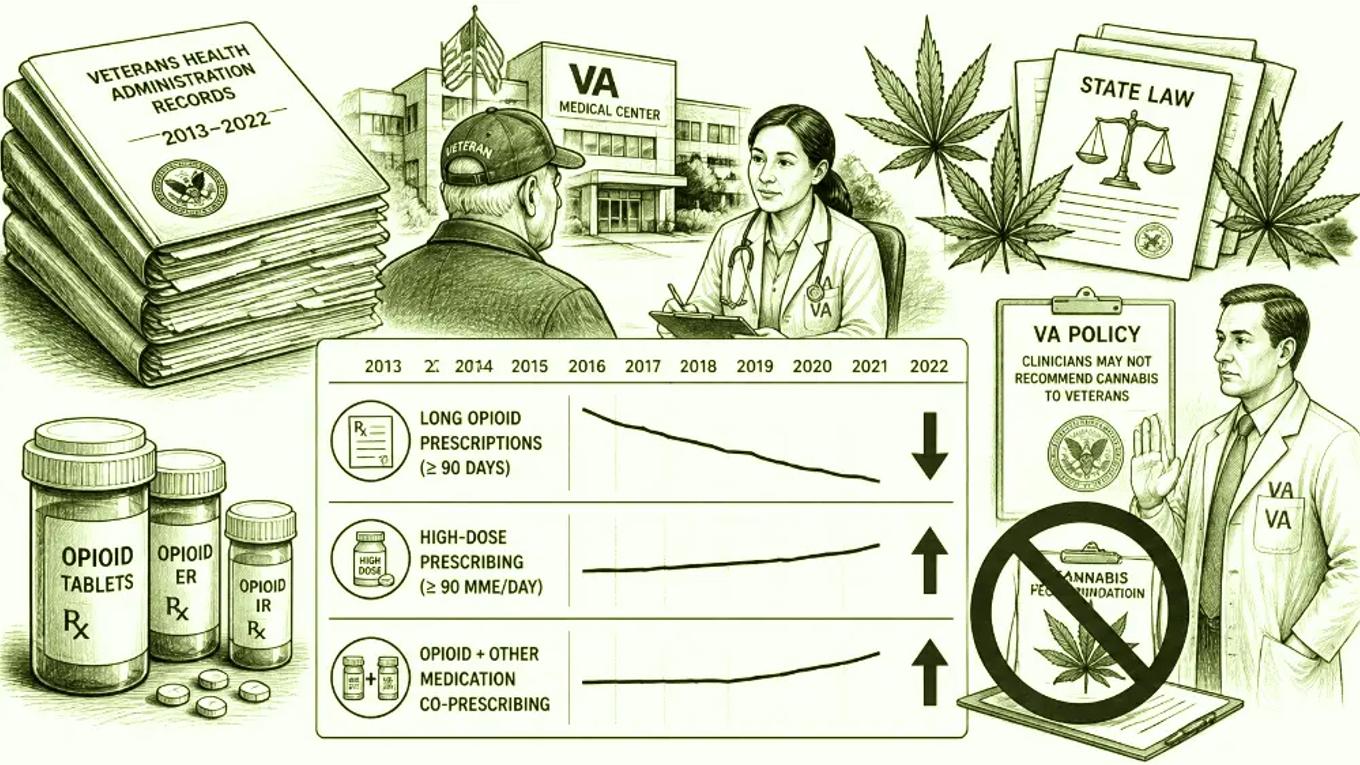
Researchers at Columbia University and other institutions, with VA-affiliated authors, report that US state cannabis laws are associated with lower opioid prescribing to veterans with chronic pain. The article was published in the Journal of General Internal Medicine on 28 September 2026, having been accepted on 10 August 2026. It was funded by the National Institute on Drug Abuse (R01DA048860).
Editor's Note: The full text is behind a paywall, so this report relies on the abstract.
What the study found
The authors used VHA electronic health records for 2013–2022 covering patients aged 18 to 75 with chronic pain diagnoses. Using a staggered-adoption difference-in-differences design, they compared states with medical cannabis laws (MCL), states with MCL plus recreational laws (RCL) and states with neither.
Against states with no law, MCL enactment was associated with:
- ≥30 days of opioids: −0.79 percentage points (95% CI −0.86 to −0.71).
- Long-term opioid therapy (≥90 consecutive days, no gap over 15 days): −0.34 points.
- High-dose opioids (≥50 morphine milligram equivalents): 0.09 points.
- Opioid/benzodiazepine co-prescribing: 0.11 points.
The abstract describes the last two as "smaller declines", yet the figures are printed as positive. Whether they show small rises or small falls is therefore unclear from the abstract alone.
After RCL enactment, compared with MCL, the estimates were −0.14 (≥30-day), −0.33 (high-dose) and −0.33 (co-prescribing). Reductions were generally more consistent among people aged 65–75. The authors conclude that greater legal access "may be associated with modest reductions" in opioid prescriptions. They do not claim causation.
What this means
Our analysis: on the abstract's own figures, MCL enactment is associated with about 79 fewer veterans per 10,000 with ≥30-day opioid use, but the high-dose and co-prescribing measures moved by under 12 per 10,000. That is our scaling of percentage points, assuming they apply directly to a group of 10,000 chronic pain patients. Baseline rates are not in the abstract.
The VA rule has not changed
VHA Directive 1315, first issued in December 2017, bars VA clinicians from recommending medical cannabis or completing state forms. It permits discussion and says cannabis use is not grounds for denying care (VA publication). The April 2026 DEA order (91 Fed. Reg. 22714) did not amend it, and no VA amendment had been found when we last verified on 8 October 2026. The association therefore runs through state law and patient choice, and perhaps clinician decisions, which is the authors' own wording. It does not run through VA endorsement.
The data predate rescheduling
The data end in 2022. The April 2026 rule moved only FDA-approved products and marijuana under a "state medical marijuana license" to Schedule III. Adult-use activity stays in Schedule I. The study's RCL-versus-MCL contrast concerns the Schedule I category, and it says nothing about the rescheduling's effects.
Policy debate
Three federal measures could change the VA position. H.R. 1384, the Veterans Equal Access Act, has been referred to a House subcommittee and not enacted (bill page). The House passed the FY2027 MilCon-VA bill with recommendation language on 20 May 2026, according to NORML, and no later Senate status is known. H.R. 10655, a research bill, was sent to committee on 1 October 2026. Policy advocates and counsel to veterans' groups could cite the study, bearing in mind its modest and mixed effects. No report links the study to any of these measures.
Benefits practice
The study does not touch benefits law. Cannabis use is generally not a bar to VA care or benefits, but it is recorded in VA records and can be relevant evidence in some claims. Our guidance material advises consulting a VA-experienced disability attorney before disclosure.
For related reading, see our existing coverage of VA Directive 1315 and veterans' benefits, and the 21 October 2026 report by The Marijuana Herald on a Massachusetts bill for veterans' medical cards, which has not become law.
This is information, not legal, tax or financial advice.
Limits
- Only the abstract was available. Age-specific estimates, state lists, confounder handling and the authors' stated limitations are not known to us.
- The study is observational. It estimates associations, not causal effects, and it covers VHA patients only.
- The Senate status of the FY2027 bill and any amendment to Directive 1315 after 8 October 2026 are unknown.
Sources
- Mannes ZL, Wall MM, Stohl M et al., Cannabis Legalization and Opioid Prescribing in Veterans Health Administration Patients: 2013–2022, J Gen Intern Med (28 September 2026)
- VA publication on Directive 1315
- DEA final rule, 91 Fed. Reg. 22714
- H.R. 1384 bill page
- NORML report, 20 May 2026
- Congress.gov, H.R. 10655
- The Marijuana Herald, 21 October 2026
Based on Cannabis Legalization and Opioid Prescribing in Veterans Health Administration Patients: 2013–2022 (Journal of General Internal Medicine (Springer Nature); authors led by Zachary L. Mannes and Deborah S. Hasin, 28 September 2026).
Information, not legal advice. Check the primary source before relying on it.


