Who may prescribe medical cannabis? Luxembourg trains its doctors, Britain asks for a specialist, Australia asks the regulator
Luxembourg lets any doctor prescribe after a state course. That puts it between the UK's specialist gate and Australia's open door, and close to the American states. Germany needs no course at all.
By Neil Cartwright · · 8 min read
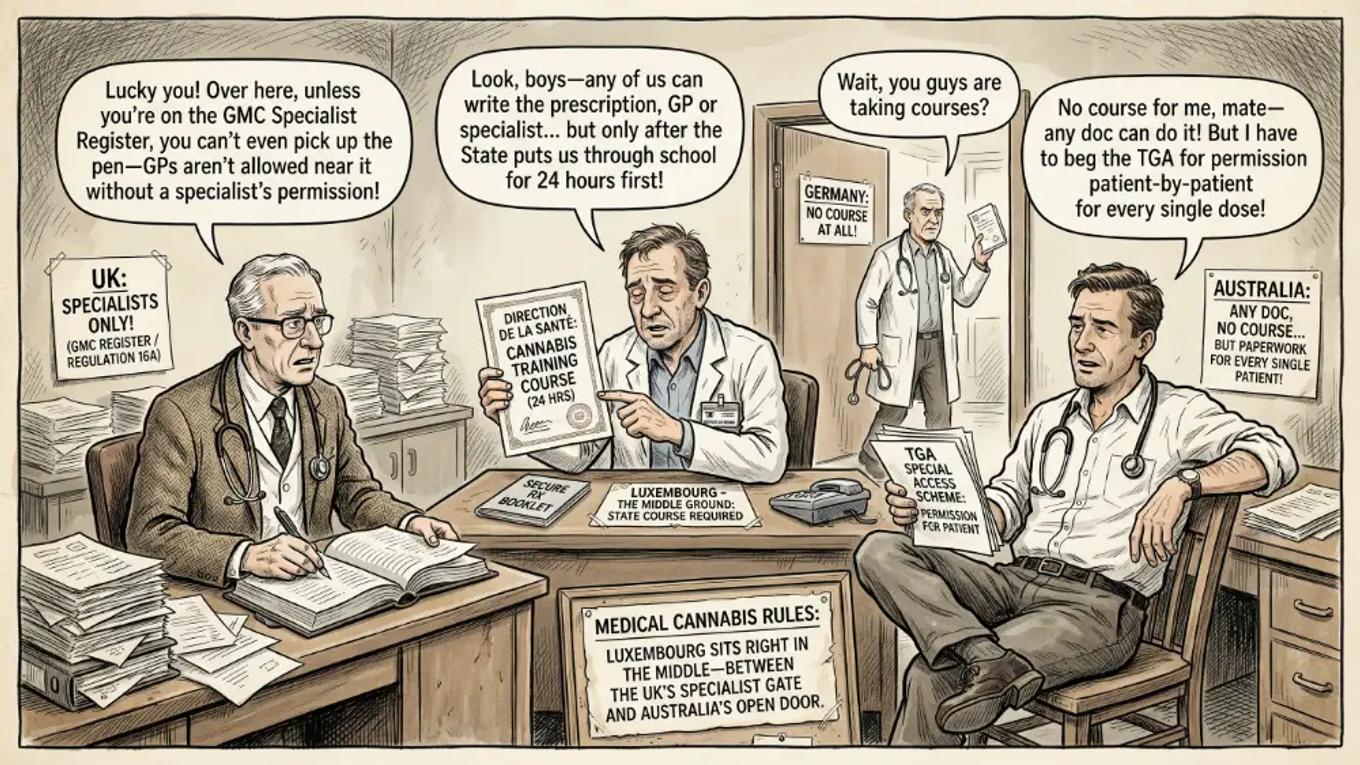
In one line: Luxembourg lets any doctor licensed there prescribe medical cannabis, but only after a course run by the state. That puts it in a third group, between the United Kingdom's specialist gate and Australia's open door, and close to how most American states work.
What changed, and what did not
The Direction de la santé's page for its medical cannabis training course was updated this week. It now opens with a sentence citing the law of 20 July 2018: any doctor authorised to practise in Luxembourg may prescribe medical cannabis to a patient, provided they have first completed the training organised by the Direction de la santé.
The rule itself is not new. The 2018 law created the programme, which has run since February 2019. What the page does is state the rule plainly, on the page a doctor would find when looking for the course. It is a useful moment to set Luxembourg against the other ways countries decide who may write a cannabis prescription.
Luxembourg in brief
- Who prescribes: any doctor authorised to practise in Luxembourg, GP or specialist, who has completed the certified training. A doctor without it can refer the patient to one who has.
- The training: run and certified by the Direction de la santé. The 2018 parliamentary committee report capped it at 24 hours.
- Who qualifies: three groups only: severe, disabling chronic pain in an advanced or terminal long-term illness, where drugs have failed or none exist; nausea or vomiting from chemotherapy; and spasticity in multiple sclerosis. Severe chronic pain was 99% of prescriptions in 2024.
- The prescription: a secure form from a numbered booklet, taken within 60 days to one of four hospital pharmacies.
- The product: since 1 January 2025, CBD-rich and balanced THC/CBD flower and oil extracts; THC-rich flower was withdrawn. The limit fell from 100 g to 60 g of flower per 28 days.
- The cost to the patient: none. The guide says medical cannabis is dispensed free of charge during the pilot phase.
The answer to the question
Is Luxembourg like the UK? No. In the UK only a doctor on the General Medical Council's Specialist Register may start a prescription for a cannabis-based product (regulation 16A of the Misuse of Drugs Regulations 2001). A GP can continue one only under shared care, once the specialist has handed over. In Luxembourg a GP can prescribe from the start.
Is it like Australia? Not quite. In Australia any registered medical practitioner or nurse practitioner may prescribe, with no federal requirement to be a specialist and no compulsory course. The control is on the product instead: most cannabis medicines are unapproved, so the prescriber needs approval from the Therapeutic Goods Administration for each patient (the Special Access Scheme) or authorisation to prescribe to a class of patients (the Authorised Prescriber scheme). Luxembourg asks the doctor to qualify once, then lets them prescribe without asking anyone's permission case by case.
So where does it sit? With the American states, most of which require a short course before a doctor may certify a patient, and with the UK's own professional expectation that prescribers should be trained. The difference is that in Luxembourg the state itself runs the course and issues the certificate.
Four ways to decide who prescribes
In one line: every country controls access somewhere; the question is whether it controls the doctor, the patient's condition, the product or the payment.
- The specialist gate. Only senior specialists may start treatment. The UK and Ireland. Ireland is stricter still: only a hospital consultant may prescribe under its Medical Cannabis Access Programme, and only for three conditions.
- The trained-doctor gate. Any licensed doctor, after a course. Luxembourg, and most US states: New York requires an approved course (OCM's page still says at least two hours), Florida a two-hour course and examination before approval and each renewal, Ohio two hours of medical education a year, Pennsylvania a four-hour course, Massachusetts 2.0 Category 1 credits.
- The product gate. Any doctor or nurse practitioner, but the regulator approves the use of an unapproved medicine, for each patient or class of patients. Australia.
- The open door. Any licensed doctor, no course, no per-patient approval. Germany since 1 April 2024, and Canada, where a physician or nurse practitioner signs a "medical document" for any condition.
Most countries then add a second control: what the patient must have (a condition list), where the product comes from (pharmacy or dispensary), and who pays.
Country by country
| Jurisdiction | Who may prescribe or certify | Extra step for the doctor | Conditions | Dispensed by | Paid by |
|---|---|---|---|---|---|
| Luxembourg | Any doctor licensed in Luxembourg | State-certified training | Three groups | Four hospital pharmacies | Free to the patient (pilot) |
| United Kingdom | Specialist Register doctors only; GPs under shared care | None beyond specialist status | No statutory list | Pharmacies | Mostly private; over 99% of prescriptions are private |
| Ireland | Hospital consultants | Enrolment in the programme; HSE notified of first prescription | Three conditions | Pharmacies | Case by case |
| Australia | Any medical practitioner or nurse practitioner | TGA approval per patient, or Authorised Prescriber status; state approvals for Schedule 8 | No list | Pharmacies | Mostly private |
| Germany | Any licensed physician (not dentists or vets) | None | None for private prescriptions; strict test for insurance | Pharmacies, including mail order | Patient, or statutory insurer after prior approval; insurers stopped paying for flower on 30 July 2026 |
| Canada | Physicians and nurse practitioners | None federally | No list | Federally licensed sellers | Mostly private |
| New York | Practitioners licensed to prescribe controlled substances | Approved course | Statutory list plus any condition the practitioner certifies | Medical dispensaries with pharmacists | Patient; not a Medicaid benefit |
| Florida | Qualified physicians | Two-hour course and exam, repeated at each renewal | Statutory list | Licensed treatment centres | Patient |
| Ohio | Physicians with a certificate to recommend | Two hours of education a year | Statutory list | Licensed dispensaries | Patient |
| Pennsylvania | Registered practitioners | Four-hour course | Statutory list | Licensed dispensaries | Patient |
Germany and the American states
In one line: Germany treats cannabis as a medicine any doctor may prescribe; the American states treat it as a programme a trained doctor may admit you to.
- Prescription or certification. A German doctor writes an ordinary prescription, now often an e-prescription, because the 2024 law took cannabis out of the Narcotics Act. An American doctor does not prescribe at all. They certify or recommend, and the patient registers with the state. The programmes were built that way because cannabis was a Schedule I drug under federal law.
- Training. Germany requires none. Most states require a course, from New York's approved course to Pennsylvania's four hours.
- Conditions. Germany sets no condition for a private prescription. The states range from fixed lists (Florida, Ohio, Pennsylvania) to New York's list plus "any other condition certified by the practitioner".
- Where the patient goes. In Germany, a pharmacy, including an online one. In the states, a licensed dispensary that is not a pharmacy, though New York requires a pharmacist on site.
- Who pays. German statutory insurance pays, after the insurer approves the first prescription, for serious illness where standard treatment is unavailable or unsuitable, and since 30 July 2026 only for extracts and dronabinol or nabilone medicines. No American state programme is covered by Medicaid.
- Telemedicine. Both allow it. Germany's online platforms have become a major route to private prescriptions, and a government bill would require an in-person first consultation and end postal dispatch. It is not yet law. New York allows certification by telehealth.
The German model produced the faster growth: private prescriptions and imports rose sharply after April 2024, which is why the government now wants to tighten the telemedicine route. The American model produced registries, which is why New York can say it has 69,031 registered patients and 4,820 certifying practitioners. Germany has no equivalent count.
What the gates seem to do
The numbers that exist are not comparable, because some count patients, some count approvals and some count registrations. They are still worth setting side by side.
- United Kingdom: no registry. Estimates of active private patients range from about 50,000 to over 100,000, and more than 99% of prescriptions are private. The specialist gate did not stop a market forming; it moved it into private clinics.
- Australia: more than 113,000 Special Access Scheme approvals in the first half of 2025 alone. The regulator, Ahpra, now warns against consultations lasting seconds and prescribing that "cannot be achieved in a short online consultation".
- Canada: 161,267 medical registrations with licensed sellers in March 2025, authorised by 4,172 practitioners.
- Luxembourg: a small programme, almost entirely for chronic pain, run through four hospital pharmacies at no cost to the patient.
The pattern is that the open models grow fastest and then add controls on how doctors practise (Australia's Ahpra guidance, Germany's pending bill). The closed models grow slowly through the public system and quickly through private clinics. Luxembourg's trained-doctor gate, combined with free supply and a short condition list, has kept its programme small and medical.
How to read it if you advise or run a cannabis business
- Clinic operators planning a new market: the prescriber rule decides your staffing. A specialist gate (UK, Ireland) means recruiting consultants; a training gate (Luxembourg, most US states) means putting GPs through a course; an open door (Germany, Canada) means competing with platforms.
- Producers and importers: in Luxembourg the buyer is the state, through four hospital pharmacies, and only CBD-rich and balanced products are now dispensed. In Germany the insurer no longer pays for flower; the private market does.
- Telemedicine businesses: watch Germany's MedCanG amendment (printed paper 21/3061) and Australia's Ahpra guidance; both target remote prescribing.
- Doctors in Luxembourg: the course is the condition. Contact the Direction de la santé at infocannabis@ms.etat.lu for the next session.
This article is information, not legal advice.
Sources
- Direction de la santé, Formation sur le cannabis médicinal (page updated 25 November 2026)
- Cannabis Knowledge Base: Luxembourg (Qualifying Conditions and Clinicians; Medical Programme; Licence Types)
- Cannabis Knowledge Base: United Kingdom (Medical Access and Prescribing; Market Sizing); Misuse of Drugs Regulations 2001, regulation 16A
- Cannabis Knowledge Base: Ireland (Qualifying Conditions and Clinicians; Medical Program)
- Cannabis Knowledge Base: Australia (Medical Program; Qualifying Conditions and Clinicians); Australian Capital Territory (Medical Program)
- Cannabis Knowledge Base: Germany (Medical Access and Prescribing; Health Insurance Coverage)
- Cannabis Knowledge Base: Canada (Qualifying Conditions and Clinicians; Medical Programme)
- Cannabis Knowledge Base: New York (Qualifying Conditions and Clinicians; Medical Program)
- Florida, Stat. § 381.986; Ohio, Admin. Code 4731-32-02; Pennsylvania, 28 Pa. Code ch. 1181a; Massachusetts, 935 CMR 501.000
Information, not legal advice. Check the primary source before relying on it.