Colorado marijuana taxes bring in $19.3m in August as 2026 sales run 3.5% below last year
The Colorado Department of Revenue reports $19,322,443 in marijuana tax and fee revenue for August 2026 and $111.2m of sales in July. Twelve years in, the state has collected $3.26bn from a market that is shrinking slowly rather than collapsing.
By Neil Cartwright · · 6 min read
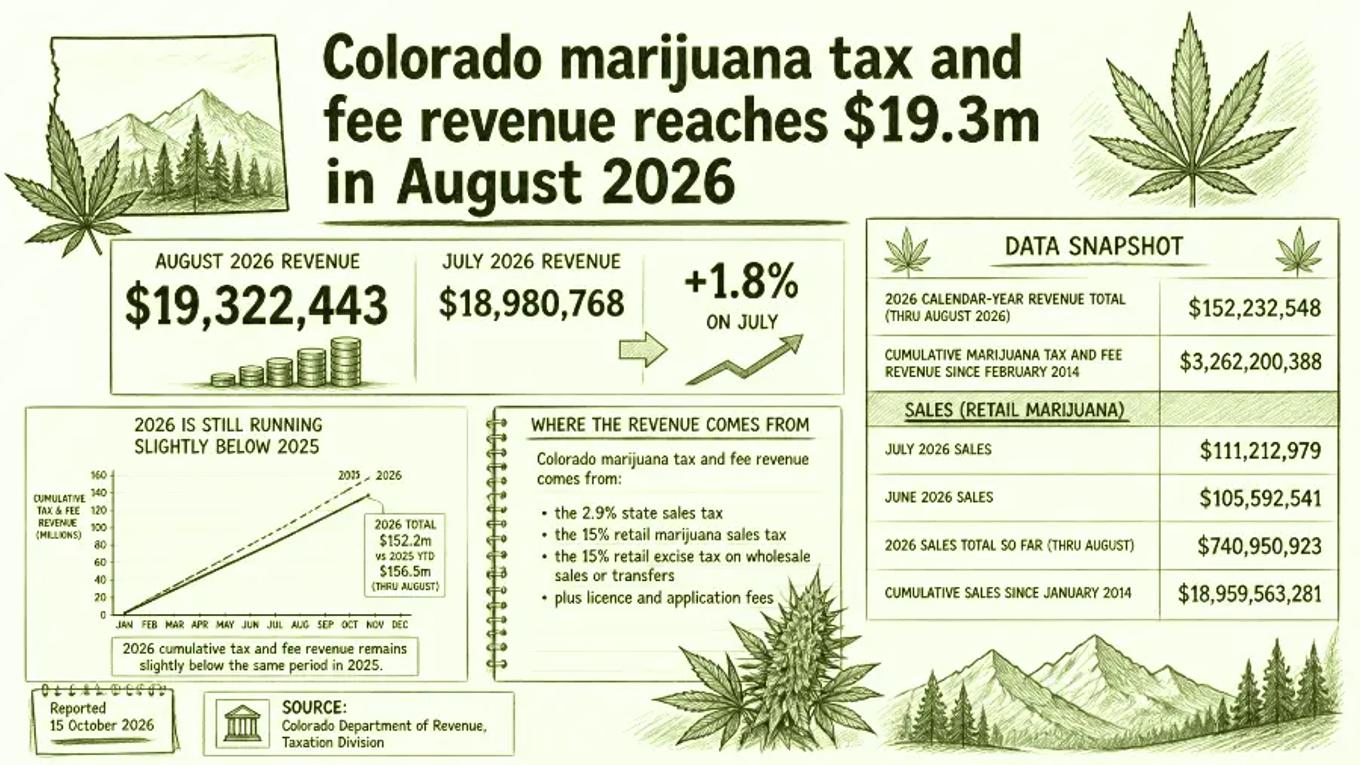
The Colorado Department of Revenue’s Taxation Division published its monthly marijuana figures on 15 October 2026. Tax and fee revenue for August 2026 was $19,322,443, up from $18,980,768 in July. Sales for July 2026 (the Department reports sales one month behind revenue) were $111,212,979, up from $105,592,541 in June.
For the 2026 calendar year so far, the Department reports $152,232,548 in tax and fee revenue and $740,950,923 in sales. Since the first legal sales in 2014 the running totals are $3,262,200,388 in revenue and $18,959,563,281 in sales.
The revenue total is made up of the 2.9% state sales tax on marijuana sold in stores, the 15% state retail marijuana sales tax, the 15% state retail marijuana excise tax on wholesale sales and transfers of retail marijuana, and licence and application fees. The Department points readers to its Marijuana Sales Reports and Marijuana Tax Reports for the detail, and to its Disposition of Marijuana Tax Revenue page for how the money is allocated, including to public schools. The release does not split medical from retail sales; that is in the separate Marijuana Sales by County Report.
What changes in the law we track
Nothing in this release changes a rule. Colorado’s marijuana tax rates are as they were: a 15% retail marijuana sales tax on sales to consumers, a 15% excise tax on the first sale or transfer from a retail cultivation facility, and the 2.9% state sales tax on medical marijuana, which pays no excise (C.R.S. Title 39, Article 28.8). Two things are pending and worth watching: the Department’s Notice of Proposed Rulemaking on Retail Marijuana Taxes, published on 15 October 2026 with no detail or dates yet given; and HB 26-1077 (signed 3 June 2026), which requires separate average market rates for fresh frozen indoor and outdoor unprocessed retail marijuana, with rules due by 1 July 2027.
What this means
Colorado’s market is shrinking at about 3.5% a year on sales and faster on tax revenue, and the state has so far responded with rulemaking on the excise base rather than any change to its rates.
For operators and investors: a slow decline, not a cliff
The Department’s own sales reports put 2025 total sales at $1,315,678,364, down from $1,397,131,978 in 2024 (a 5.8% fall). Our analysis: 2025 averaged $109.6m a month; the $740.95m reported for January to July 2026 averages $105.9m a month, 3.5% lower. If the rest of 2026 runs at that pace the year lands near $1.27bn. July’s $111.2m was the strongest month of the year so far, so the decline is slowing rather than accelerating. The Joint Budget Committee staff briefing for FY 2026-27 describes the same pattern in California and Washington: the mature markets are all past their peak. For anyone valuing a Colorado licence, the useful comparison is this year’s run rate, not the headline cumulative figure.
For public finance: revenue is falling faster than sales
Our analysis: $152.2m over eight months is $19.0m a month, or about $228m a year. The Division of Criminal Justice’s Impacts of Marijuana Legalization in Colorado report puts total marijuana tax revenue at $423.5m in 2021 and $274.1m in 2023; the Legislative Council’s Marijuana Handbook gives $248.2m for the 2023-24 fiscal year. On those figures 2026 is running roughly 17% below 2023 and 46% below the 2021 peak. The bases differ (calendar year against fiscal year, and the reports may define revenue slightly differently), so treat these as orders of magnitude, but the direction is clear: because the excise is charged on wholesale value, falling wholesale prices cut revenue faster than retail sales fall. This matters for the regulator as much as the Treasury: a report by High Times (13 October) says the Marijuana Enforcement Division can afford 84 of its 158 posts, and the State Auditor’s report, as reported by MJBizDaily and Ganjapreneur on 20 and 21 October, found shortfalls in product testing oversight.
For cultivators and wholesalers: watch the excise base, not the rate
The 15% excise is calculated on the contract price between unaffiliated businesses, or on the Department’s quarterly average market rate for transfers to affiliated stores (C.R.S. § 39-28.8-101(1.5)). For 1 October to 31 December 2026 the AMR for retail bud is $601 a pound; our analysis: that is $90.15 of excise per pound at first transfer, with trim at $204 a pound ($30.60) and bud for extraction at $425 ($63.75). Our analysis: the Department’s August revenue divided by July sales gives an effective state take of about 17.4% of retail value, which is what you would expect when the excise sits on wholesale rather than shelf prices. HB 26-1077 will split the fresh-frozen AMR into indoor and outdoor rates by 1 July 2027, and the 15 October rulemaking notice may touch the same ground. Vertically integrated operators, whose transfers are taxed on AMR, have the most at stake in both and should read the draft rules when the Department publishes them.
For medical businesses: a lower tax burden, and a federal change on top
Medical marijuana pays the 2.9% state sales tax and no excise. Since 28 April 2026 the DEA’s final rule (91 FR 22714) has placed marijuana covered by a state medical licence in Schedule III, and states that such licensees “will no longer be subject to the deduction disallowance imposed by Section 280E”. Colorado already allows a state deduction for 280E-disallowed expenses (Department of Revenue Book 104, line 16 of DR 0104AD). Adult-use marijuana remains in Schedule I. The release does not say how much of the $111.2m was medical; the Sales by County Report does, and medical operators modelling 2027 should start there.
Colorado against the other mature markets
Colorado has held its rates steady while its neighbours’ debates are about rates. These are reports, not law:
| Place | Tax position | Status |
|---|---|---|
| Colorado | 15% retail sales tax + 15% excise on wholesale; medical 2.9% | In force; rulemaking notice 15 Oct 2026, no detail yet |
| Nevada | Lawmakers weighing a higher point-of-sale excise after a reported 40% fall in excise revenue from the 2021 peak | Reported by MJBizDaily (27 Oct) and Ganjapreneur (30 Oct); no bill passed |
| Michigan | Bill proposed to suspend the 24% wholesale tax for 12 months | Reported by MJBizDaily (30 Oct); not law |
| Connecticut | THC-potency tax replaced by a flat 10.75% excise on adult-use retail from 1 Oct 2026 | Reported by LexBlog (20 Oct); not yet reviewed by us against the statute |
| California | Commissioning new studies on cannabis taxation and market conditions | Reported by The Marijuana Herald (22 Oct) |
The option these reports describe for other states, cutting or restructuring the tax to slow the decline, has not been proposed in Colorado. The Department’s rulemaking is about how the excise base is measured. Operators and trade bodies who want the rate itself discussed will need to raise it with the General Assembly, not the Department.
This is information, not legal, tax or financial advice.
Limits
- The release pairs August revenue with July sales; the two figures cover different months and the ratio between them is our calculation, not a published effective rate.
- The 2021 and 2023 revenue figures come from the Division of Criminal Justice and the 2023-24 figure from the Legislative Council; their definitions of “marijuana tax revenue” may not match the Department’s monthly total.
- The 15 October Notice of Proposed Rulemaking on retail marijuana taxes gives no content or dates, so what it changes is not yet known.
- The Nevada, Michigan, Connecticut and California positions are from news reports and have not been checked against the statutes.
Sources
- Colorado Department of Revenue, Marijuana Sales Generate More Than $19M in Revenue in August 2026, 15 October 2026
- Colorado Department of Revenue, Marijuana Sales Reports, Marijuana Sales Tax, Marijuana Excise Tax, Average Market Rate
- Colorado Department of Revenue, Notice of Proposed Rulemaking – Retail Marijuana Taxes, 15 October 2026
- Colorado General Assembly, HB 26-1077; Legislative Council Staff, Marijuana Handbook 2024; Joint Budget Committee, FY 2026-27 staff briefing
- Colorado Division of Criminal Justice, Impacts of Marijuana Legalization in Colorado, 2025
- DEA, Schedules of Controlled Substances: Rescheduling of FDA-Approved Products, 91 FR 22714, 28 April 2026
- Reports: MJBizDaily on Nevada, Ganjapreneur on Nevada, MJBizDaily on Michigan, LexBlog on Connecticut, The Marijuana Herald on California, MJBizDaily on the Colorado audit, High Times on regulator funding
Information, not legal advice. Check the primary source before relying on it.