Company round-up: what three weeks of corporate announcements say about where the legal risk is
About 150 company announcements from 13 October to 3 November, read against the law that moved in the same weeks. Five patterns, each scored for severity and likelihood: who the DEA's first registrations sort out, where hemp revenue is already going, valuations priced to a reform probability, enforcement and insolvency outside the US, and the local fees, taxes and payroll cases that are actually hurting operators.
By Neil Cartwright · · 12 min read
This is a reading of about 150 company announcements that passed through our Companies desk between 13 October and 3 November, set against the law changes that landed, or are about to land, in the same three weeks. It is not a market report. The question we asked of each announcement was the one an in-house lawyer asks: what exposure does this create or remove, how likely is it to bite, and what is the date?
The short answer is that companies are re-organising themselves around legal lines before the law has finished moving. The biggest operators are splitting medical from adult-use, moving capital from North America to Europe, and marking their own valuations to a probability of federal reform. The smaller ones are being sorted by fees, taxes, local approvals and, increasingly, criminal enforcement on the back office. Five patterns follow, each scored on the severity-by-likelihood matrix (1 to 5 on each axis; 16 or more is red, 10 to 15 orange, 5 to 9 yellow).
1. Rescheduling is sorting the US industry into the registered and the unregistered
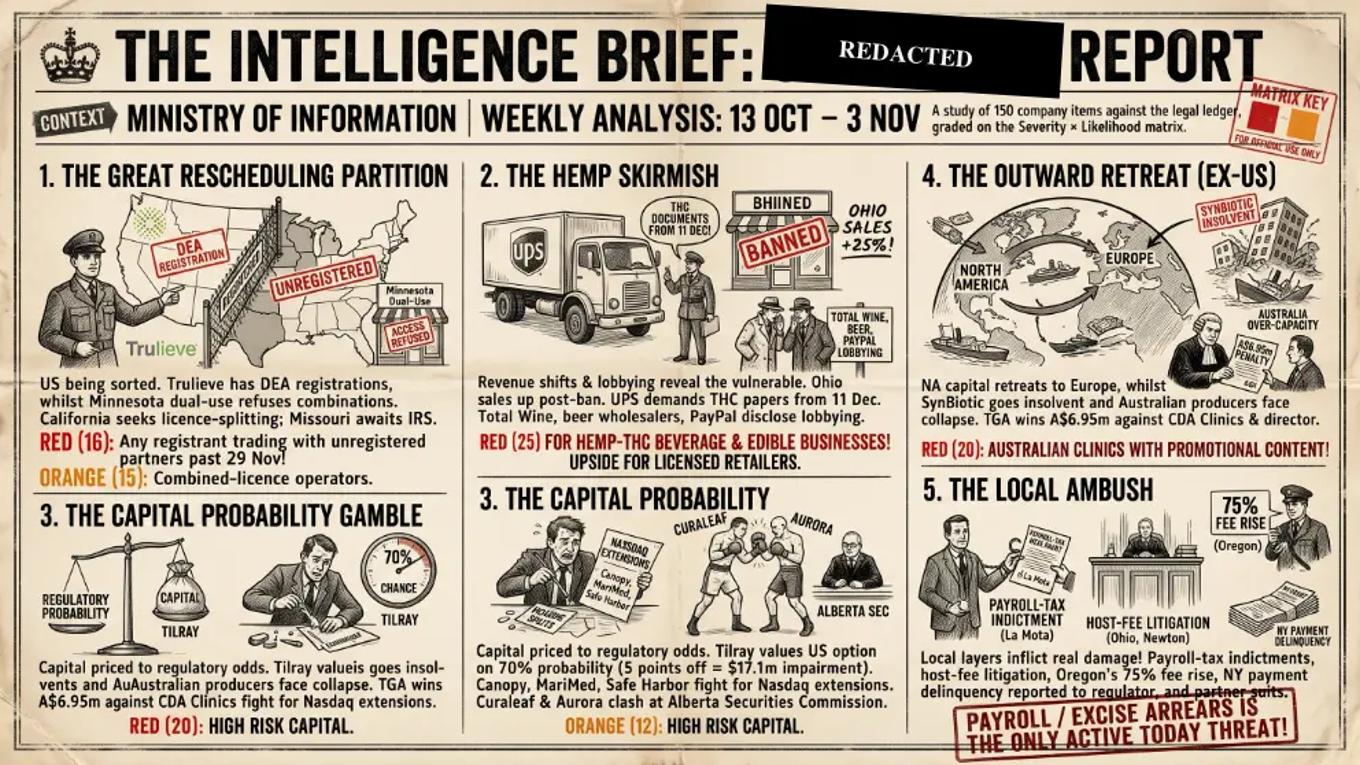
What companies announced. Trulieve said on 2 November that some of its medical dispensaries are among the 900-plus the DEA registered on 30 October. It is the only major multistate operator to say so, and that is not an accident: Trulieve reorganised itself as a medical-only company before its New York Stock Exchange listing in June. Vireo Growth announced DEA registrations for its Florida dispensaries the same day, a fortnight after a $21 million Florida purchase and three weeks after Nevada approved its Planet 13 acquisition. On the other side of the line, a Minneapolis dual-use retailer told the Star Tribune the DEA refused it because "non-medical use of marijuana remains prohibited under federal law"; Minnesota licenses medical and adult-use together, so nobody there qualifies. Missouri operators are waiting for IRS guidance on how §280E relief applies to mixed sales. California's regulator proposed permanent rules letting retailers split their medical and adult-use licences so that the medical half can apply. Verano, reporting $212 million of quarterly revenue, pointed investors to Virginia's adult-use launch next year, in a state that is one of the seven where the DEA has just registered medical pharmacies.
The law behind it. The 23 April final order put state-licensed medical cannabis in Schedule III; the all-cannabis hearing is stayed with reply briefs due 5 November. The DEA's 30 October paper says Timely Applicants and registrants may deal only with each other and are "expected to … establish compliant supply chains no later than November 29, 2026"; anything else "could be potential grounds for denial … or revocation". The paper "does not have the force and effect of law", which is cold comfort to a registrant whose registration is the thing at stake.
The exposure. Three different companies face three different risks from one document:
- A registered or Timely Applicant medical operator that still buys from, sells to or tests through an unregistered partner. Severity 4 (loss of registration, and with it the tax position), likelihood 4 before 29 November. Score 16, red. Action: partner audit, written confirmations, laboratory check, done this month.
- A dual-licence operator in a combined-licence state (Minnesota is the live example). Severity 3 (no federal recognition, no §280E relief on the medical side), likelihood 5. Score 15, orange. Action: state-level licence separation, where the regulator offers it, as California now does.
- A medical-only applicant outside the seven states, still waiting. Severity 2, likelihood 3. Score 6, yellow. Action: keep the file, do nothing rash, and read the Timely Applicant paper rather than summaries of it.
2. Hemp intoxicants: the revenue is already moving, and the lobbying tells you who expects to lose
What companies announced. MJBizDaily reported Ohio cannabis sales up 25 per cent after the state pushed hemp THC products out of unlicensed shops, a direct transfer to licensed multistate operators. UPS will require THC testing documentation on hemp shipments from 11 December. Total Wine disclosed $510,000 of lobbying on hemp THC beverages; the National Beer Wholesalers Association and the National Restaurant Association disclosed their own; PayPal reported lobbying on cannabis banking. A Republican congressman wants hemp rules put into the tax reconciliation bill, and there is open talk of a "rescue after the midterms, but with new rules". An Illinois state-funded study found 26 per cent of tested hemp edibles over 10 mg THC a piece, one at 121 mg. New Jersey's Legislature is moving a bill to extend its hemp drinks deadline. Rare Cannabinoid Company and Joy Organics put out holiday gift guides for CBD products as if nothing were happening, which for THC-free product is roughly right.
The law behind it. Pub. L. 119-37 § 781 has two dates: 12 November 2026, when cannabinoids the plant cannot make stop being hemp, and 11 December 2026, when the 0.4 mg total THC per container cap arrives. The Congressional Research Service confirmed both, and also that the FDA has still not published the cannabinoid lists the statute requires. A federal "rescue" is possible only after 3 November and would need to move through a lame-duck Congress before 11 December.
The exposure. For a company whose revenue is hemp-derived THC beverages or edibles: severity 5, likelihood 5. Score 25, red. This is not a risk to mitigate; it is a business model with a statutory end date and a possible, unwritten reprieve. For a licensed cannabis retailer in a state that has already banned hemp THC outside the licensed system: the same facts are upside, and the risk is in packaging and marketing claims as new products rush in (a point made bluntly at a compliance conference this week: "the risks after products leave the lab"). For a carrier, distributor or retailer of any hemp product: UPS's 11 December paperwork is the kind of private-sector rule that arrives faster than the statute. Severity 3, likelihood 5, score 15, orange, and cheap to fix now.
3. Capital is being priced to a regulatory probability, and the exchanges are the enforcers
What companies announced. Tilray's 10-Q, filed 8 October, values its option over a 68 per cent stake in a US operator on a 70 per cent assumed probability of federal legalisation, and its annual report says a five-point fall in that probability means $17.1 million more impairment. Tilray then posted record revenue of $257 million on beverages while cannabis revenue fell 13 per cent, and announced the closure of its Fenwick, Ontario facility and a Canadian restructuring. Canopy Growth shareholders approved a reverse split of up to 1-for-15 after a Nasdaq warning for trading under $1; MariMed shareholders approved 1-for-50 to 1-for-100; Safe Harbor Financial got a second 180-day Nasdaq extension and signed a non-binding term sheet to combine with a media company. Curaleaf's attempt to take over Aurora went hostile: Aurora rejected the enhanced proposal, the Alberta Securities Commission dismissed Curaleaf's application against Aurora's at-the-market programme, and both sides issued "myths" and "responses". SNDL raised its indirect stake in Parallel to 92 per cent. Decibel is subject to a partial tender. Cronos closed its €57.5 million purchase of CanAdelaar. Insurance brokers report cannabis property rates down at least 20 per cent since 2025, but no new insurers have entered on the strength of rescheduling.
The law behind it. Nothing in the April order changes a Nasdaq or NYSE listing rule, a Canadian takeover rule, or the enforceability of a cannabis contract (NORML filed an amicus brief in October in a case about exactly that). What the order did change is the probability that goes into the valuation models, and the securities regulators on both sides of the border are now the forum for cannabis disputes: Nasdaq for bid-price compliance, the ASC for the Aurora fight.
The exposure. For any listed company carrying a rescheduling-dependent asset: the disclosure risk is that the probability assumption is public, auditable, and about to be tested by an ALJ recommendation and a Treasury notice. Severity 4, likelihood 3. Score 12, orange. For a buyer in a hostile or contested deal in Canada: the ASC decision shows defence by dilution is available to a target. Severity 3, likelihood 4, score 12, orange. For counterparties of sub-$1 listed companies: reverse splits are a symptom; counterparty credit terms should be reviewed. Yellow.
4. Outside the US the direction is the opposite: more licences, more capacity, more enforcement
What companies announced. The money is moving east. Cronos bought the Netherlands' largest regulated adult-use producer; Aurora doubled German production; Canopy received a new EU-GMP certificate for Europe; Tilray took a Portuguese licence; a Business of Cannabis investor survey found North American capital now rates Europe its growth priority, though little has been deployed. In the same fortnight SynBiotic SE, one of Germany's pioneers, filed for insolvency; an Australian producer, Levin Health, blamed "cheap imports" for revenue almost halving; Cann Group warned the Australian industry has "more capacity than demand supports" and proposed sharing resources with competitors; Better Leaf and Cannabis Warehouse, two Australian pharmacy and distribution businesses, collapsed into administration; and the Federal Court ordered the defunct CDA Clinics Qld and its former director to pay A$6.95 million for unlawful advertising of medicinal cannabis, while Montu's advertising trial continues. The UK is the counter-example: Mamedica reports £21.5 million annualised sales and a rapper as investor; Coversure launched an insurance brokerage for clinics and prescribers; the first plant-based THC spray and THCV flower arrived. And Jersey announced stricter medical cannabis rules after a patient death. Further out: Sothema won three marketing authorisations for cannabis epilepsy medicines in Morocco in the same week Moroccan licences were being revoked; Brazil's import market grew 51 per cent in two years and Embrapa warned the cultivation rules may not allow competitive domestic production; Argentina's Chubut province approved home cultivation, pharmacy sales and hemp rules; New Zealand extended four producers' licences to 2027 and a Phase 2 sleep trial will use Helius oil.
The law behind it. The EU Council agreed its position on new hemp production and marketing rules covering the whole plant; Germany's medical market keeps growing under the 2024 law; Australia's TGA has chosen advertising as the place to enforce, and is winning; the Netherlands' regulated supply experiment is now large enough to be bought; Health Canada updated its composition requirements guide; Ontario proposed a crackdown on the 30 per cent of sales outside the legal market.
The exposure. Any clinic or telehealth operator in Australia with promotional social media, influencer content or patient-facing "education": severity 5 (the CDA penalty is 7 figures and reached the director personally), likelihood 4. Score 20, red. Any supplier or landlord to an Australian producer, pharmacy or distributor: counterparty credit, severity 3, likelihood 4, score 12, orange. Any European entrant pricing on 2024 German wholesale prices: SynBiotic is the warning; severity 3, likelihood 3, score 9, yellow. UK clinics: the exposure is reputational and regulatory after Jersey, and it points at prescribing governance rather than advertising; yellow, rising.
5. The local layer: fees, taxes, payments and the back office are where US operators are actually being hurt
What companies announced. A multistate operator sued an Ohio town, calling its local fees "extortion", with the Newton, Massachusetts ruling (a court ordering the city to repay millions of host-community money) fresh in everyone's mind. A Mount Olive, New Jersey licence was renewed over the council's objection; Snohomish County voted down a second shop in Clearview; Hoboken is considering a CBD shop's dispensary application. Oregon's regulator asked for a 75 per cent fee increase against a $17.25 million shortfall; Nevada is studying a move from wholesale to retail tax; Michigan lawmakers proposed pausing the new 24 per cent wholesale tax. New York retailers are shrinking orders as payment enforcement tightens, and Metrc's New York integration now carries delinquent-payment reporting. The New Jersey CRC fined companies $105,000, gave Curaleaf a special renewal because of a lawsuit, and refused a pesticide request. Michigan's CRA published a disciplinary report and permanently barred an individual. On the litigation side: the CEO of Oregon's La Mota was indicted federally over $1.54 million of unpaid payroll taxes; Green Thumb was sued by a worker alleging dismissal for a cannabis allergy; Stiiizy sued its San Francisco equity partner; an investor sued the founders of a Los Angeles trade show over $750,000; a Missouri dispensary unionised; NORML asked a federal appeals court to reconsider the reversal of the $31.8 million verdict against Curaleaf subsidiaries. Massachusetts votes today on whether to repeal its adult-use market.
The law behind it. None of this is federal. It is the ordinary machinery of state and municipal regulation, tax collection and employment law, applied to an industry that for a decade has been able to treat federal illegality as the only risk worth a board paper.
The exposure. Unpaid payroll or state excise tax: severity 5 (criminal, personal), likelihood 3 across the industry and 5 for any company already in arrears. Score 15 to 25, orange to red, and the only item on this list where the recommended action is "today". Host-community and local fee disputes: severity 3, likelihood 4 now that there is a precedent on each side, score 12, orange; review every agreement against the state statute. Payment delinquency in New York: severity 3, likelihood 4, score 12, orange, with the twist that the reporting now goes to the regulator. Employment claims of the GTI kind: yellow, but new. Massachusetts: if Question 8 passes, every licence in the state has a 14-month run-off and the Legislature has the power to change the result; the polls say it will not.
The register
| Risk | Who it touches | Severity | Likelihood | Score | Date or trigger |
|---|---|---|---|---|---|
| Trading with an unregistered partner after the DEA paper | Registered and Timely Applicant medical operators | 4 | 4 | 16, red | 29 Nov 2026 |
| Hemp-derived THC product line ends | Hemp beverage and edible makers, their retailers | 5 | 5 | 25, red | 12 Nov and 11 Dec 2026; any post-midterm bill |
| Advertising enforcement, Australia | Clinics, telehealth, any promotional content | 5 | 4 | 20, red | Montu judgment; TGO 93 changes |
| Payroll and excise tax arrears | Any operator in arrears; officers personally | 5 | 3 to 5 | 15 to 25 | Now |
| Combined medical/adult-use licence, no federal recognition | Dual-use operators, Minnesota first | 3 | 5 | 15, orange | State licence-splitting rules |
| Carrier and distributor documentation for hemp | Anyone shipping hemp product | 3 | 5 | 15, orange | 11 Dec 2026 (UPS) |
| Valuation assumption tied to reform probability | Listed companies with US options or assets | 4 | 3 | 12, orange | ALJ recommendation; Treasury §280E notice |
| Host-community and local fee disputes | Operators in HCA states | 3 | 4 | 12, orange | Rolling |
| Retail payment delinquency reported to regulator | New York supply chain | 3 | 4 | 12, orange | Rolling |
| Counterparty insolvency, Australia and Germany | Suppliers, landlords, lenders | 3 | 4 | 12, orange | Rolling |
| Contested takeover defence by dilution | Bidders for Canadian listed targets | 3 | 4 | 12, orange | Aurora process |
| Medical-only applicant outside the first seven states | Waiting applicants | 2 | 3 | 6, yellow | DEA second phase, no date |
| Massachusetts repeal | Every Massachusetts licensee | 5 | 1 | 5, yellow | 3 Nov 2026 |
What to watch
- 3 Nov: Massachusetts Question 8; the US midterms, which decide whether a hemp bill moves in the lame-duck session.
- 5 Nov: reply briefs close in the stayed all-cannabis hearing; WM Technology (Weedmaps) results. 6 Nov: Canopy Growth results. 12 Nov: Auxly and Ascend Wellness results, and the first hemp date.
- 29 Nov: the DEA's supply-chain date for Timely Applicants.
- 11 Dec: the 0.4 mg hemp cap, and UPS's documentation rule.
- Undated: the ALJ recommendation; the Treasury §280E notice (Missouri is the state asking loudest); DEA's second phase for manufacturers, distributors and laboratories; the Montu judgment in Australia; the EU hemp regulation trilogue; Virginia's adult-use launch date, which will test how a registered medical pharmacy keeps its registration in a state that is about to sell adult-use.
This is information, not legal advice, and the scores are a starting point for a company's own register, not a substitute for it.
Sources
All items were collected by our Companies and Law desks between 13 October and 3 November 2026. Principal items: MJBizDaily on Trulieve and the Minnesota refusal; Trulieve's announcement; the DEA Timely Applicant paper; California DCC licence-splitting rules; Missouri and §280E; Verano Q3; hemp bans and MSO revenue; Tilray's 70 per cent assumption and its 10-K sensitivity; Tilray results; Fenwick closure; Canopy, MariMed and Safe Harbor Nasdaq notices; Aurora and Curaleaf statements on the Alberta Securities Commission decision; TGA on CDA Clinics Qld; Cann Group on over-capacity; LGP-Cannatrek; SynBiotic insolvency (Cannareporter); Business of Cannabis investor survey; Coversure; Mamedica; Sothema; NZ licence list; Nevada tax study; Oregon OLCC fee proposal; New York payment enforcement and Metrc reporting; NJ-CRC October decisions; La Mota indictment; the Ohio fee suit; Massachusetts Question 8; CRS on the hemp dates.
Information, not legal advice. Check the primary source before relying on it.