IAVA survey: veterans back medical cannabis, but few have raised it with their doctor
A voluntary survey of 470 Iraq and Afghanistan Veterans of America members found 87% support legal medical cannabis, yet only 29% of those interested had discussed it with their primary care doctor. The group uses the findings to back three pending House bills, none of which has been enacted.
By Neil Cartwright · · 4 min read
On 15 October 2026 IAVA published data summaries from its member survey on alcohol, tobacco and nicotine, and cannabis. This is an advocacy organisation's research report.
The survey. It was administered online and was voluntary. IAVA received 493 responses and analysed 470 after excluding one respondent without consent and responses less than 10% complete. Respondents were aged 32 to 85 (mean 50.05), 86% were men, 98% reported an honourable discharge, and 96% lived in a US state. Percentages use question-level denominators because of skip logic.
Cannabis findings.
- 69% agreed with reclassifying cannabis from Schedule I to Schedule III "in recognition of its medical value"; nearly three-quarters were aware of the proposed change as the survey described it.
- Agreement or strong agreement was 61% for recreational legalisation, 87% for medicinal legalisation, 91% for medicinal research and 88% for VA research.
- 271 respondents reported past recreational use and 179 past medicinal use. Among those with prior use, 72% were interested in cannabis as a treatment option (n=212).
- Of those 212, 70% would be comfortable discussing it with a primary care doctor, but only 29% had discussed it with their current primary care doctor.
Policy positions. IAVA supports the VA Medicinal Cannabis Research Act of 2026 (H.R. 10655), the Veterans Equal Access Act (H.R. 1384) and the Veterans Cannabis Use for Safe Healing Act (H.R. 966). It also calls for VA-validated clinical resources for providers. The document states that VA policy permits discussion of cannabis, but VA clinicians cannot recommend it or complete state programme paperwork.
The document also reports alcohol and tobacco results, including 76% past-year drinking and 61% of those answering the binge-drinking item reporting at least one episode. Its tobacco figures are inconsistent in places (see CHECK).
What this means
Our analysis: among the 212 respondents interested in medical cannabis, about 148 were comfortable raising it with a primary care doctor but only about 61 had done so, a gap of roughly 41 percentage points that the VA's own rules on discussion do not obviously explain.
The conversation gap is not (on its face) a legal bar
Working: 70% × 212 ≈ 148; 29% × 212 ≈ 61. This assumes both percentages use the 212 as their base, as the document's wording suggests.
Green Ark records that VHA Directive 1315 permits VA clinicians to discuss cannabis and says use is not grounds for denying VA care. It also records that the directive prohibits clinicians from recommending cannabis or completing state forms, and that no amendment has been found since the April 2026 rescheduling. The survey asks about the respondent's "current primary care doctor", who may not be a VA clinician, and it does not say why conversations did not happen.
The legislative route is real but unresolved
H.R. 1384 was introduced on 14 February 2025, has not been enacted and was referred to the House Subcommittee on Health. The House passed the FY2027 Military Construction and VA appropriations bill on 20 May 2026 with language allowing VA recommendations, and that the bill then went to the Senate. Green Ark's watch list shows H.R. 10655 pending, with no vote date known.
Options for VA-facing practitioners: track the Senate treatment of the appropriations language and any amendment to Directive 1315. Veterans' representatives could also note that the survey's 88% support for VA research is the one result closest to what H.R. 10655 would do.
Respondents' "reclassification" is narrower in law than the survey wording suggests
The 69% figure relates to reclassification as the survey described it. The 28 April 2026 final rule moved only FDA-approved marijuana products and marijuana under a state medical licence to Schedule III. Recreational and adult-use cannabis stays in Schedule I. The broader DEA proceeding was stayed by the ALJ on 29 September 2026, with no recommended decision as of 5 October. Green Ark's watch list shows final arguments expected on 5 November 2026, which is an expected date, not a confirmed one. The survey shows more support for medical than recreational use (87% against 61%), which matches the shape of the rule now in force. It does not show respondents were responding to that specific rule.
Federal employment limits are untouched
Executive Order 12564 and the HHS testing guidelines were not amended by the rescheduling, and that VA employees are subject to the federal-employee prohibition. The survey does not measure federal employment. Employment lawyers should not read its support figures as signalling any change to those rules.
What other countries show, and what our data cannot
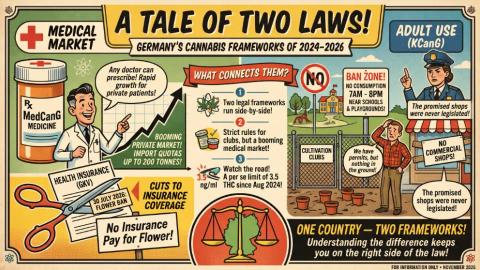
Two points may interest policymakers elsewhere. First, the knowledge base reports that in the UK the Medical Cannabis Clinicians Society's 2026 guidance treats communication with the patient's GP as a "core component of safe prescribing". This is professional guidance, not law. Second, Germany's statutory insurance no longer covers cannabis flower from 30 July 2026, so a wider prescriber pool did not secure reimbursement.
This is information, not legal, tax or financial advice.
Limits
- The survey is voluntary and self-selected: 470 respondents, mostly men, 68% degree-educated. Against the approximately 18 million US veterans in the knowledge base, 470 is about 0.003%. It cannot show how many veterans use cannabis, and the brief's premise that millions do is not in our data.
- Some survey figures conflict within the document, and denominators vary by question. The survey does not say why respondents had not had conversations.
- Our evidence has no other veteran studies, no RCT evidence and no veteran-specific rules for the UK or Germany. News items and watch-list entries are reports and expected dates, not law.
Sources
- IAVA, 2026 IAVA Findings Related to Alcohol, Tobacco, and Cannabis Use, 15 October 2026: https://iava.org/media/2026-iava-findings-related-to-alcohol-tobacco-and-cannabis-use
- Green Ark knowledge base, US: Veterans Affairs and Cannabis (overview and Directive 1315 sections), official source https://govinfo.gov/content/pkg/FR-2026-04-28/html/2026-08176.htm
- Green Ark knowledge base, US: Federal Cannabis Framework and DEA rescheduling sections, sources https://www.govinfo.gov/content/pkg/FR-2026-04-28/html/2026-08176.htm and https://www.dea.gov/sites/default/files/2026-09/Proposed%20Marijuana%20Rescheduling_Stay%20and%20Briefing%20Order.pdf
- Green Ark knowledge base, US: Federal Employment and Drug-Free Workplace (EO 12564 section), source https://www.federalregister.gov/citation/91-FR-22714
- Green Ark knowledge base, UK: Cannabis Legal Framework and clinic set-up sections, source https://www.legislation.gov.uk/uksi/2001/3998/regulation/16A
- Green Ark knowledge base, Germany: Medical Access and Health Insurance sections, sources https://www.bfarm.de/EN/Federal-Opium-Agency/Narcotics/Cannabis-as-Medicine and https://www.gesetze-im-internet.de/sgb5/_31.html
- Green Ark's watch list of upcoming events (H.R. 10655; DEA final arguments deadline)
Based on 2026 IAVA Findings Related to Alcohol, Tobacco, and Cannabis Use (Data Summaries) (Iraq and Afghanistan Veterans of America (IAVA), 15 October 2026).
Information, not legal advice. Check the primary source before relying on it.