New York repeals its cannabis labour peace mandate, and promises to repeal what it put in its place
Governor Hochul signed S10643 on 28 October: the five-year-old requirement that every licensee sign a labour peace agreement is gone with immediate effect. The wage board and pay-disclosure rules the same bill created start on 31 January 2027, unless the Legislature removes them first, which the Governor says it has agreed to do.
By Neil Cartwright · · 7 min read
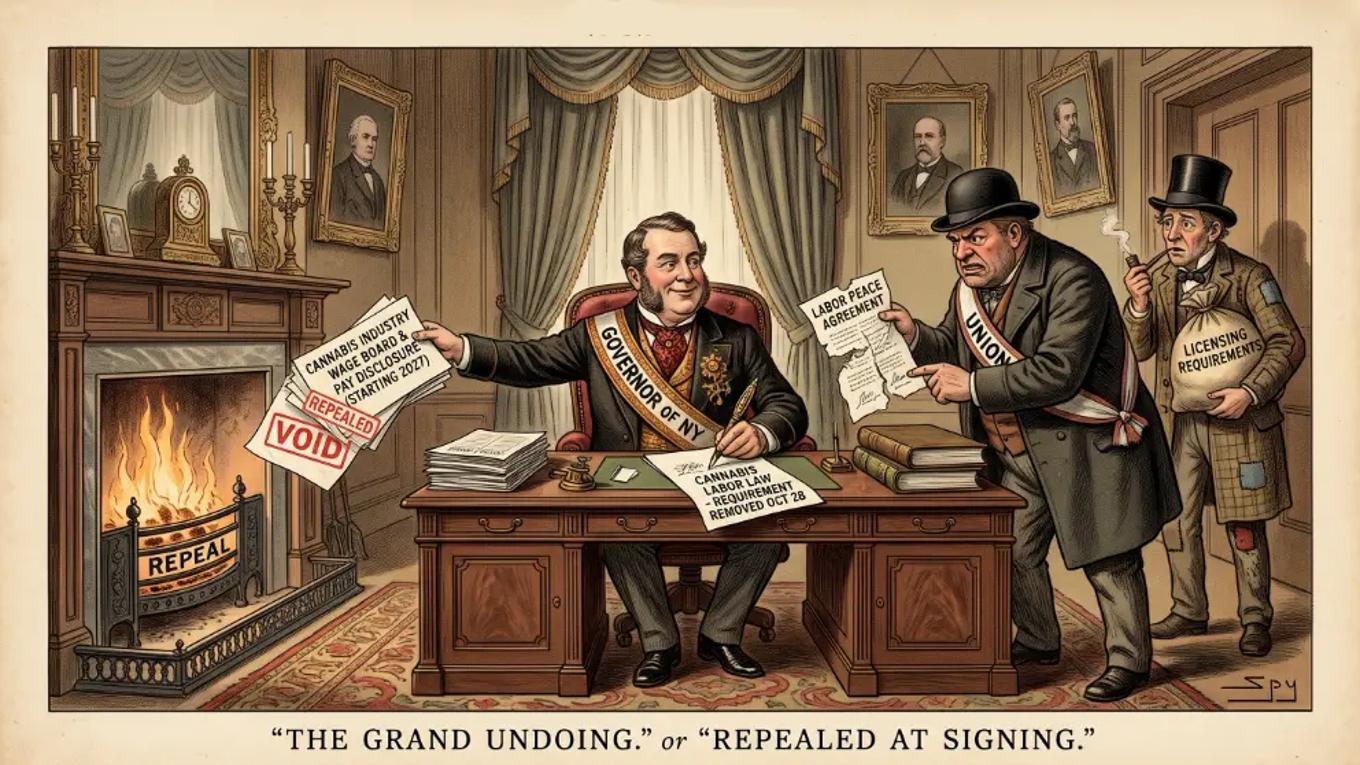
For five years, no one could sell cannabis legally in New York without first signing a labour peace agreement with a union. On 28 October Governor Hochul signed the bill that removes the requirement, with immediate effect. The same bill creates a Cannabis Industry Wage Board and a public pay-disclosure regime, both starting on 31 January 2027. In the memorandum she signed with it, the Governor announced that the Legislature has agreed to remove those too, in a further bill, before they start. New York has therefore repealed a labour law and, in the same signature, promised to repeal its replacement.
What the mandate was
The 2021 Marihuana Regulation and Taxation Act made a labour peace agreement a condition of every adult-use licence, every medical registration and every certification: the applicant had to show it had "entered into a labor peace agreement with a bona fide labor organization", and keeping one was "an ongoing material condition of licensure". The Cannabis Control Board was told to suspend or terminate any registered organisation that violated or terminated its agreement. A labour peace agreement is a private contract: the employer promises not to interfere with union organising, usually by staying neutral and giving access; the union promises not to picket, strike or otherwise disrupt the business. New York was one of several states to make it a licence condition rather than a choice.
How it ended
The courts got there first. In May 2025 a federal judge in Oregon held in Casala LLC v. Kotek that Oregon's equivalent, a 2024 ballot measure, was pre-empted by the National Labor Relations Act: the "remain neutral" clause took away an employer's federal right to say what it thinks about unionisation, and the state cannot put its thumb on a balance Congress set. Oregon's regulator stopped asking for the agreements the same month. New York's version was already in court. Hybrid NYC LLC, which trades as Gotham, had sued the Office of Cannabis Management and the Cannabis Control Board on 14 April 2025 on the same grounds plus the First Amendment; on 23 December 2025 Judge Alvin Hellerstein refused to dismiss the case. The mandate was not struck down. It was, by the spring, a licence condition the state could not be confident of defending.
The Legislature's answer arrived in the last week of the session. Senator Jessica Ramos, who chairs the Senate Labor Committee, introduced S10643 on 1 June 2026; the Senate passed it on 4 June by 37 votes to 23 and the Assembly the next day. The vote did not split on party lines. The 23 against were 19 Republicans and four Democrats, among them Liz Krueger, Gustavo Rivera, Rachel May and Michelle Hinchey, which is to say the people who usually vote for labour bills voting against one. The reason is the shape of the deal. The bill gave the industry what the courts were about to give it anyway, the end of the mandate, and gave labour something new in exchange: a three-member wage board (one industry seat, one AFL-CIO seat, one public chair) with power to subpoena witnesses, hold hearings and recommend minimum wages for cultivation, processing, distribution and retail workers, first hearing by 1 March 2027, report by 31 December 2027. Ramos's view, given to the Times Union earlier in the year: "what makes a wage board ideal is precisely representation from both sides."
The bill then sat for nearly five months. New York governors call bills up when they are ready to act on them; S10643 was delivered on 28 October and signed the same day as Chapter 369, with an approval memorandum. The memorandum says the bill "would create uncertainty in the industry by imposing a burdensome reporting requirement on applicants, and by creating a wage board that could raise costs for licensees and drive consumers to the illicit market", and that the legislative leaders have agreed to a further amendment in the coming session. That amendment "would preserve the repeal of the labor peace agreement requirement in full", remove the wage board and the disclosure rules, and "give the Cannabis Control Board the discretion to prioritize" applicants who sign a labour peace agreement voluntarily.
What the Governor is removing
Two things, neither of which has yet taken effect.
The first is the wage board. The industry's case against it is on the record: a joint statement from the Empire Cannabis Manufacturers Alliance, the Association of New York Cannabis Processors and the Cannabis Farmers Alliance says the industry "already pays our workers an average of 19% more than those in comparable occupations statewide", citing a survey by FTI Consulting, and that mandated wage increases "would have compounded at every stage of the supply chain". Safe Affordable Cannabis for New York called it "a special interest-driven wage board" and pointed to federal tax rates "as high as 70%". Nobody in the record we have read put the unions' side after the signing; the AFL-CIO's seat on the board is the only union presence in the documents. More than 40 per cent of the state's cannabis businesses are unprofitable, according to figures the industry gave the Times Union.
The second is less discussed and more interesting. Section 7-a of the Act would have required every applicant and every renewal applicant to file "the full ownership structure of the licensee, any management service agreements, including the full ownership structure of the company providing such services", and a public report of the pay range and average hours offered for each job title. Management service agreements are the device through which out-of-state capital runs New York licences that it cannot own; disclosing who sits behind them is the thing regulators in other states say they wish they had required earlier. In New York it was passed on 5 June and marked for removal on 28 October, 145 days later, as a "burdensome reporting requirement". It will have been law, in the sense of being on the statute book without ever operating, for about three months.
What survives
More than the headline suggests.
Existing labour peace agreements are contracts, and the repeal of the licence condition does not cancel them. Most run for a term, carry notice and termination provisions, and in some cases continuing obligations; the law firm Bond, Schoeneck & King told employers in June to read theirs before assuming anything. Existing collective bargaining agreements are protected in terms: the amended section 10 of the Cannabis Law still says that such an agreement "shall not be infringed or voided" by a licensee that loses market share after a Board review. The consideration the Office must give, for applicants with 25 or more employees, to agreements with the building trades for construction work stays in section 64. The Board's review of licensees with substantial market share still counts "violations of New York state labor law", with only the words "and labor peace agreements" struck out.
And the state keeps a thumb on the scale. Under the agreed amendment the Board may prioritise applications from businesses that sign a labour peace agreement voluntarily. Whether a licensing preference is a mandate by another name is the question the next lawsuit will ask: Oregon's judge found the problem in the neutrality clause, and a voluntary agreement with the same clause, rewarded by the state, is not obviously different. The Gotham case may now be moot on the mandate. It is not obviously moot on the preference, and the judge who had it, the Times Union reports, died last week without ruling.
The dates
| Date | What |
|---|---|
| 14 Apr 2025 | Hybrid NYC (Gotham) sues OCM and the Cannabis Control Board over the mandate |
| May 2025 | Casala v. Kotek: Oregon's labour peace mandate held pre-empted by the NLRA; Oregon stops enforcing |
| 23 Dec 2025 | Judge Hellerstein refuses to dismiss the Gotham case |
| 1 Jun 2026 | S10643 introduced; passed Senate 4 June (37 to 23) and Assembly 5 June |
| 28 Oct 2026 | Signed as Chapter 369 with approval memorandum 7. Labour peace mandate repealed with immediate effect |
| Jan 2027 | Legislative session opens; the agreed further amendment must pass before the next date |
| 31 Jan 2027 | Wage board (Labor Law § 665) and pay and ownership disclosure (Cannabis Law § 66(5)) take effect unless removed |
| 1 Mar 2027 | Wage board's first hearing, if it still exists |
| 31 Dec 2027 | Wage board's report due, if it still exists |
What to do
If you hold a New York licence: read your labour peace agreement for its term, notice and termination clauses before you act on the repeal; the state no longer requires it, the union may still be able to enforce it. If you are applying or renewing: no agreement is needed, but until the amendment is drafted nobody can say how much the Board's "discretion to prioritize" will be worth, so the decision to sign one voluntarily is a commercial one with a licensing upside of unknown size. If you have a management services agreement: the disclosure rule is scheduled to start on 31 January 2027 and scheduled to be removed before then; prepare the ownership chart anyway, because the next version of the rule will ask for it. If you are a union: the mandate is gone and the preference is a promise in a memorandum. Watch the amendment text in January.
This is information, not legal advice.
Sources
- S10643 (2025-2026), text, sponsor memorandum, votes and actions, New York State Senate
- MJBizDaily, 29 October 2026, with the Governor's memorandum and the industry statements
- Times Union, "Hochul, citing industry 'uncertainty,' torpedoes cannabis wage board bill"
- Ganjapreneur, 2 November 2026
- mg Magazine on the Hybrid NYC case, the Oregon decision and the Bond, Schoeneck & King advice
- Cannabis Law Report on Casala LLC v. Kotek, No. 3:25-cv-00244 (D. Or.)
Information, not legal advice. Check the primary source before relying on it.