Northern Ireland consults on drug-driving offences based on limits, not impairment
The Department for Infrastructure wants to let the PSNI prosecute drivers over a specified drug limit without proving impairment, with a medical defence for prescribed medicines. No drugs or limits are named yet, and responses are due by 27 January 2027.
By Neil Cartwright · · 3 min read
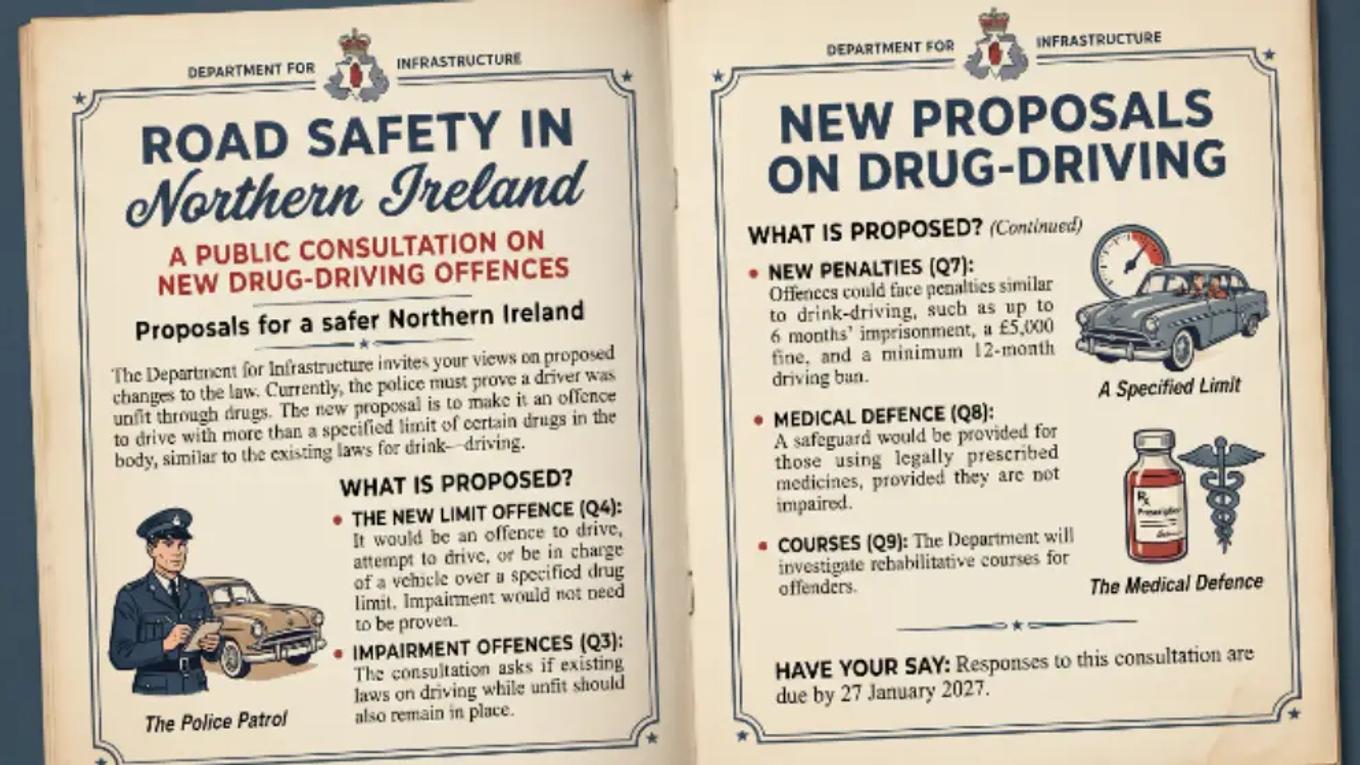
The Department for Infrastructure opened a consultation on 4 November 2026 on new drug-driving offences for Northern Ireland. Under them, being over a specified limit for a specified drug would be an offence on its own, with no need to prove impairment. The paper does not say which drugs or what limits. It describes this as the first of two stages.
What it proposes
Northern Ireland "currently operates an impairment-based drug driving regime", so the PSNI must prove a driver was unfit through drugs. Drink driving already has a limit-based offence.
- Limit offences (Q4): driving, attempting to drive or being in charge of a vehicle over the limit for a specified drug.
- Impairment offences (Q3): the paper asks whether they should stay, for any drug and any amount.
- Death or grievous bodily injury (Q5): the careless-driving offence would extend to over-limit drivers.
- Regulations (Q6): the Department would set and amend drugs and limits by regulations.
- Penalties (Q7): these could mirror the alcohol offences. For driving, that means up to 6 months or £5,000, a 12-month minimum ban and 3-11 points. A repeat within 10 years brings a 3-year minimum ban (Annex C, Table 2).
- Medical defence (Q8): for medicines "legally supplied (such as by a doctor or dentist)". It would not be available to anyone charged with being impaired.
- Courses (Q9): the Department would investigate courses for drug-driving offenders.
The changes need amendments to the Road Traffic (NI) Order 1995 and the Road Traffic Offenders (NI) Order 1996. A draft Bill would be consulted on later, with no date given. Roadside testing powers are going through the Justice Bill and are outside this consultation.
The Department says 94 people were killed or seriously injured in drug-impairment collisions from 2021 to 2025. The yearly average rose from 8 to 19. Just over half of those screened since August 2024 tested positive for cannabis and/or cocaine.
What this means
Our analysis: the reform is likely to arrive in stages. Great Britain's limit offences were introduced in 2013 but enforceable only from 2 March 2015 in England and Wales and 21 October 2019 in Scotland, once regulations named the drugs (Annex C). Northern Ireland's second consultation on drugs and limits is still to come.
| Northern Ireland (proposed) | GB | Ireland | |
|---|---|---|---|
| THC limit | None named | 2 µg/L | 1 ng/ml |
| Medical defence | Proposed, scope open | Statutory, s.5A(3) | Exemption certificate |
| Minimum ban, first offence | Could mirror alcohol: 12 months | 12 months | 1 year (4 for impairment) |
For prescribers, clinics and patients. The GB defence has three conditions: medical supply, use as directed, and lawful possession. It is lost if the patient ignores advice on the interval before driving (s.5A(4)). It does not cover the impairment offence in section 4. The Irish defence turns on a certificate signed by the prescriber. The Northern Ireland paper does not say whether its defence would cover cannabis-based medicines, or what proof would be needed.
For anyone using cannabis. GB's limit aims at ruling out accidental exposure, and regular users can exceed it long after any effect has gone. Convictions in England and Wales rose from 878 at the end of 2014 to 20,597 at the end of 2024. If Northern Ireland follows that route, cannabis-positive drivers, patients included, would be easier to prosecute.
What to do
- By 27 January 2027: respond online, by email to drugdrivingconsultation@infrastructure-ni.gov.uk, or by post. Say at Question 1 whom you represent.
- At Q8: ask for the defence's scope for prescribed cannabis-based medicines, and for a documentation route.
- At Q2 and Q6: ask that any THC limit be set only after the promised second consultation, with the evidence published.
- No date yet: the summary of responses, the second consultation and the draft Bill. Clinics should wait for the limits before changing patient driving advice.
Limits
- No dates have been published for the summary of responses, a draft Bill or the second consultation.
- We have not reviewed Northern Ireland's Road Traffic Order provisions beyond the document's account of them.
- No Northern Ireland figures on medical cannabis patients were found.
Sources
- Department for Infrastructure, Consultation on proposals to Modernise Northern Ireland's Drug Driving Laws (4 November 2026)
- Road Traffic Act 1988, s.5A
- Road Traffic Act 2010, s.4 (Ireland)
This is information, not legal advice.
Based on Consultation on proposals to Modernise Northern Ireland's Drug Driving Laws (Department for Infrastructure (Northern Ireland), 4 November 2026).
Information, not legal advice. Check the primary source before relying on it.