The midterms and cannabis: voters were asked to repeal it, to stop voting on it, and to stop policing it. No, no, and yes
Massachusetts kept its market by three to one, Idaho refused to hand the question to its Legislature, Houston told its police to look elsewhere, and two new senators from prohibition states arrive in January on record for legalisation. What it changes, what it does not, and what to do about it.
By Neil Cartwright · · 8 min read
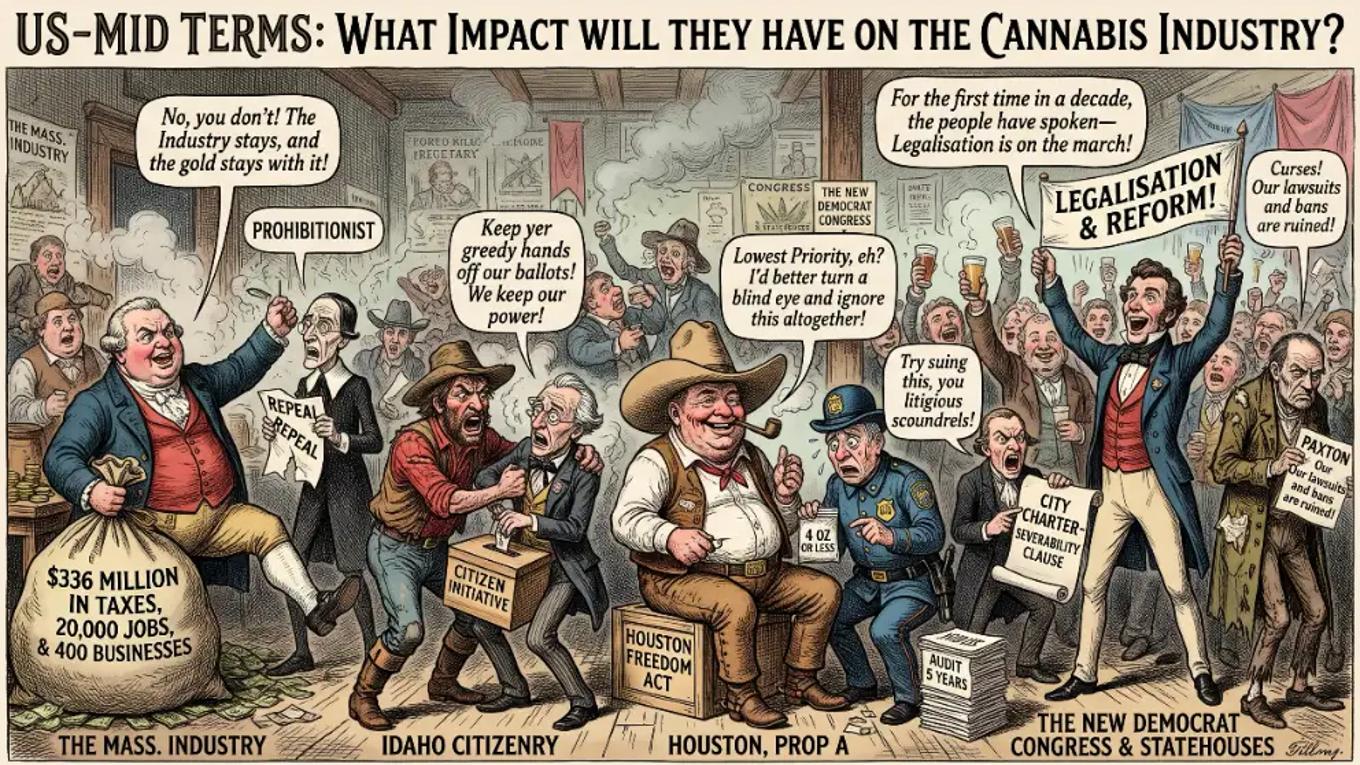
For the first time in a decade, no American state voted on 3 November to legalise cannabis. Voters were asked instead whether to take it away, whether to stop themselves from ever voting on it, and whether their police should bother with it. The answers, in order: no, no, and no. In Washington the Democrats took both houses of Congress, and two of the Senate seats they flipped went to candidates who campaigned on legalisation in states that have none.
Here is what was decided, what it changes, and what it does not.
The results in one place
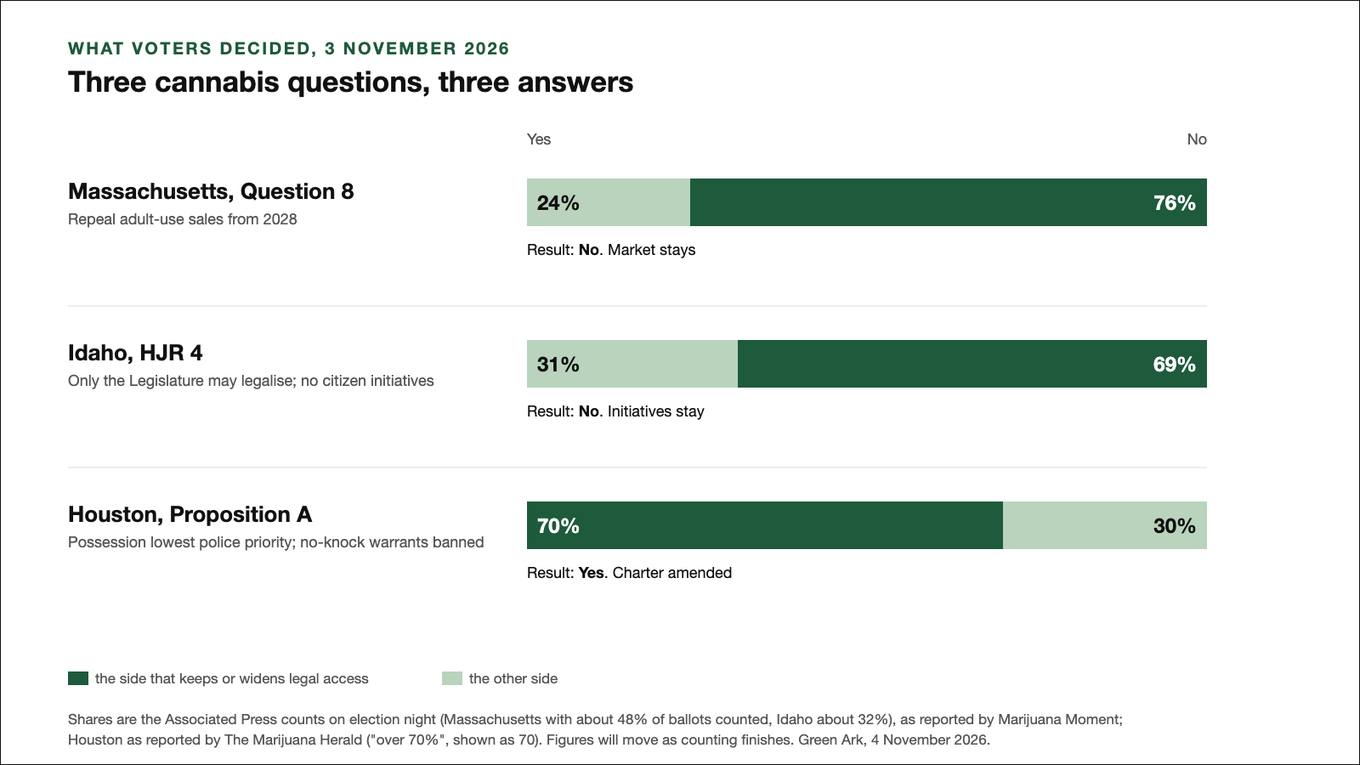
- Massachusetts, Question 8 (repeal adult-use sales): rejected, 76 to 24 on the Associated Press count as of election night, with about half of ballots counted. The industry stays; $336 million a year in tax, 400 businesses and about 20,000 jobs stay with it. In 2016 legalisation passed with 53.6 per cent.
- Idaho, HJR 4 (give the Legislature "sole" power over cannabis and other drugs; end citizen initiatives on them): rejected, 69 to 31 on the AP count with a third of ballots in. Idaho stays the state with no medical cannabis, a mandatory minimum fine for possession, and a citizenry that can still put the question on a ballot.
- Houston, Proposition A (the "Houston Freedom Act"): approved, with more than 70 per cent on the current count. Misdemeanour possession of up to four ounces becomes the police department's lowest priority; no-knock warrants are banned; the city must audit five years of possession enforcement within 120 days. It is written into the city charter, with a severability clause, which is to say it was drafted by people who have read the Attorney General's lawsuits against Austin and Dallas.
- Congress: Democrats won the House and the Senate, the latter by flipping North Carolina, South Carolina, Texas, Ohio, Kansas, Iowa and Maine (AP, via ABC News). The new Congress sits from 3 January 2027. Until then the old one is still in charge, which matters for hemp (below).
- Texas Senate: James Talarico (D) beat Attorney General Ken Paxton. Talarico: "In the Senate, I'll support legalizing marijuana for adults." Paxton is the man who sued Texas cities for doing what Houston just voted to do.
- South Carolina Senate: Annie Andrews (D), a paediatrician, beat Darline Graham: "I support full legalization as a criminal justice issue."
- Governors and statehouses: David Crowley (D), who backs legalisation, won Wisconsin's governorship; Pennsylvania's Democrats flipped the state Senate and kept the House and the Governor, which the Marijuana Herald reads as a path to adult-use in Harrisburg (no bill is scheduled). Massachusetts re-elected Maura Healey, whose Republican opponent also opposed repeal.
Massachusetts: the number that travels
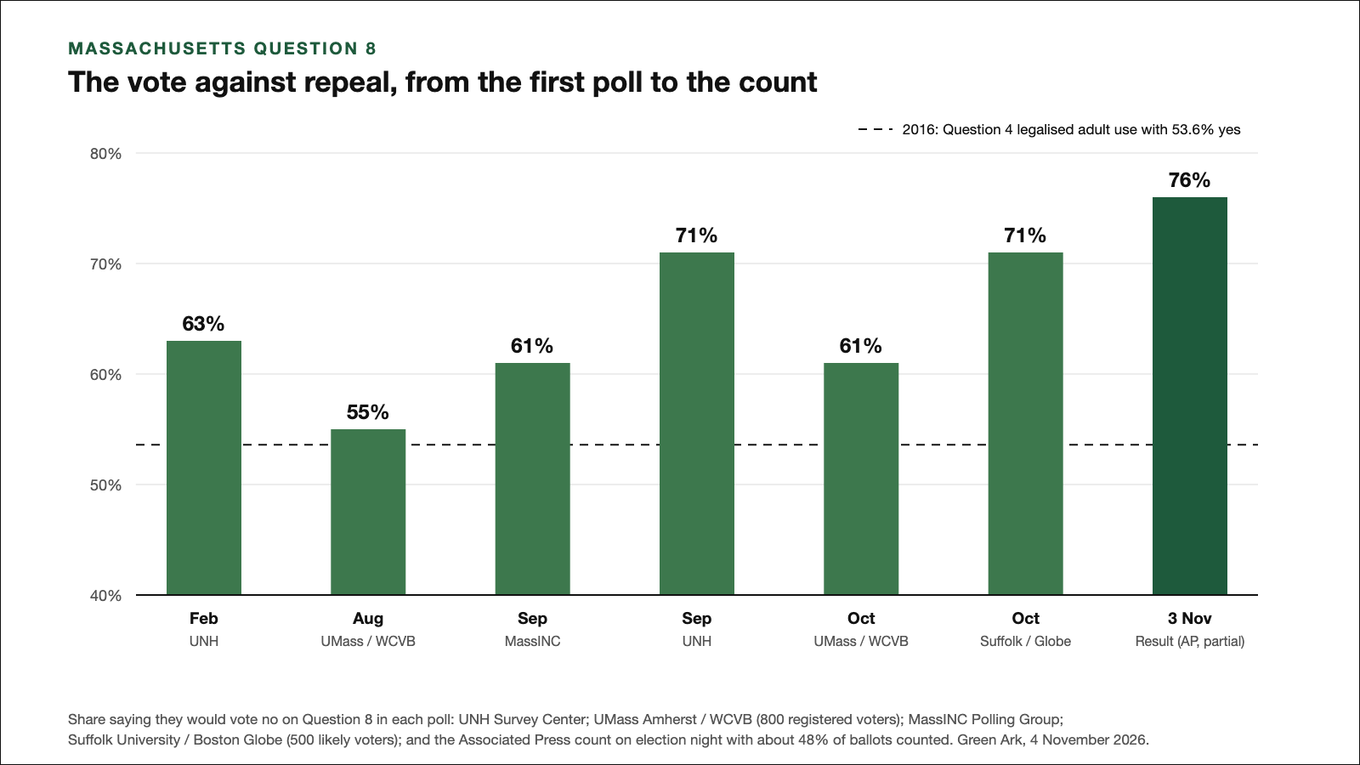
The result is not that repeal failed. Every poll since February said it would. The result is the margin.
- The sponsors, the Coalition for a Healthy Massachusetts, were funded almost entirely by SAM Action, which put in more than $3.7 million. The industry raised about $2.75 million against (Curaleaf $241,875, INSA $265,000, Ascend $250,000, Verano $150,000, Vireo and Chicago Atlantic $125,000 each). It was the most expensive question on a nine-question ballot.
- Support for repeal never reached a third in any poll and finished at a quarter. The no vote rose from 63 per cent in February to 76 per cent at the count. The only group the Suffolk poll found split was Republicans, 46 to 44; everyone else was against by two or three to one.
- The Governor, both US senators, the Boston and Worcester councils, 50-plus legislators, the SEIU, the retired police, and the Republican candidate for Governor all opposed it. The Cannabis Control Commission, which cannot take a position, said in general terms that repeal "could eliminate thousands of jobs".
- SAM's Kevin Sabet called the result a "victory" for having "forced a conversation", and said the money goes next to Maine, where the parallel petition missed its 2026 deadline and is aimed at 2027. The Maine campaign now carries a 76 to 24 result from the state next door.
Idaho: a legislature asked voters to give up a vote, and they declined
- HJR 4 would have put in the state constitution that "only the legislature of the state of Idaho shall have power and authority to legalize" the growing, selling or possessing of "marijuana, narcotics, or other psychoactive substances". No citizen initiative on the subject, ever.
- It was the Legislature's answer to a medical cannabis initiative that collected signatures this year and fell short of qualifying; a resolution urging voters to "reject" that initiative passed both chambers in the same session. Its sponsor, Senator C. Scott Grow, said the issue is "money to be made by people that are purveyors of drugs".
- Idaho has no medical programme, a $300 mandatory minimum fine for possession and one of the highest cannabis arrest rates in the country. A February poll for the initiative campaign put support for medical access at 83 per cent, including 74 per cent of Republicans.
- The vote changes no law. It keeps the door open, and the campaign that nearly made the 2026 ballot will be back for 2028 with a result to point at. The Natural Medical Alliance of Idaho is also disputing the Secretary of State's handling of its signatures, including his referral of petitioning allegations to law enforcement.
Houston: enforcement by charter
- Ground Game Texas collected about 40,000 signatures. Austin and Dallas passed similar measures earlier; the Texas Attorney General sued both on the ground that cities cannot decline to enforce state law.
- Houston's drafters put the policy in the charter rather than an ordinance, added a five-year audit, annual reporting and a 15-second knock-and-announce rule alongside the no-knock ban, and made every section severable. The 2019 Harding Street raid, built on fabricated evidence, is the reason the warrant provisions are there.
- Texas law is unchanged. Possession is still a Class A or B misdemeanour. What changes is which cases Houston's officers are told to spend their time on, and the question is whether the Attorney General's office, under whoever holds it from January (Paxton did not stand again for the office and lost the Senate race), sues a fourth city.
The new Congress and the old one
Two different calendars run from here.
- To 2 January 2027: the outgoing Congress. This is the one that has to act, if anyone does, before the hemp definition changes on 11 December (the 0.4 mg per container rule) and after the 12 November synthetic-cannabinoid exclusion. A lame-duck Republican majority that just lost both chambers is not an obvious vehicle for the Paul-Klobuchar opt-out or a 1 per cent THC bill, and the attorneys general who asked Congress not to move the date have not gone anywhere.
- From 3 January 2027: a Democratic House and Senate. Two new senators from prohibition states on record for legalisation; a President who has said he favours it and whose Justice Department put medical cannabis in Schedule III in April; a Treasury that has promised §280E guidance and not written it; a DEA hearing on all-cannabis rescheduling whose briefing closes tomorrow. The arithmetic for banking reform and a §280E fix is better than at any point since 2021. The arithmetic for a statutory end to prohibition still runs through a filibuster.
- Talarico's line is the one to watch: "He's for legalizing marijuana, and so am I. I hope we can do that together." If a Democratic Senate and a Republican White House want the same bill, the usual excuse for not passing one is gone.
What the votes have in common
- There is no repeal constituency. A decade of legal sales produced a market with problems (potency, packaging, host-fee litigation, a regulator the Governor had to rebuild) and voters chose the problems over the alternative by three to one. The first repeal vote in American history lost by a wider margin than most legalisation votes have won.
- Voters protect the initiative, not just the policy. Idaho's result was not a vote for cannabis; the ballot did not offer one. It was a vote against being told the subject was closed. Legislatures in other initiative states that have floated the same idea will read it.
- Local decriminalisation keeps spreading where the state will not move, and the drafting is getting better. Charter amendments with severability and audit requirements are harder to enjoin than ordinances.
- Money did not buy the frame. The best-funded side of the Massachusetts question lost 76 to 24. SAM's own statement treats "hundreds of thousands" of yes votes as the achievement.
- The map did not grow; it held. No new state. The federal track (Schedule III for medical, a hearing for the rest) is now the only place the legal perimeter is moving, and the hemp law is the only place it is shrinking.
How to read it if you advise or run a cannabis business
- Massachusetts licences are stable assets again. The 14-month run-off, the licence-conversion scramble and the takings litigation that a yes vote would have started are off the table. The live items are the ones that were there before: host-community agreements, the Commission's new membership, and a veterans' medical access bill the Senate votes on tomorrow (5 November).
- Price the Maine campaign at what Massachusetts told you. A repeal petition with a 24 per cent ceiling next door is a nuisance cost, not an existential one. Budget for it as such.
- Idaho is a 2028 file, not a 2026 one. Nothing changes for a company; for a campaign, the signature count and the Secretary of State dispute are the work.
- In Texas, the enforcement risk just moved. Houston's charter does not make possession lawful and does not bind the state. It makes the city a poor venue for the Attorney General's next suit and a better one for a defendant. Until the new Attorney General's view is known, treat Houston as Austin and Dallas were treated in year one.
- Federally, the next five weeks belong to the old Congress and the hemp date, not to the new one. Do not plan on a January rescue for an 11 December problem. Plan on the new Senate for banking and §280E in 2027, with the same caution we gave last week: announced is not written.
- The polling held. Six polls, one result, no surprises. For the next ballot fight, the survey numbers can be trusted more than the spending numbers.
This is information, not legal advice. Green Ark will update this article when the counts are final.
Sources
- Associated Press results as reported by Marijuana Moment (Massachusetts), Marijuana Moment (Idaho) and ABC News (congressional control)
- MJBizDaily, 4 November 2026: campaign finance, industry donors, SAM statement
- The Marijuana Herald on Houston Proposition A; on the Texas Senate race; on South Carolina; on Pennsylvania
- NORML on HJR 4; Cannabis Business Times on Question 8
- City of Houston, 2026 charter amendment election; Idaho Legislature, HJR 4; Massachusetts Question 8 text
- Green Ark: Massachusetts Question 8: the first vote to repeal a legal cannabis market and The hemp ban, explained (both this week)
Information, not legal advice. Check the primary source before relying on it.